
The UK and indeed most of the world has not seen a significant surge in rates of Covid infections for some time and people are beginning to ask the questions- has it gone? Do we need to stop worrying? Do we need to stop shielding or taking precautions? This short blog discusses the data and the issues.
What does the data show?
The available data for the UK is of course very limited and with the exception of Scotland there is no analysis of wastewater. We are therefore heavily reliant on hospital testing data which provides some indication of trends. Bob Hawkins provides excellent weekly overviews in order to help readers understand what the available data is showing. In addition Professor Christina Pagel has published a recent blog commenting on the data.
Analysis shows that despite the limitations, it is clear that the UK has been witnessing unprecedented low levels of Covid infections for many months now.
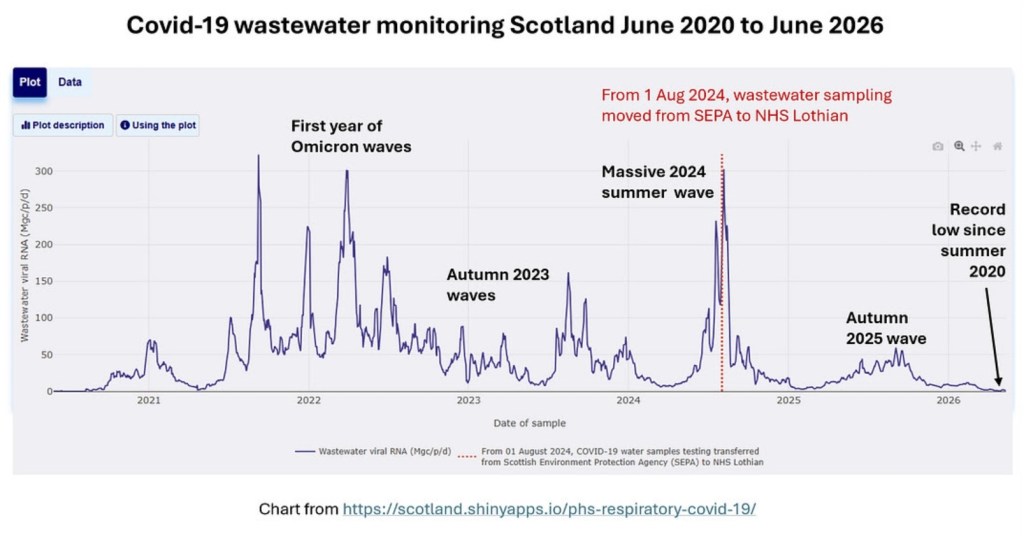
The following chart taken fromChristina Pagels recent blog shows trends in Scottish wastewater analysis. Commenting on this Christina says:
‘The latest data show the very large spike in the summer of 2024 and smaller waves that autumn. The only wave since then, in the autumn of 2025, is evident. Since then, levels in Scottish wastewater have been low and declining. The most recent week is the lowest recorded since the summer of 2020 when Scotland almost eliminated Covid‘.
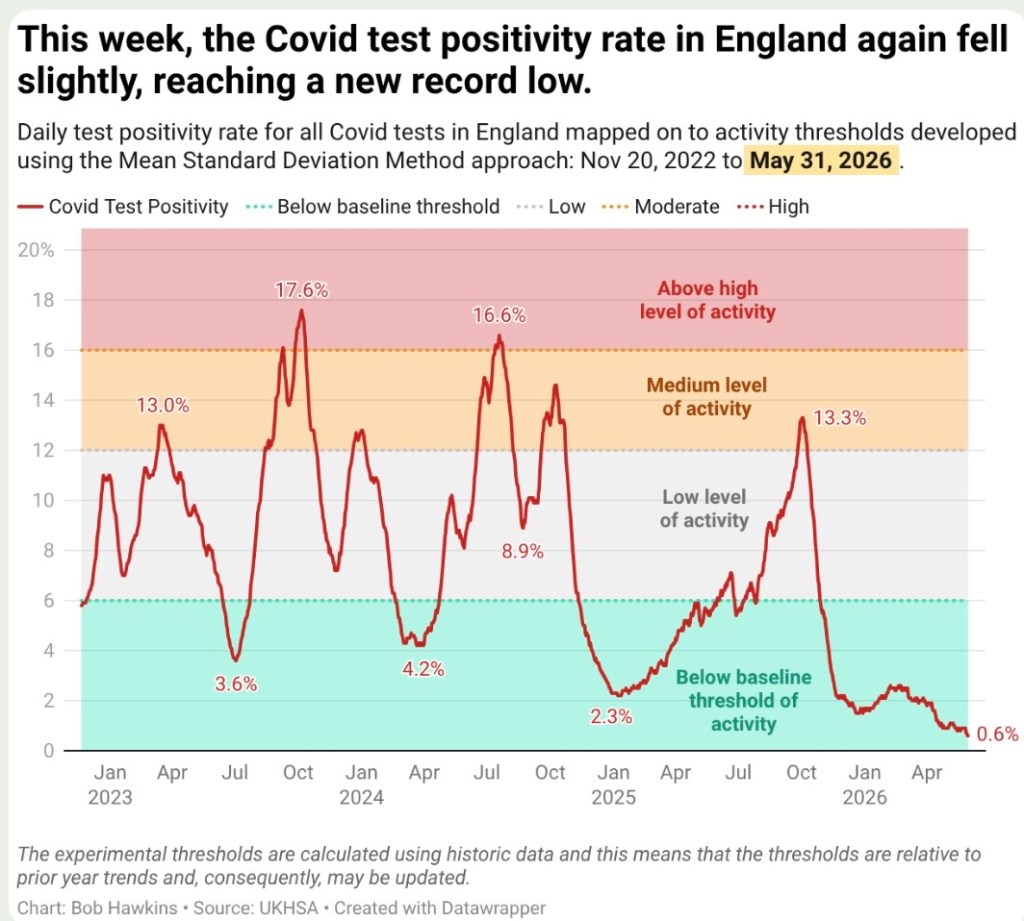
The following chart from Bob Hawkins latest blog paints a similar picture of very low levels of infections in the UK based on hospital testing data.
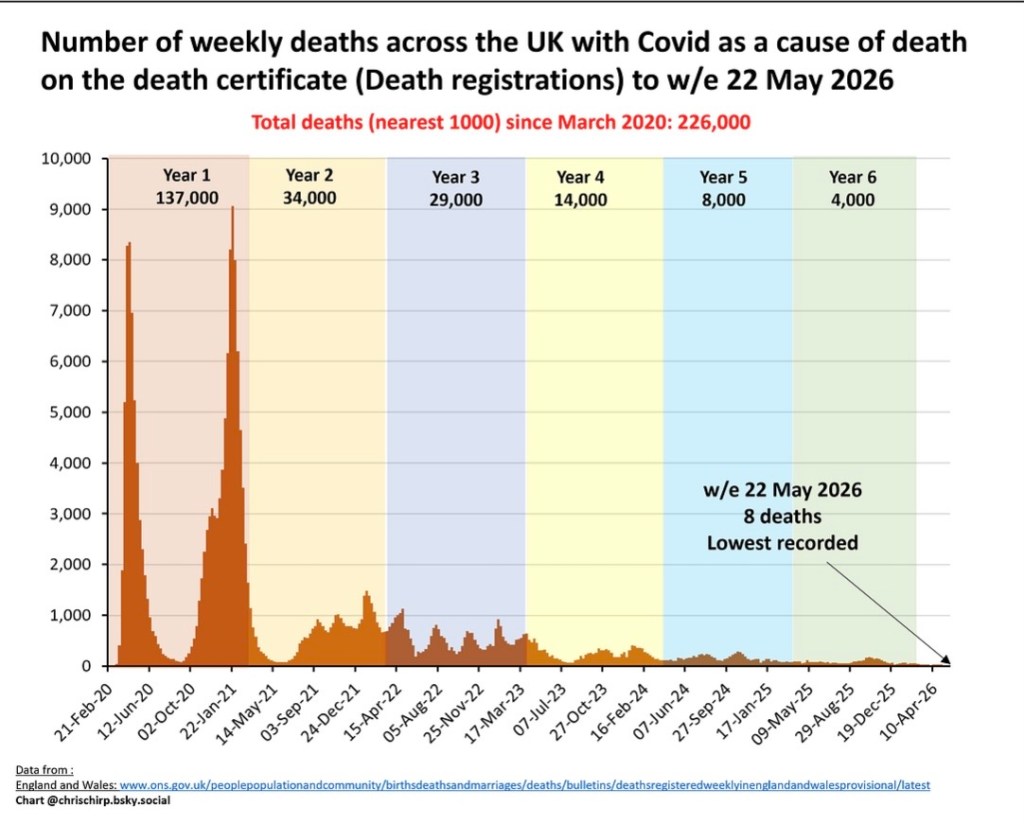
And the data on the number of Covid related deaths suggests that only a tiny number of people are currently dying of Covid based on data showing the reason for death on death certificates. See the following chart from Christina Pagel.
Moreover, the patterns reported above are strikingly similar across the rest of Europe and the US as far as we can tell given data limitations.
What does the data mean for the future?
Key questions are should this data be encouraging us to ‘make hay whilst the sun shines’ and then wait and see what happens next. Or is it a sign that Covid is disappearing long term? This is of course a difficult question to answer but the consensus amongst scientists is that the longer the current lull in infection rates goes on the better is the hope of a near Covid free future. a great deal of uncertainty remains, but it is possible that we have hit the so called ‘herd immunity’.
Personally speaking I would signal caution in making long term assumptions about future trends in Covid-19, and for the moment consider current patterns as a welcome lull in which to ‘make hay’.
Implications for Clinically Vulnerable Families
So should we stop taking precautions to protect ourselves against Covid-19? This is a question that only individuals and families can answer depending on their personal circumstances and risks. Speaking personally I do take more risks by for example, just having the HEPA filter on when people are in the house, but tend to ditch masking and testing in my own home, and when out and about I only wear a mask in cramped shops eg pharmacies, and in cramped and crowded hospital waiting rooms. Also I always open a window when travelling in taxis.
We have learnt a great deal about how to protect ourselves against Covid-19 – see for example, my blog on ‘How to Avoid Catching Covid’, and we are in a strong position to scale down precautions in an informed way without throwing all of the useful learning acquired over the last few years out of the window. I would certainly not advocate throwing all cautions to the wind.
As I note above, any adjustments to behaviour are a matter for individuals and families. I would also add that all infections are low at present as influenza is seasonal, but once the next flu season hits or indeed any wave of airborne infections, it would in my view be appropriate to tighten up precautions again.
Concluding Comments
The patterns reported above are good news at last. But we should avoid falling into a false sense of security.
In order to detect any fresh spikes in infection we need more and better data, not less. I agree with Christina Pagel on the desirability of implementing wastewater analysis across the UK. This should be good public health practice as the benefits go beyond Covid – for example in 2021 wastewater analysis picked up signs of polio in parts of North East London which led to an emergency programme to vaccinate all children in London.
I also agree with Christina Pagel on the need to extend entitlement to Covid vaccine doses in order to protect the clinically vulnerable and give them the confidence to rejoin society when infection rates are low. As discussed in a previous blog, the JCVI calculations which form the basis of their recommendations to government are flawed, non transparent and overly narrow. This needs to change.
It is worth noting that there may be promising news on the horizon regarding the use of AI to develop a vaccine to combat all virus variants. This is currently under development – see clip from BBC News. However, we should not take our eyes off the ball regarding the potential dangers of continuing to restrict vaccine boosters in the immediate period of this Autumn and the near future.
We also need to avoid the dangers of complacency in driving forward the agenda for clean ventilated air. Clean air has been shown to drastically reduce the chances of becoming infected with Covid and other viruses. A key priority therefore is implementing the findings of the Covid inquiry particularly around the need for ventilation /air cleaning – including the use of HEPA filters in the immediate term – see my previous blog on module 3 of the Covid Inquiry. The findings are also relevant beyond healthcare – particularly in schools, public buildings, hospitality, retail and in workplaces. The role out of ventilation would put the UK in an immeasurably stronger position to deal with any surge in Covid infections as well as preparing ourselves for a future pandemic.
Gillian Smith 9 June 2026


Leave a Reply