Summary
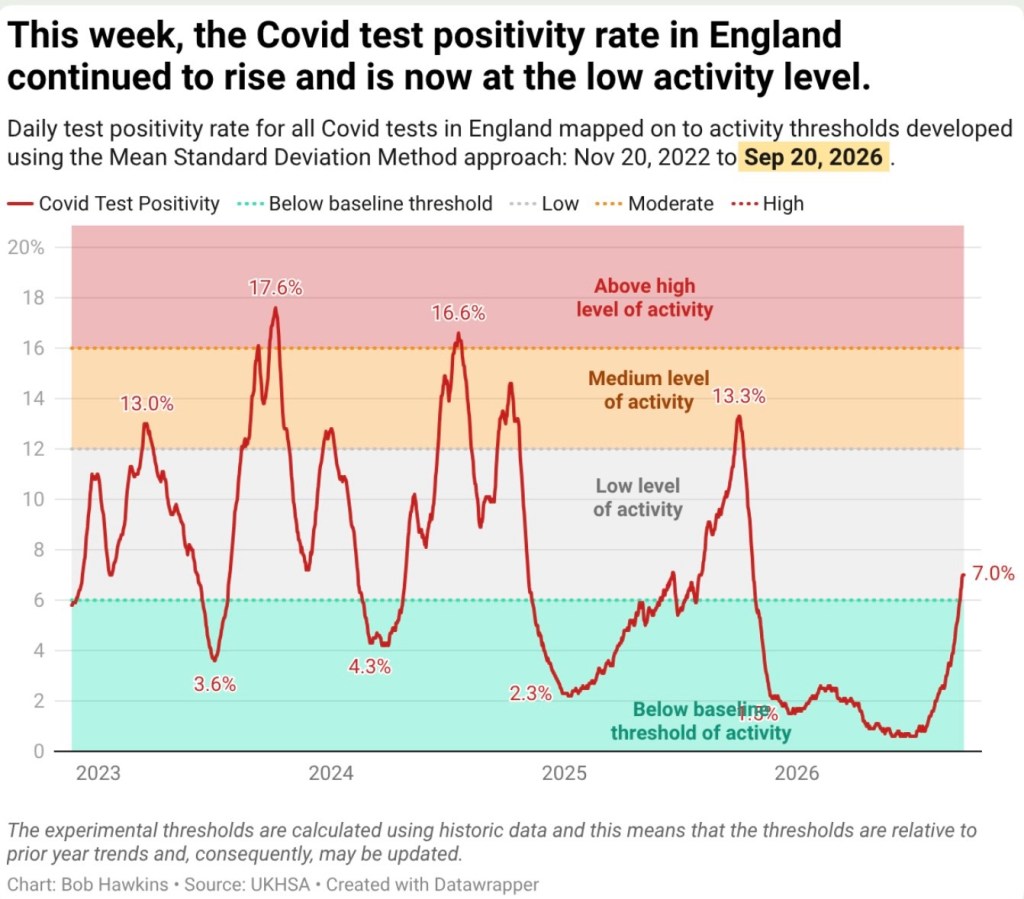
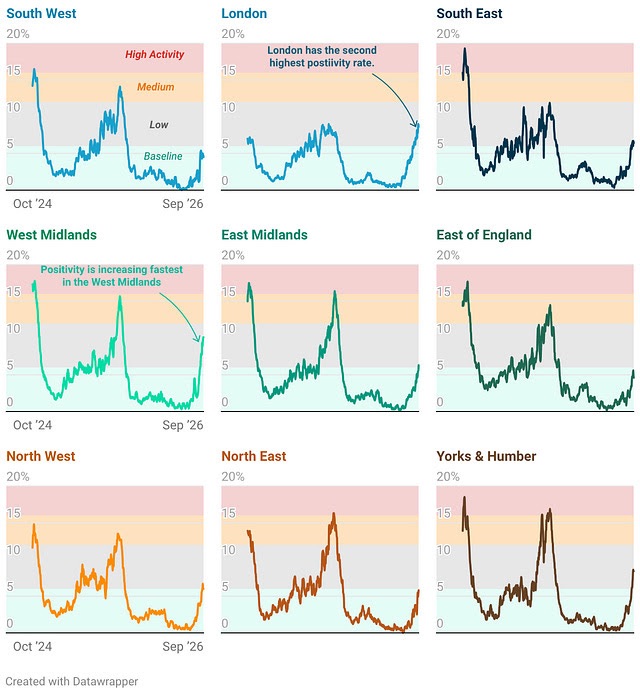
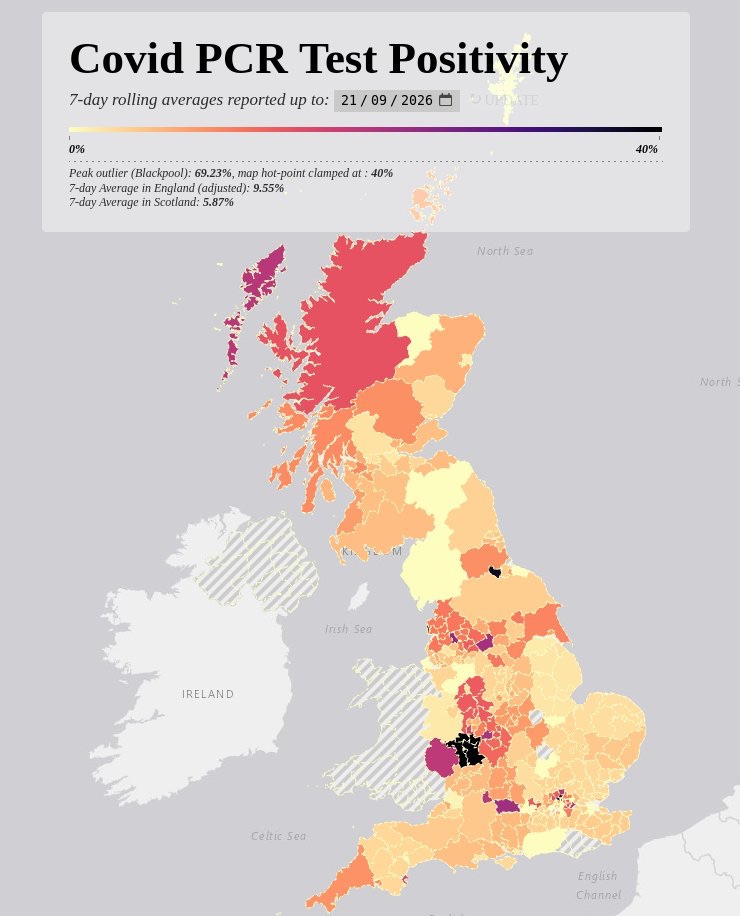
Covid-19 Test positivity has continued to rise in England and Scotland and is now above ‘baseline’ levels, though still classified as low – for an overview of the data and explanation of the classifications used see the latest blog from Bob Hawkins. However, geographical differences continue to be observed with significant increases in the London region , the West Midlands and Yorkshire and Humberside, though Covid19 appears to be on the increase in all English regions . And mapping work by Dan O’Hara reveals particular concentrations in certain places including Westminster, Worcester, Blackpool and Kirklees. The final part of this blog goes on to discuss data sources and highlights some potential bad news but also some good news on the prospects for better data on the prevalence of Covid19 in future.
What does the latest data show?
As illustrated by the chart above, for England, all key indicators increased this week suggesting what Bob Hawkins describes as ‘a low but increasing risk of Covid’. In Scotland positivity rates increased after a slight fall in the previous week, whereas Covid appears to be low in Wales and we lack data for Northern Ireland.
Looking in detail at England, we can see from the charts below that test positivity rates are climbing fastest in the West Midlands, London, and Yorkshire & Humberside, but that all regions are now seeing an increase .
Drilling down further we can see from the following map produced by Dan O’Hara that there are high concentrations in places as diverse as Blackpool , Darlington, Kirklees, the Malvern Hills, Worcester, Dudley, Westminster, and Islington.
Data Sources
The data described above is based on the proportion of Covid19 tests done in hospitals that are recorded as positive. As discussed previously on this website this is a long way from being ideal, is dependent on local practice, and does not equate to a measure of the prevalence of Covid-19.
However, there is a danger that the situation will get worse as NHS England recently proposed to cease publishing data on people in hospital with Covid 19 outside of the three winter months. My previous blog on ‘Further cuts to data on Covid19 infections proposed’ discusses the issues, highlighting the incorrect assumptions behind the proposal. The consultation on the change is open until 2 November and I encourage you to respond.
Nevertheless, there was also some potential good news last week. Many people have long argued that the UK was failing to realise the potential of waste water analysis for identifying and tracking diseases such as Covid-19. Helpfully, the UK Health and Security Agency published an update on their development work (called PRISM) to explore the potential of monitoring wastewater. What makes PRISM different from traditional wastewater surveillance is that it isn’t limited to a single pathogen. Instead, one sample of wastewater can be tested for many different threats at once – thus enabling clusters of rare diseases (in the UK) such as dengue fever and polio to be detected . The intention at present is not to introduce regular updates on Covid19 prevalence, though looking to the future the potential is clearly there to provide time series data on several pathogens over time. Encouragingly, the paper goes on to outline future work as: ‘Beyond new pathogens, over the coming year PRISM will explore targeted surveillance in new environments such as targeted hospital wastewater sites and high-footfall locations, including transport hubs, alongside exploratory work on air surveillance. This work will help assess where environmental surveillance could add most value.’ This is all encouraging. Watch this space.
Concluding Comments
On the basis of the data we have it now appears that an early Autumn wave of Covid-19 is well underway. It remains to be seen how significant this turns out to be as the very pleasant September weather in the UK turns into something more Autumnal and people retreat indoors. If you have not already done so, now would seem to be the right time to ramp up precautions to protect yourself and others. See my blog on ‘How to Avoid Catching Covid’.
Gillian Smith
27 September 2026


Leave a Reply