Summary
On 16 July the Joint Committee on Vaccines and Immunisation (JCVI) published their recommendations on who should be entitled to a free Covid19 booster in Autumn 2027. The proposals amount to a further significant narrowing of entitlement and would mean that only those living in care homes for the elderly, those people immunosuppressed using the JCVIs narrow definition and people over the age of 80 would get a free booster. People aged between 75 and 80 who do not fall into the other two categories would no longer be able to get a free jab.
Despite the drastic nature of these proposals the JCVI document is even thinner than usual in terms of presentation and evidence to support the recommendations. It is expected that the proposals will be put before Ministers for rubber stamping when parliament returns from the summer recess. This blog discusses the issues and why Ministers shouldreject them and make criteria for eligibility for a Covid booster the same as for the annual flu vaccine.
Recommendations
To recap, if the proposals were to be accepted only the following three groups would be able to receive a free Covid 19 booster in Autumn 2027:
- adults aged 80 years and over;
- residents in a care home for older adults;
- individuals aged 6 months and over who are immunosuppressed (as defined in the ‘immunosuppression definition’ box of the COVID-19 chapter of the green book)
The key change from 2026 and spring 2027 is that people aged 75 to 79 who are currently entitled to a free booster would be excluded.
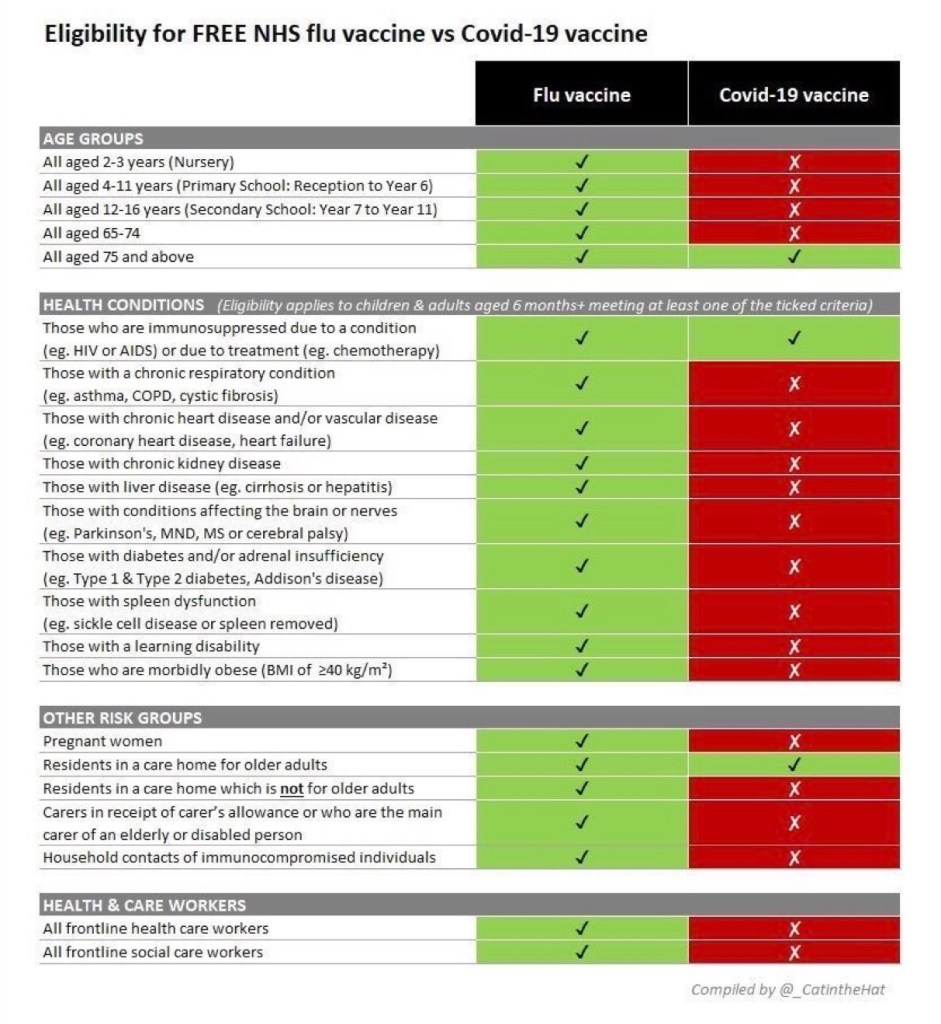
This is an extraordinary move given the health issues that this age cohort tend to suffer from. Indeed, commentators are baffled given the rules that currently exist are far more restrictive than eligiblity for a free annual flu vaccine, and I am not aware of any document from JCVI that explains why the list of groups entitled to a covid19 and flu vaccine are different. The table below illustrates this and outlines the large number of groups of seriously ill people not currently entitled to a free Covid 19 boost.
Table: Who is currently entitled to a free Covid19 booster compared with a flu vaccine
Flawed Reasoning
Alas the new paper on the Autumn 27 programme is even thinner on detail and evidence than previous papers issued by JCVI. All papers are based on the cost-benefit method discussed in previous blogs. A key drawback is that the JCVI base their recommendations solely on modelling of how many deaths and hospital admissions would be prevented by implementing various eligibility criteria for free boosters. This seems to be entirely driven by a cost – benefit analysis (kept secret) couched in purely financial terms. They are not saying it will prevent all deaths or admissions. Moreover, and very importantly, this is an incomplete picture of the costs as the JCVI work takes no account of the extra pressure on the primary healthcare system – that’s GP practices, urgent care centres and A and E departments of already seriously ill people coming forward suffering from Covid-19.
This focus is on very narrow criteria of preventing hospitalisations and deaths also means that the JCVI ignore the wider range of health, social and economic benefits (eg sickness absence, withdrawal from the labour force) of vaccinating a bigger percentage of the population. It is true that the scientific community are divided on the question of whether boosting people reduces transmission of the virus – but there is high agreement on the point that boosters reduce the chances of becoming seriously ill with Covid19.
Other key flaws include ignoring the benefits to babies of vaccinating pregnant women (also resulting in savings to the NHS). Furthermore, the lack of acknowledgement of the role of vaccines in preventing Long Covid at a time when the long term health impacts of suffering multiple Covid 19 infections is becoming increasingly clear is a clear omission. The JCVI also ignore the issue of how Covid-19 transmits and the potential benefits of vaccines in reducing transmission which could benefit schools, hospitals, reduce NHS staff absence as well as bringing numerous other benefits (see my previous blog).https://www.ncbi.nlm.nih.gov/research/coronavirus/
Turning to the rationale given for the latest changes, the JCVI point to the decline in incidence of Covid19 and the fact that there are fewer waves of infection per year compared with previous years. In other words the JCVI are arguing that Covid 19 is now less prevalent and less inclined to mutate significantly.
The problem with this is we don’t know whether the current situation represents a welcome lull in activity or whether we are seeing a more enduring picture. The fact is that there is a great deal of uncertainty and debate amongst scientists. Indeed, in the section of their paper discussing future plans the JCVI acknowledge that ‘there remains uncertainty about the future epidemiology of Covid 19‘. Whatever the truth turns out to be, it is surely premature for the JCVI to be so confidently making assumptions about what policy should be more than one year hence.
The paper then goes on to state that ‘The highest hospitalisation rates and mortality continue to be seen in the elderly, particularly in those over 85 years of age.‘ One assumes this is what is behind the decision to recommend a cut off point of 80 years old.
The paper also contains the following phrase: ‘willingness to pay increased with age’. However, it is not clear whether this recommendation explicitly assumes that the over 75s will pay to have a private booster so the state does not need to bother? If this is the case it is surely very dangerous to assume that all people aged 75-80 face the same level of risk from Covid19 or all have the same level of resources to be able to pay £100 plus for a private jab.
Moving on through the paper there is a curious statement about assessing clinically at risk groups as follows;
‘An OpenSAFELY analysis (unpublished) has provided some updated data on the clinical risk groups at higher risk of severe outcomes from COVID-19. Similar to previous analyses, individuals with certain underlying health conditions were noted to be at higher relative risk of severe COVID-19 compared with individuals without those health conditions. ‘
This seems to be stating the blindingly obvious, but it then goes on:
‘For all individuals (with or without underlying health conditions), the absolute risk of severe COVID-19 continues to decline year-on-year. ‘ but that :’Further work is required to better understand the impact of multiple comorbid illnesses and to include data from more recent years given the changing epidemiology.’
This is an extraordinary admission that the analysis about risks to clinically at risk groups is unpublished and therefore, we assume, has not been subject to peer review. This means it must therefore be regarded as uncertain.
In my assessment it feels fundamentally wrong to plough on with making the recommendation s that they do about further restricting eligibility and failing to take account of the needs of the clinically at risk groups listed in the table above who continue to be excluded from getting a free Covid jab.
Yet as usual the JCVI shows no awareness of the fact that these recommendations will impact on real people. I have motor neurone disease, for example, and am often told by professionals to protect myself from coughs, colds and viruses because my breathing could be seriously compromised. But I am not eligible for a free jab. Fortunately, I am in a position to pay for a private boost but may millions of people are not.
In the words of clinically vulnerable Mal from South Wales who appeared before the Covid Inquiry in Autumn 2024 – we are not graphs or facts – we are people. It is surely the job of Ministers to inject this kind of reasoning when assessing the recommendations.
Future Plans
The JCVI continues : ‘There remains significant uncertainty regarding the future epidemiology of COVID-19. The year-round baseline activity of COVID-19 has been decreasing over time and is currently at its lowest level. Further decreases may continue or there may be a stabilisation at the current low level. In addition, the single wave of COVID-19 in 2025 may indicate the start of a future pattern involving only a single peak across the year in autumn. If so, and together with a potential increase in the durability of vaccine protection, only one vaccine dose per year may be needed in future to protect individuals at higher risk of COVID-19.’
And: ‘More definite advice on COVID-19 vaccination in 2028 will be provided in due course. Eligibility for vaccination in 2028 is likely to be similar to autumn 2027.’
This is a clear indication of where the JCVI thinking is heading ie towards one covid19 boost p.a.for the most vulnerable. They need to be closely watched to endure that any emerging proposals in the future are evidence based and not based on an overly optimistic assessment of current trends.
Concluding comments
In my opinion the JCVI proposals are flawed based as they are on a very narrow cost-benefit methodology. Moreover, it is surely risky to try to pre judge what the situation will be regarding levels of Covid infections and how the virus is evolving this time next year. The paper openly admits that it is difficult to pre judge these issues and is also explicit in saying that we do not know enough about how Covid impacts on people with multiple illnesses. All of this also sends out a worrying signal that covid is no longer a problem which could discourage the small number of people still eligible from coming forward for their booster.
It is hoped that the new ministerial team will raise questions about the basis for the recommendations which would see millions of people paying over £100 per jab despite the fact, as is admitted in the JCVI paper, the NHS could do it for £25 per head. It is important to remain optimistic that any government interested in keeping people out of not only hospitals but primary care and ensuring that the population is as healthy as possible, will throw out these recommendations
Regardless of what happens in the short term, we need to be mindful that the JCVI is likely to recommend further narrowing of eligibility criteria in future and we need to keep challenging. The overarching point is of course that it has never been explained why the criteria for accessing a free Covid 19 booster are now so different from criteria for the annual flu vaccination. We need to keep asking the questions.
Gillian Smith
10 August 2026


Leave a Reply