Summary
NHS England are proposing to abolish the publication of regular data on hospital Covid 19 activity and only publish it in the winter months alongside data on flu activity. The consultation on the change is open until 2 November. The purpose of this short blog is to set out the arguments on why the assumptions behind the recommendation are problematic and why the loss of this regular data set would be damaging to clinically vulnerable people and their families, hampering our ability to protect ourselves.
What is being Proposed?
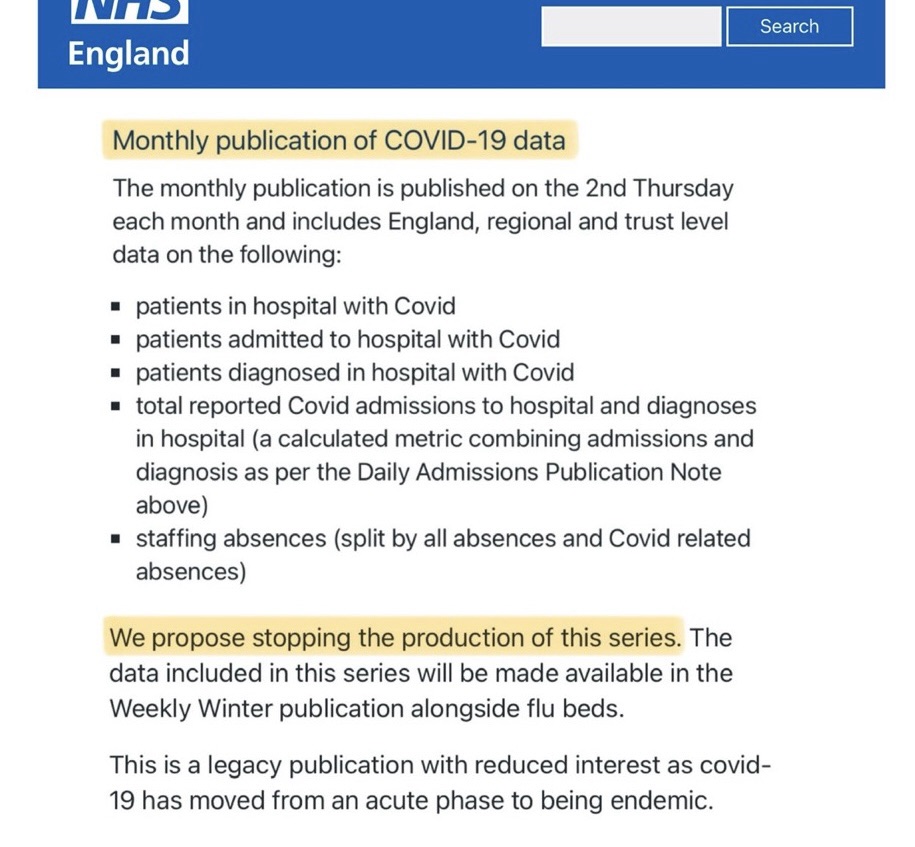
The proposal is that data on Covid 19 Hospital Activity would only be published in the four winter months. The consultation paper says:
‘We propose stopping the production of this series. The data included in this series will be made available in the Weekly Winter publication alongside flu beds’. ‘This is a legacy publication with reduced interest as covid-19 has moved from an acute phase to being endemic.’
The details are as follows:
Why the Proposals need to be rejected
Covid 19 is not a minor illness for clinically vulnerable people – data is a key means of managing our risks
The assumption seems to be that Covid 19 is not a serious threat anymore- hence the reference to ‘legacy statistics’ . But this is incorrect, particularly for people with pre-existing conditions . Clinically vulnerable people are still dying from or becoming very seriously ill in the long term from the effects of Covid infections. Indeed, evidence shows the detrimental effect that Covid-19 infections can have on immunocompromised patients and people with cancer, as well as for those with heart, liver, kidney and respiratory problems to name a few. I myself have been told by specialist doctors to avoid catching Covid as I have motor neurone disease and am in danger of respiratory failure .
Following the opening up of society in 2021 clinically vulnerable people and their families were left to their own devices to judge and manage the risk that Covid posed to their health. Data on the level of Covid infections has been a key way of attempting to manage these risks. For example when the level of Covid is high many clinically vulnerable people and their families avoid high risk appointments, improve ventilation and always wear a FFP2 or FFP3 mask – see my blog on how to Avoid Catching Covid, for example .
As the years have gone by the amount of data available to allow us to do this effectively has dwindled as data set after data set has been cut. Essentially what we were left with is data on the number of people in hospital with Covid19 and the number of positive Covid tests recorded by hospitals. The latest proposal would therefore take away one of the last remaining data sets available and would effectively mean we would be operating in the dark and second guessing the levels of infection via word of mouth for most of the year. This is unacceptable and needs to be resisted.
Covid 19 is not a stable winter virus
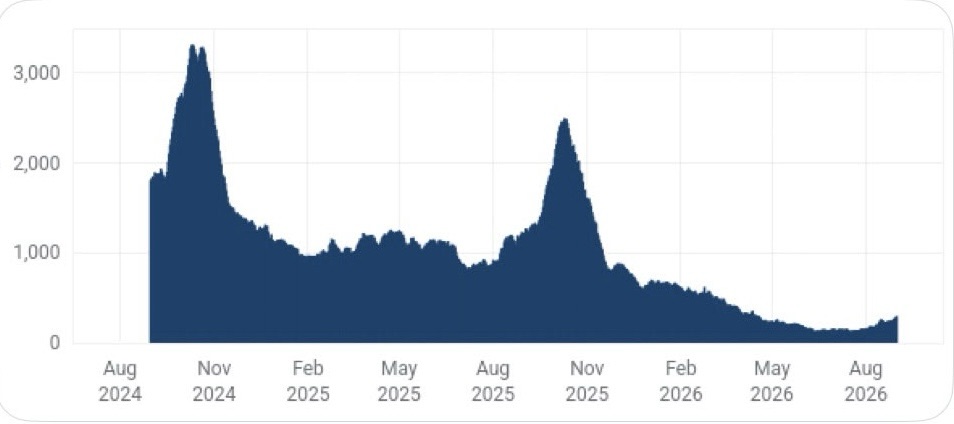
The consultation paper assumes that Covid is a stable endemic winter virus like flu. This is incorrect and few of the serious experts in this area would support this idea. Moreover, one can see from looking at the data that it is not a winter virus. In the recent period, waves have tended to start in late August, peaking in October/November. All of this would therefore be missed by the proposal to only report in the 3 /4 winter months. See the following graph helpfully provided by Dan O’Hara.
The Covid 19 Hospital Activity data set is not lightly used
The data on usage of the raw statistics published alongside the consultation shows that this is a heavily used data set compared to the other statistics they propose to scrap. The NHS England usage table shows 1225 average monthly views, against a catalogue average of 725. Nevertheless the consultation paper still goes on to describe the data as ‘of reduced interest’. The key point to make here is that this data on the number of people looking at the raw data will vastly underestimate usage of it. In reality people don’t tend to look at the raw statistics themselves because a number of analysts and commentators pull together easy to read papers and blogs which are circulated to a wide audience hence avoiding the need for most users to look at the raw data.
No Equality Impact Assessment provided
The consultation paper does not provide any equality impact assessment of the impact of the proposals. Yet many of the users of the data will be disabled within the meaning of the Equality Act, so their needs must be considered under the Equality Duty. NHS England should therefore publish their equality analysis with out delay.
Concluding Comments
The purpose of this blog has been to set out why the reasoning behind the proposal is flawed and on how damaging the loss of data on Covid 19 hospital activity would be. We know that this data is far from perfect in informing us of the risks at any one point in time but the fact is that it is all we have been left with. There may be additional arguments as well. You are encouraged to respond to the consultation by the deadline of 2 November 2026 ( link above) and resist this latest attempt to airbrush the dangers posed by Covid 19 out of the public eye.

Gillian Smith
18 September 2026


Leave a Reply