Summary
The Covid Inquiry report on the care sector (module six) appeared on 20 October 2026 and paints a devastating picture of how the adult social care sector was not treated as a priority particularly during the early stages of the pandemic. Care homes were left to their own devices often without any PPE, and the claim made by politicians that there was a protective ring around them turned out to be a myth. The result was that 43,000 deaths involving COVID 19 occurred in care homes between March 2020 and July 2022.
The chair of the Inquiry, Baroness Hallett, makes a number of recommendations about the need for better planning in future and it is encouraging that the recommendations come at a time when the new Prime Minister has signalled the need for improvements across the social care sector. This report can only serve to reinforce this message. All of the module six recommendations are very important. However, in my assessment the module report fails to discuss the need for measures to combat what is an airborne virus, including the need to deploy FFP3 masks and HEPA filters, something that was gone over and proven in the module three evidence on the healthcare sector . It is particularly important that in future authorities should adopt the precautionary principle and maintain an open mind about how any new virus transmits. In other words they should assume the worse eg airborne and asymptomatic transmission until it is proven otherwise, rather than the opposite of this which is what happened in 2020/21. This is a key omission which it is hoped will be remedied in the final report of the inquiry which will draw all of the threads from the different modules together.
Key Findings
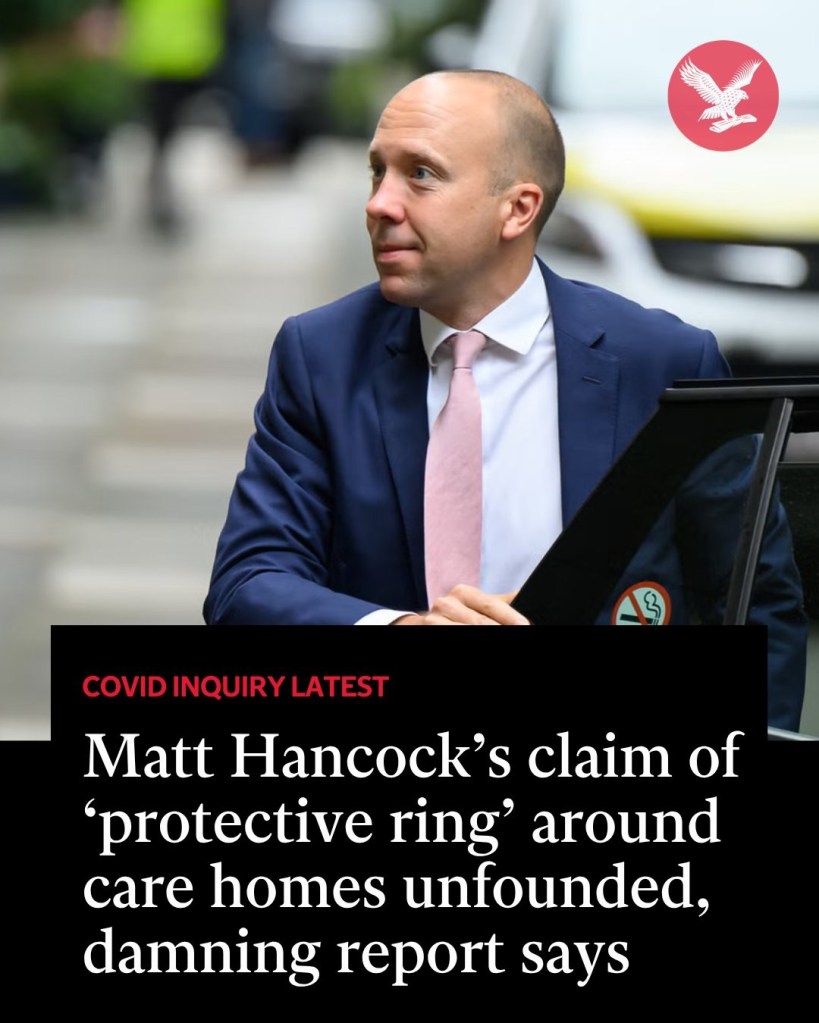
The report concludes that the pandemic had a devastating impact on the millions of people who were in receipt of adult social care and on the people who were providing care, including unpaid carers who were left to their own devices without support. Despite the obvious vulnerabilities of people in receipt of this kind of care, the report notes that protecting the sector appears to have been an afterthought by all four governments of the UK compared with the emphasis placed on trying to protect hospitals. This is despite what politicians said at the time. On this, Baroness Hallett pours cold water on the idea that the government placed a protective ring around care homes- a claim made by Secretary of State for Health and Social Care, Matt Hancock. Overall the report estimates that there were a staggering 43,000 deaths in care homes involving Covid 19 between March 2020 and July 2022.
The report recognises that the decision to speed up the discharge of patients from hospitals into care homes was necessary to free up hospital beds. But the decision to do so was taken in March 2020 when there was not enough testing capacity to know patients’ Covid-19 status. At the time, isolating discharged patients inside care settings was one of the few effective protections available. Yet in March 2020, England, Wales and Northern Ireland did not initially advise this, a failure the Inquiry calls “a significant omission”.
Severe shortages of personal protective equipment (PPE) meant that some care workers were left having to wear waterproof ponchos from festivals and similar homemade products . The report describes this as “wholly unacceptable”, finding that care workers were left “without the protection they needed”. It concludes that while PPE shortages were a global problem, better planning could have ensured a much better supply from the outset.
The adult social care sector is made up of many different parts which meant that the UK government could not easily see what was going on. Indeed , a key message is that the pandemic exposed the frailty of the sector and its workforce characterised by low pay and high turnover.
The report also examines concerns about the use of Do Not Attempt Cardiopulmonary Resuscitation (DNACPR) decisions, echoing concerns raised in the module 3 report that some decisions were made inappropriately or without proper consultation, based on a person’s age, health condition or learning disability. While finding no evidence of national policy encouraging blanket use of DNACPRs, the report recommends mandatory end-of-life care training for health and social care workers.
Ultimately, the report finds that these failures and others stemmed from an absence of proper pre-pandemic planning for the adult social care sector. Exercise Cygnus, a pandemic preparedness exercise conducted in October 2016, recommended developing ways to assess social care and surge capacity, but this work had not been completed by the time the Covid-19 pandemic struck. As a result, ministers were left making decisions without the information they needed about the sector.
The human costs of all of these failings are still being felt by the families who lost loved ones, often in appalling circumstances. 3The report notes that care home residents were left feeling isolated, abandoned and alone as visiting restrictions cut them off from loved ones, in some cases for months. Some people were not allowed to be with dying friends or relatives in their final moments. Neither could they help their loved ones with daily tasks such as eating, drinking and washing, support which can be vital for some residents.
During wave one, visiting restrictions did not begin to ease until the summer of 2020. The report concludes that the severity and duration of these restrictions caused “profound and enduring effects” inside care homes, particularly for residents with complex cognitive conditions such as dementia.
Recommendations
The Chair makes eight key recommendations focused around better planning with the aim of ensuring that the adult social care sector is better protected and better equipped to respond to the next pandemic as follows:
- Improving arrangements for pandemic planning to ensure clearer structures, roles and responsibilities.
- Better planning for the safe isolation of care home residents.
- Implementing financial support schemes ready to be rolled out to support adult social care staff to self-isolate or to limit staff movement.
- Publishing guidance on visiting restrictions.
- Maintaining inspection and oversight by developing protocols to enable inspections to continue, including, where possible, on-site inspections.
- Improving the collection of data about deaths in the adult social care sector.
- Establishing mandatory end-of-life care training for relevant health and social care workers.
- Introducing a voluntary register for the social care workforce in England, recognising and supporting a workforce that already benefits from such registers in Scotland, Wales and Northern Ireland.
Discussion
The publication of the report was accompanied by numerous media stories in which bereaved families recalled the horrors that they suffered and in many cases are still suffering. See for example the clip of Jean Adamson talking about the death of her late father.
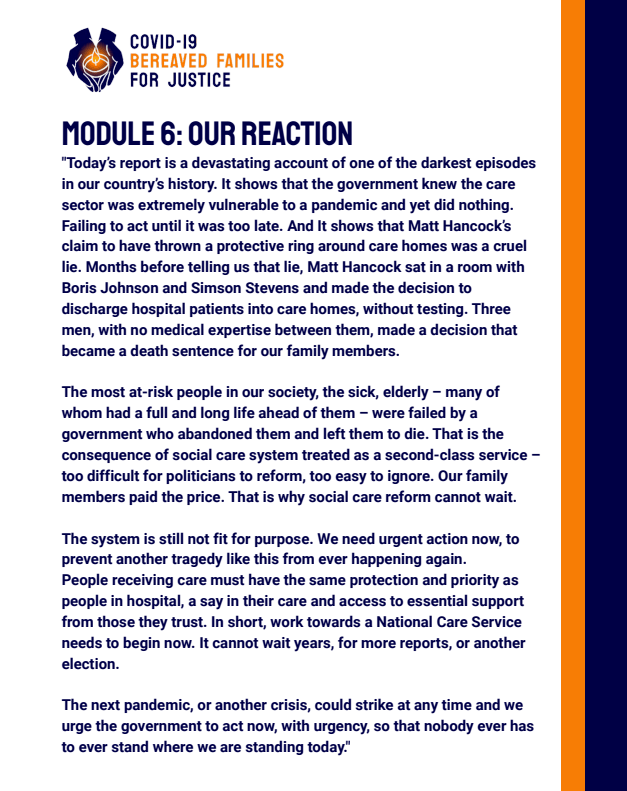
In response to the report the Covid 19 Bereaved Families for Justice issued the following statement majoring on the shortcomings of the social care sector and the need for change.
Despite the devastating impacts of the pandemic on these families and their legitimate desire for those responsible to be held to account, I fear that the report and the response is missing part of the bigger picture. My judgment is that it fails to capture the continuation of mistakes made beyond the first few weeks of the pandemic – yes testing for Covid 19 became easier, but other measures that would have helped protect people didn’t come on steam. In particular the flaws in Infection Prevention and Control measures will have cost many lives. As noted in my blogs about module three of the inquiry, for too long authorities remained wedded to the idea that Covid was transmitted via droplets, rather than being an airborne virus. All of the critically important evidence around this point was gone over in the module three report on Healthcare and it is worrying that the evidence about the importance of good ventilation and air filtration and good quality masks (essential to combat an airborne virus) has not fed into this module six report to the extent that it should have been given that people in receipt of adult social care are amongst the most clinically vulnerable in society. A reminder of why FFP3/2 masks and good ventilation are important in protecting against an airborne virus can be found in my blog on how to avoid catching COVID. Remember surgical masks are just a covering designed to prevent splashing during operations and the gapping gaps at the sides render them inadequate for protecting against an airborne virus. Baroness Hallett is aware of this, yet chapter three of the module six report skirts round the issue without directly addressing it. Indeed, the reader could be forgiven for concluding that PPE consisting of surgical masks is acceptable.

And Covid 19 hangs around in the air in unventilated spaces which is why ventilation is important – see the chart below which shows that the chance of breathing in air infected with Covid-19 is far lower in a well ventilated room of 800 ppm.

It is particularly disappointing that, unlike the report of module 3, the module six report contains no reference to the benefits of HEPA filters as a short – medium term cheap and easy way of protecting against an airborne virus. In particular , HEPAs can be deployed to overcome the problem of ensuring air cleaning at the same time as keeping vulnerable people at the right temperature that the report refers to in paragraph 3.5 reproduced below:
‘Another important IPC measure is ventilation (ie the introduction of fresh air). Given that adult social care is delivered indoors and often at close range, ventilation can help to reduce the build-up of infectious particles.6 However, not all buildings are built or equipped in such a way that fresh or better-quality air can be introduced easily, and there is a tension between the positive effects of ventilation in reducing the amount of infection in a closed setting and the risk of exposing recipients of care, especially older people, to particularly hot or cold temperatures.7’
In my assessment measures such as HEPAs and relatively cheap FFP2 masks would have gone a some way towards protecting the lives of those resident and working in the adult care sector throughout the emergency phase of the pandemic and would have helped to overcome the problem that keeping a social distance of two meters was not feasible given the nature of care work . Better ventilation and PPE would also have enabled the kind of safe visiting of vulnerable elderly relatives and friends that the groups representing bereaved families are so desperately upset about. In sum omission of discussion of how different viruses spread from future planning about the care sector during pandemics risks the continuation of a two tier system where protecting those attending and working in healthcare is seen as a higher priority compared to social care.
Concluding Comments
The report paints a picture of unimaginable stress borne by staff working in the sector, unnecessary loss of life on an industrial scale and horrendous suffering of relatives, particularly around the circumstances in which their loved ones passed away. Lack of planning is identified as the root cause and the recommendations are framed around a need for better planning in future. Adult social care was very much an afterthought reflecting the more general lack of appreciation of the importance of what is a fragile sector with low pay and high staff turnover .
On a positive note, it bodes well that the report has coincided with the greater focus on the need for improvement s across the sector pledged by the new Prime Minister.
Nevertheless, it is arguable that the report fails to spell out the key points about how to protect those receiving care and working in adult social care. This includes adopting the precautionary principle where the worst case scenario eg airborne transmission is regarded as possible and acted upon until proven to be false, rather than waiting for evidence before acting to ramp up IPC measures in order to protect people. In practice this means that the importance of good quality PPE and ventilation/air filtration should be regarded as necessary from the start of any pandemic and needs to be a key aspect of pandemic planning in the care sector. In this respect the module six report comes across as weaker than the module 3 report on healthcare. It is hoped that this apparent inconsistency will be ironed out in the final report which would otherwise risk placing patient and staff safety in the healthcare sector as more important than in the social care sector.
Gillian Smith
24 October 2026


Leave a Reply