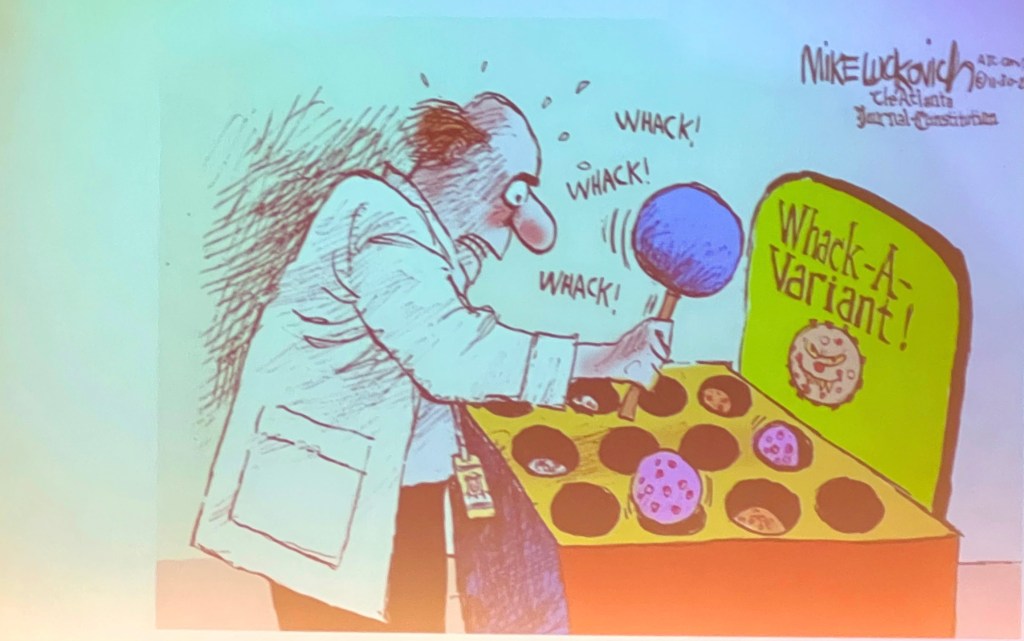
The Autumn 2023 Covid-19 vaccination programme ended yesterday. As yet there is no news about when the next NHS booster programme will be, though there are signs that the vaccine will be available privately from this spring. In the meantime the Covid-19 virus continues to mutate apace. Also many thousands of clinically vulnerable people have been refused a second dose as part of the Autumn 2023 booster campaign, despite growing evidence, including in the Lancet, that those who received their booster in September 2023 are under protected. This blog discusses the issues and updates the previous blogs The Autumn 2023 booster programme – have some clinically vulnerable people been failed and Vaccination against COVID-19 – where did UK policy go wrong.
Autumn 2023 Booster programme
My previous blog explained how the problems with the 2023 booster programme arose and made suggestions on how to address these.
I wrote to my MP in early January and on 11 January I received a helpful response saying he was seeking advice from the DHSC. I have not had a substantive response since then and on 2 February Chris Philp’s office confirmed they had not received a response.
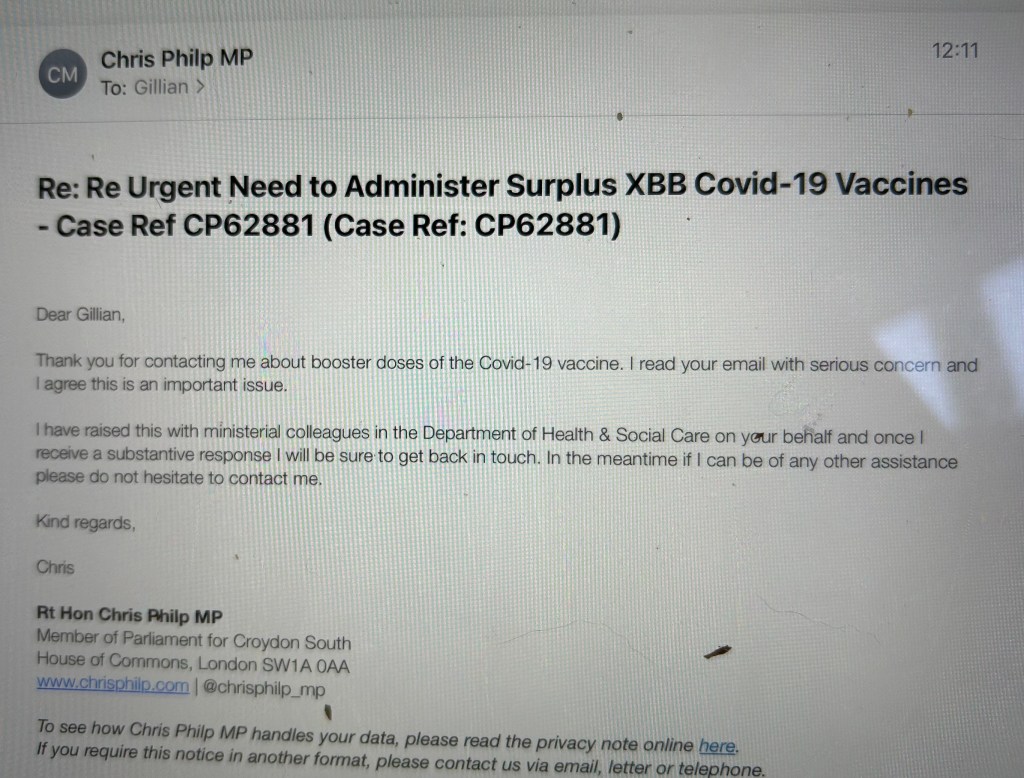
I received a response on 5 February. It does not take us any further. Essentially they are taking the line that all current vaccines remain effective. This completely ignores evidence from the US suggesting this is not the case. They also take the line that timeliness should take priority over the choice of vaccine.
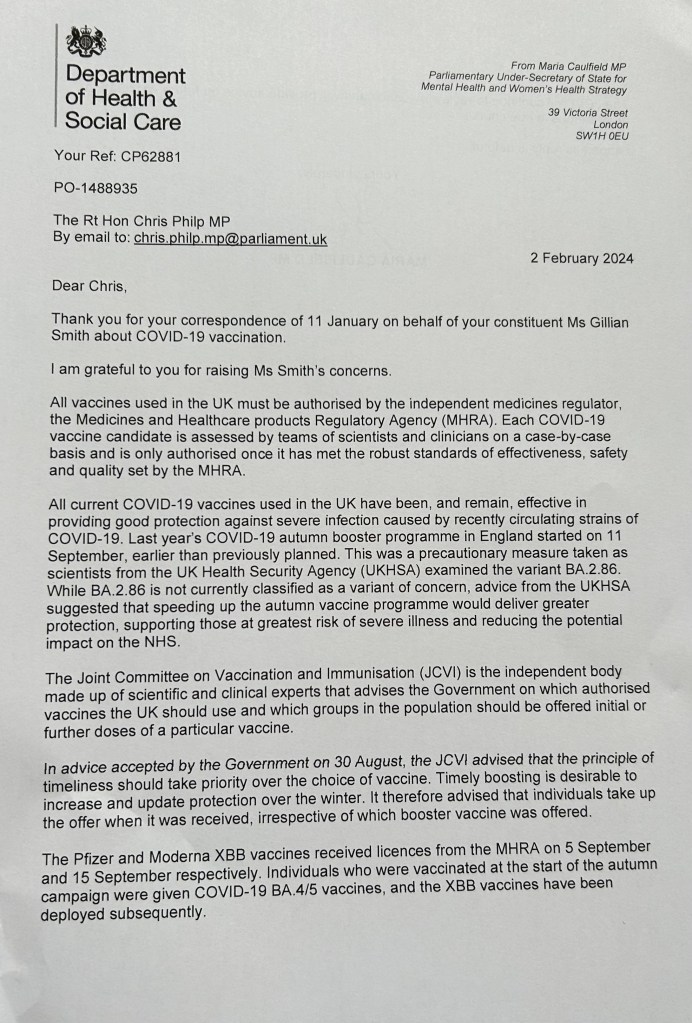
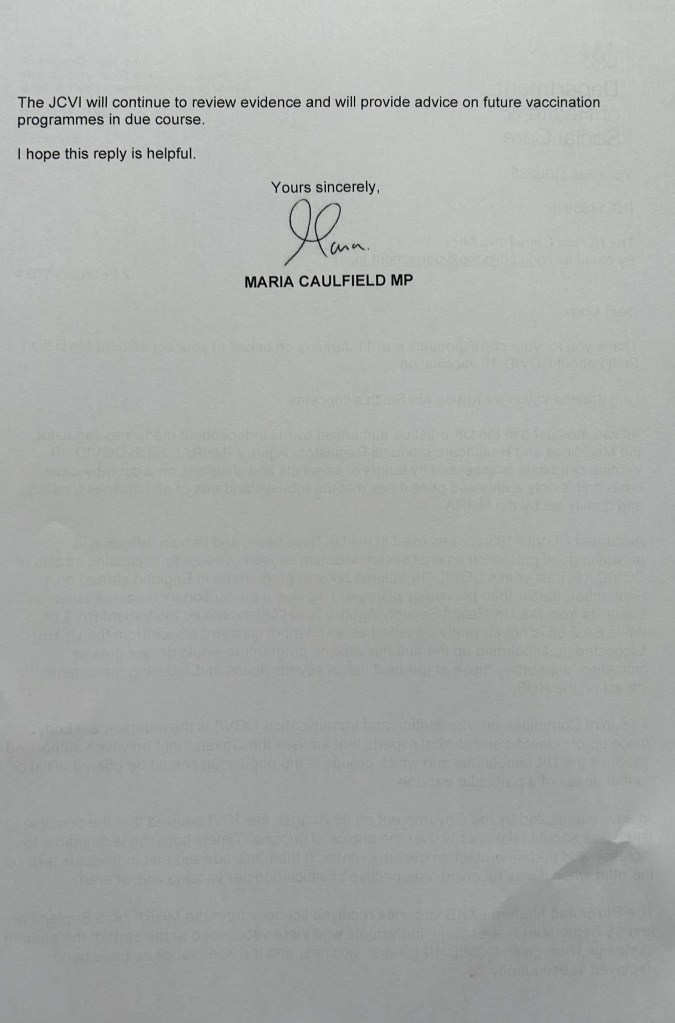
Despite their best efforts my impression is that most clinically vulnerable people who have sought a second booster unofficially have been refused, and this is discussed in an article in the i newspaper today which features Elizabeth Brown from Clinically Vulnerable Families.
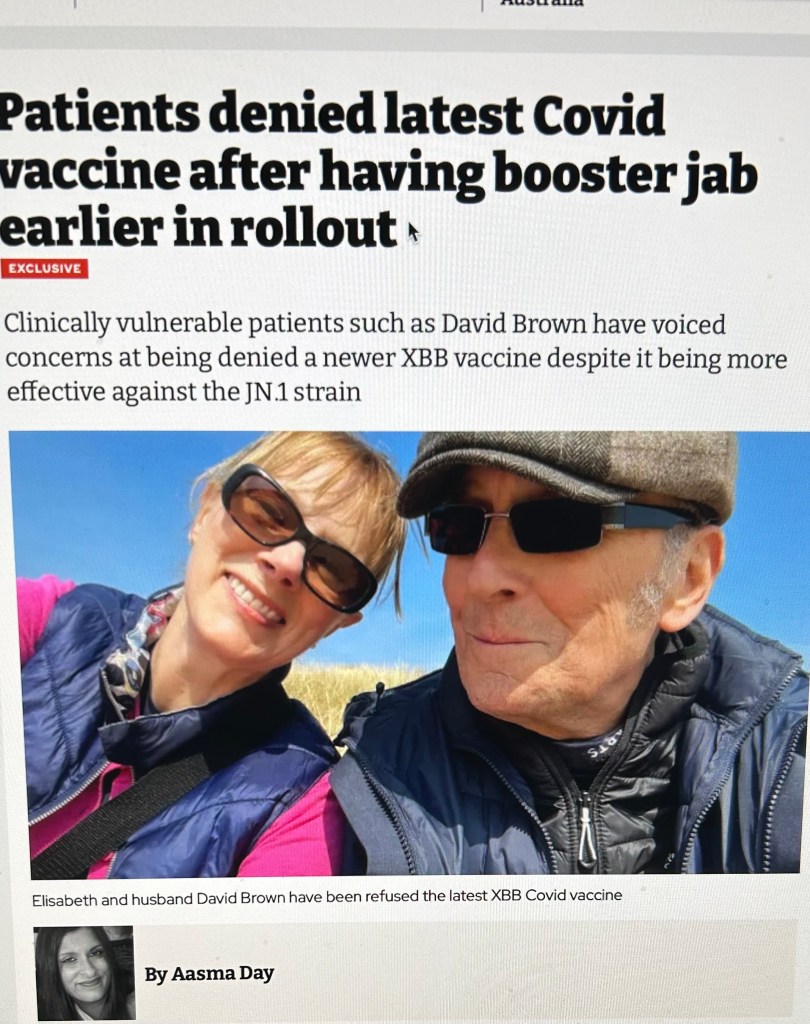
Elisabeth Brown, 64, and her husband David, 75, who has chronic lymphatic leukaemia, were vaccinated in late September with the bivalent jab – which was David’s eighth Covid vaccine.
Elisabeth, from Norwich, told i that since discovering the XBB vaccines are more effective against the dominant Covid variant, they went to their vaccination hub to ask for the jab, but were refused it.
Elisabeth said: “As the NHS states there only has to be 90 days between vaccinations, we were hoping we could now get the new one. But when we went to our vaccination hub, they flatly turned us down.”
The I newspaper 1 February 2024
The article goes on:
Professor Stephen Griffin, a leading virologist, told i that one problem is that Covid vaccines are being treated in the same way as flu – flu is more predictable and usually happens once a year, whereas with Covid, this is not the case.
“With flu, you can see the strains that are coming and predict what is coming and we’re ahead of the game with that,” he said.
“The BA.5 bivalent vaccine (used in Sept 2023) is from the summer of 2022, which means the virus has moved on to several different iterations and the most recent iteration is left-field and very different.
I newspaper 1 February 2024
And:
“The problem is when you compare that to the bivalent driven response, those antibodies are unfortunately nowhere near as good at preventing the newer strains of Covid.
“The simple fact is we are seeing four or five different strains every year because the virus is still changing at an unprecedented rate and is evolving four or five times quicker than influenza.”
He added: “With Covid, we are always behind the times. Even with XBBs, we are behind as the first XBBs are from some time last year.”
Professor Griffin says he is baffled as to why clinically vulnerable people are being refused the XBB vaccine and told i it seems very unfair when their lives are the most constrained by Covid. He says several studies have shown the bivalent vaccines are not as effective against the currently circulating viruses.
“There is a reasoning that says if you have a vaccine, you are better protected against the most severe types of Covid,” he says. “But we have to remember that clinically vulnerable people are those in the population who do.
I newspaper 1 February 2024
Looking ahead
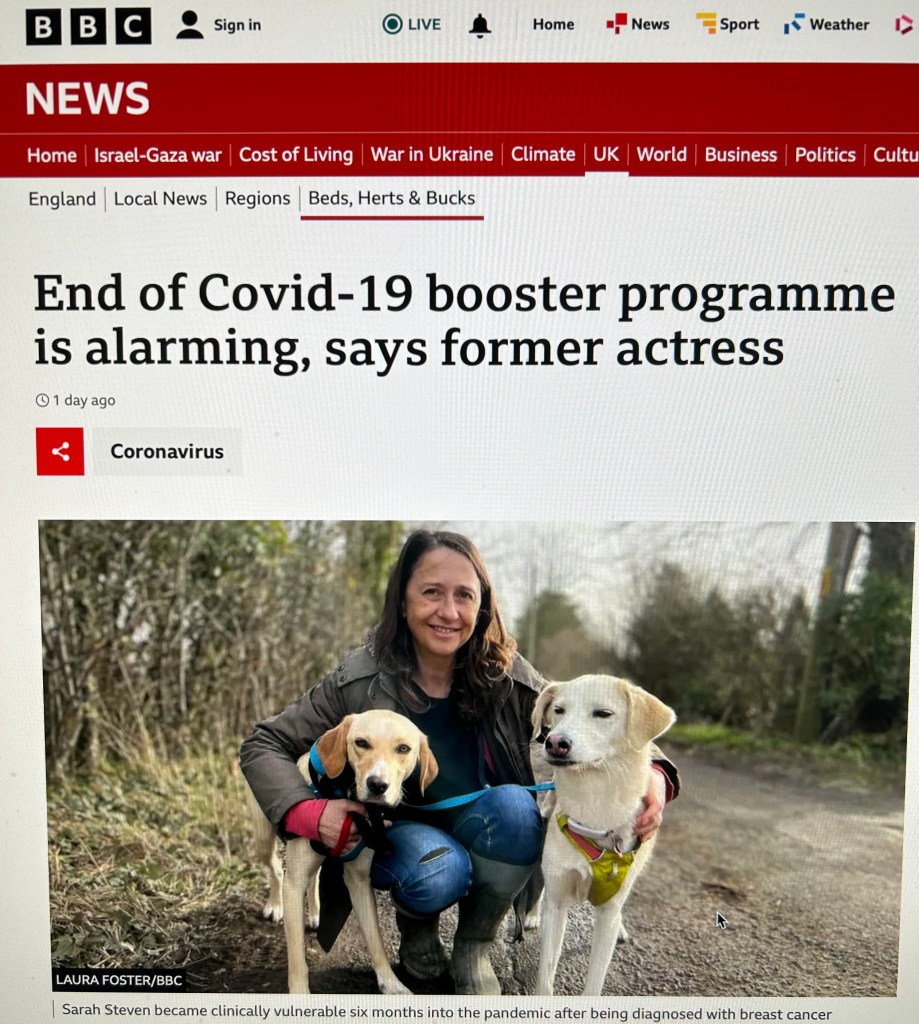
In addition to existing clinically vulnerable people, the ending of the vaccination programme will have immediate implications for people who are newly diagnosed with cancer and a range of other conditions that will mean they are clinically vulnerable, less able to mount a response to the vaccines and generally have weakened immune systems. Our understanding is that free vaccines will not be available to them until the next booster programme starts, whenever that might be. This was explained by Sarah from Clinically Vulnerable Families on BBC Look East yesterday.
More generally we have little idea what the next developments will be. There are however, some clues.
There is some good news in that the new Novavax vaccine was recently approved for use in the UK. I am not qualified to comment on whether this will be the best vaccine to come on stream this year and I understand there may be several updates in the pipeline. In commenting on this approval the President and Chairman of Novovax said:
“Today’s MHRA authorization is recognition of the role our vaccine can have in protecting the British public against COVID-19 this year,” said John C. Jacobs, President and Chief Executive Officer, Novavax. “We are in ongoing conversations with additional U.K. partners to identify potential opportunities to offer our protein-based non-mRNA COVID-19 vaccine to all eligible individuals who want one. We believe this is critical to supporting long-term, broad uptake of a seasonal COVID-19 vaccine in the U.K.”
This looks exciting, but what does it mean?
The first worry is that the free vaccine boosters will be very restricted to the most vulnerable groups – perhaps even the over 80s and immunosuppressed over a certain age. This was certainly floated as an option in the JCVI deliberations in May 2023 and discussed in my blog on the subject.
This may not happen, but the other worry is that those receiving a free booster will not receive the most up to date vaccine but get the old vaccine bought in bulk some time previously instead. I know that leading immunologist Professor Stephen Griffin of Leeds University is worried about this.
It is clear from some of the responses from the Dept of Health to the CVF campaign, and snippets in the press, that the XBB vaccines used in the booster campaign from 2 October 2023 have a long use by date and are being stored in fridges for the next booster campaign whenever that may be. We estimate that there may be millions of doses and possibly tens of millions and the UKHSA may have deliberately bought in bulk to save money in the future. See my previous blog.
They key problem here is, of course, that the vaccine will be out of date in terms of its effectiveness by the time the next booster programme comes around. As explained by Stephen Griffin and others, the virus is unstable and is mutating all the time. It is not stable and predictable like flu. Vaccine manufacturers are working hard to keep up with this.
The other concern is privatisation. Last Autumn the door was opened to allow providers to charge for boosters. Key questions are therefore will people who were previously eligible have to pay for booster jabs this year? Also, will it be necessary to pay for the most up to date vaccines?
We don’t know the answers to these questions but there are certainly signs of private GP outfits and pharmacies starting to advertise the availability of private Covid-19 jabs from spring 2024, although there has been no announcement from the government.The cost is likely to be somewhere between £45 and over £100 per dose which is considerably more than for the flu jab.
Whilst this privatisation would be welcomed by some who are not currently eligible, and possibly by some employers, it would be an extraordinary development if the most clinically vulnerable people in society, who are the most at risk at placing the NHS under pressure if they catch Covid, were to be denied the latest (or any?) vaccine free of charge. This would only serve to widen health inequalities.
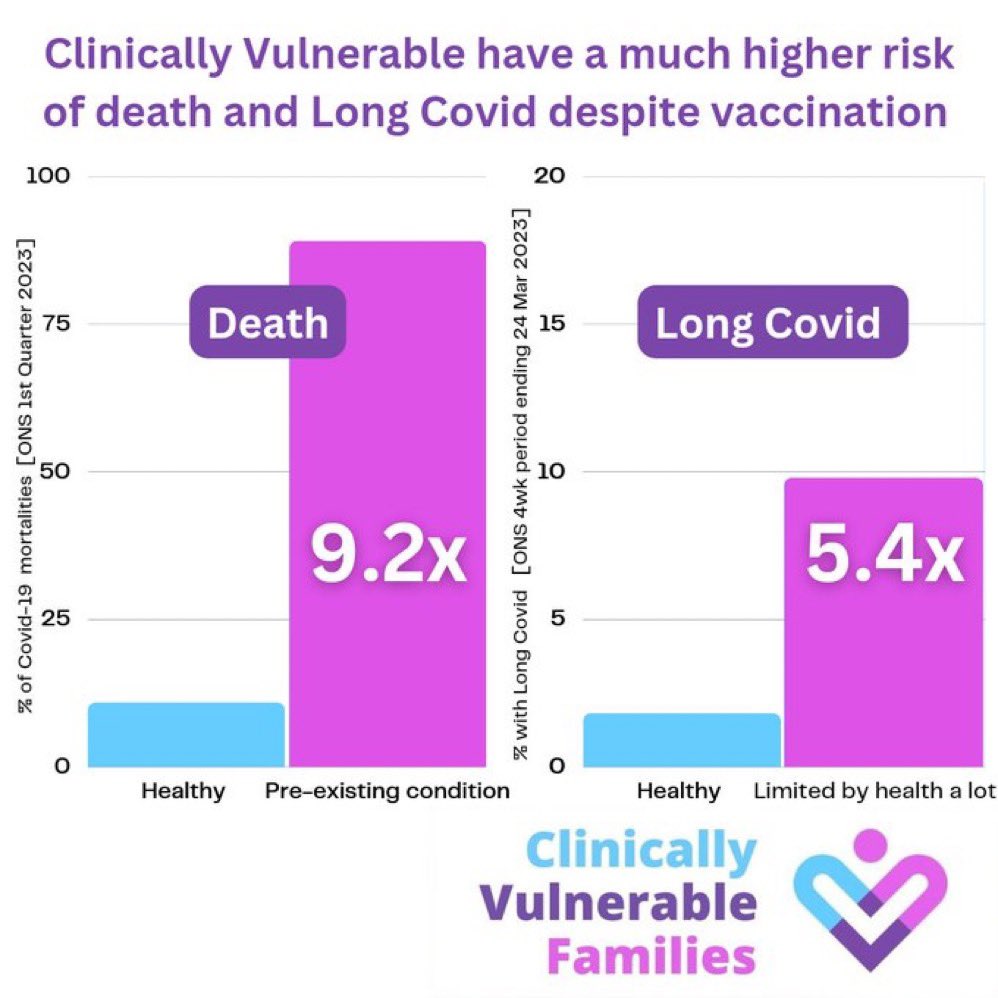
We await developments …


Leave a Reply