My previous blog It’s airborne: response to Ministers for Public Health discussed the saga of the correspondence between Tim Farron MP and the Minister for Public Health, until relatively recently, Andrew Gwynne. In his letter of 16/17 January Gwynne was dismissive of the need to change the IPC guidance which is based on the assumption that droplets are the primary route of transmission of Covid-19. Soon after this letter was received a video appeared from a group named- the ‘Covid Cover Up’ which shows Gwynne talking openly about airborne transmission before the general election – see video below. The Minister was of course sacked the next day for an unrelated matter concerning offensive WhatsApp messages sent in 2019.
Since then two letters have flowed between the new Minister for public health, Ashley Dalton, in response to Tim Farron MP, followed by a very recent letter from CATA (Covid Airborne Transmission Alliance).
Recent Developments
The new Minister for Public Health, Ashley Dalton replied (on 11 March 2025) to Tim Farron’s letter to Andrew Gwynne (see previous blog). This appeared to take a different and more serious stance than the previous reply from Gwynne. Whilst the letter does not provide everything we might wish for in terms of a commitment to revising the IPC guidance, and is not entirely accurate in that it understates the importance of air borne transmission, in the words of one commentator ‘it appears that the government advisors have been doing some reading’. See letter below.


So progress was being made? Well perhaps not. On 14 March another reply to the very same letter from Tim Farron was received. It did not mention the reply sent on 11 March but appears to backtrack and says something different and misrepresents the WHO position! See below:
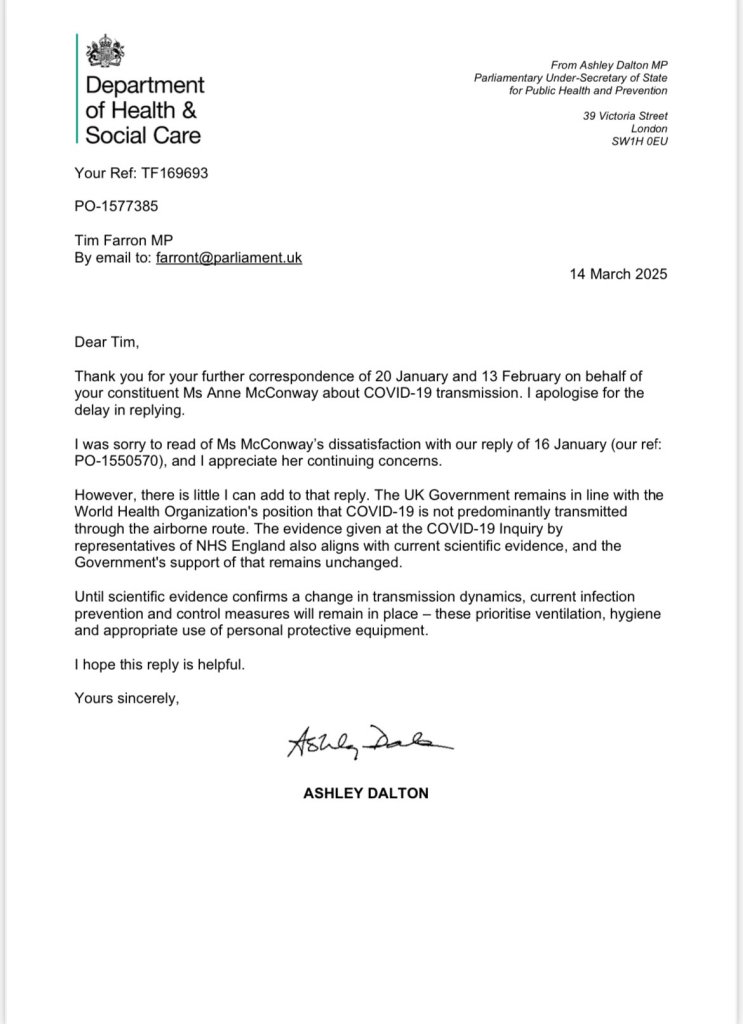
Confused? Yes, so was everyone else. People were also surprised to learn that ventilation is a priority. Why would this be a top priority if Covid-19 is not airborne ? And one is left wondering what tangible steps are the government taking to improve ventilation in healthcare settings? All this would be funny if it were not so serious.
Very Recent Developments
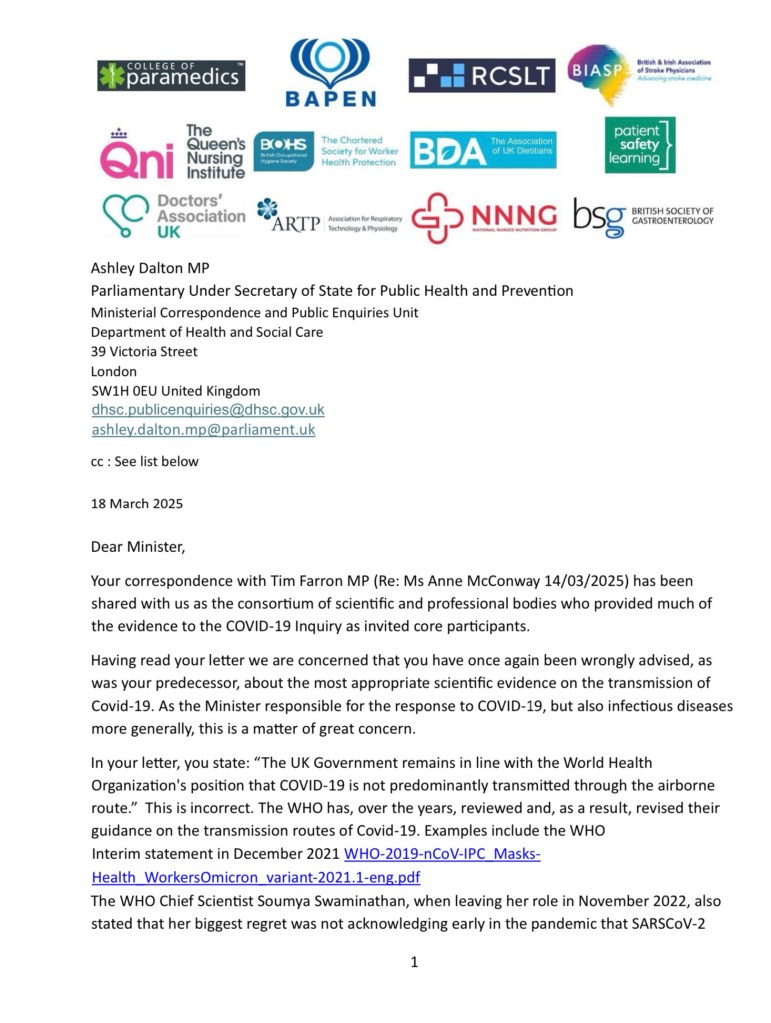
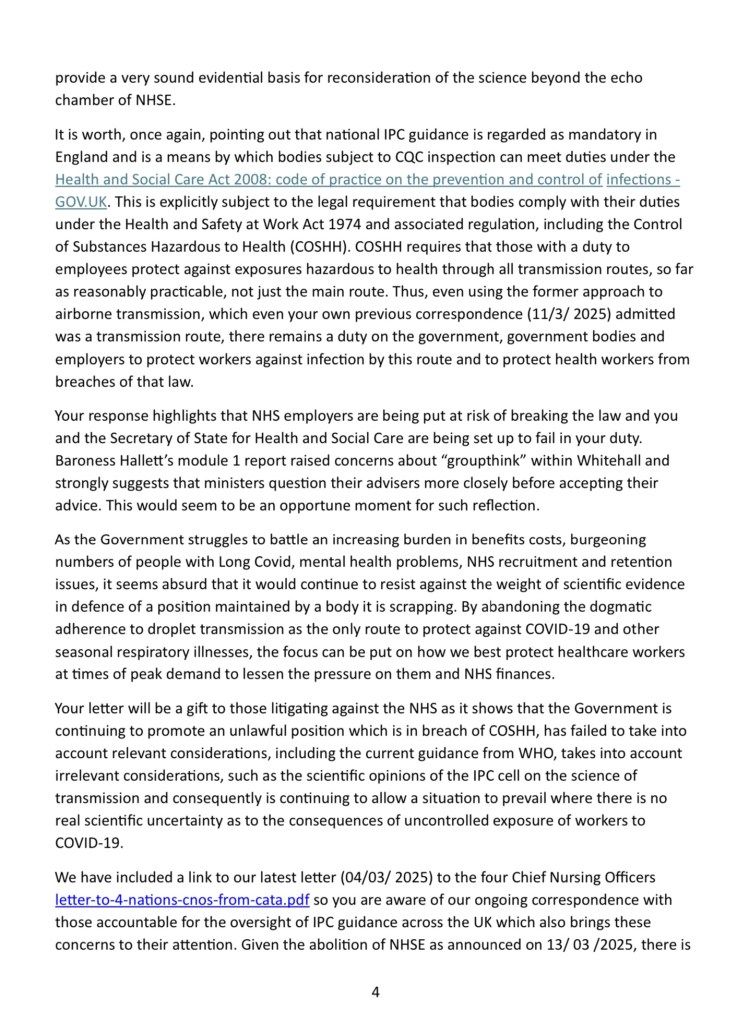
On 18 March CATA continued to press the case by sending a letter to Dalton advising her that she’s been badly advised in the drafting of her rely to Farron. The letter is reproduced below. The key points can be summarised as follows:
- The statement that the UK policy is consistent with WHO is incorrect;
- The revised WHO approach is that Covid-19 spreads primarily via inhaled respiratory particles. This terminology represents a better understanding of the behaviour of particles and moves away from focusing on particle size (eg droplets v airborne distinction);
- this terminology is now used internationally, yet not in the UK;
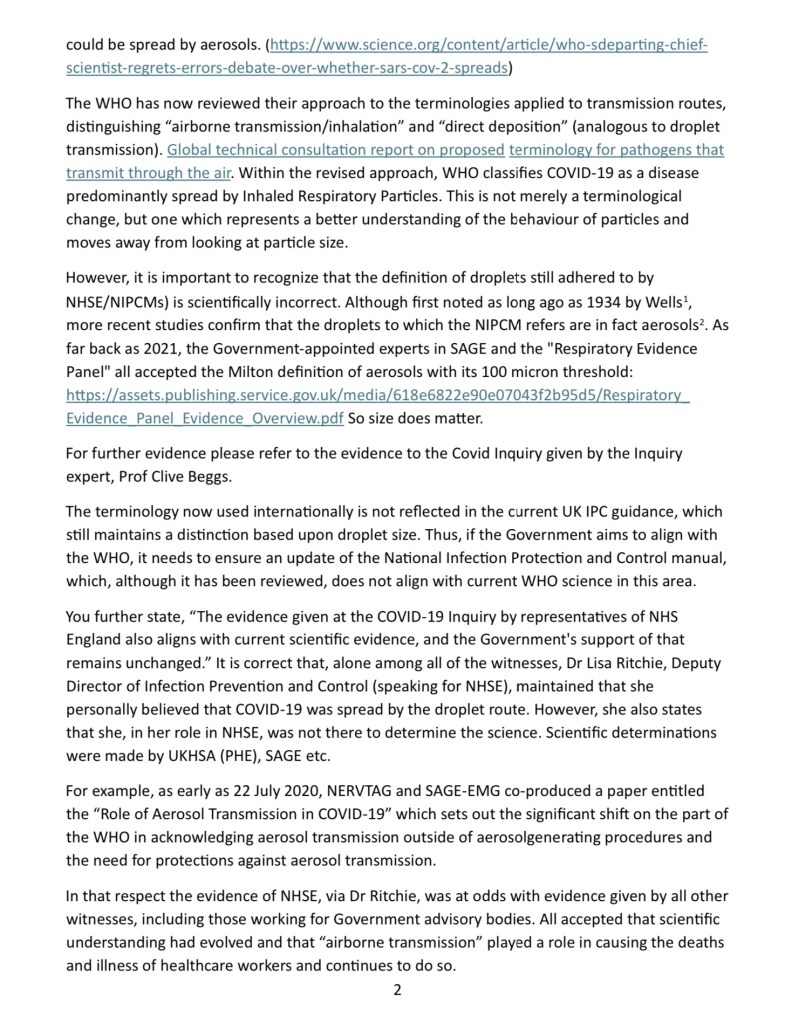
- The definition of and focus on droplets still used by NHS England is therefore out of step with these developments. Indeed, the evidence given to the Covid Inquiry by NHS England through Lisa Richie (mentioned in the letter to Dalton) was at odds with what every other witness said;
- The focus on droplets was also out of line with Government health videos released at the height of the pandemic and is inconsistent with documents from this period which are still on several government websites;
- Even putting the significant evolution of the science and terminology aside for a moment, Dalton’s first letter of 11 March (which was subsequently superseded by the 14 March letter) acknowledged airborne transmission as a transmission route.
- CATA point out that there remains a duty on government, government bodies and employers to protect health care workers from transmission via this route, as the IPC guidance is mandatory and underpinned by health and safety laws;
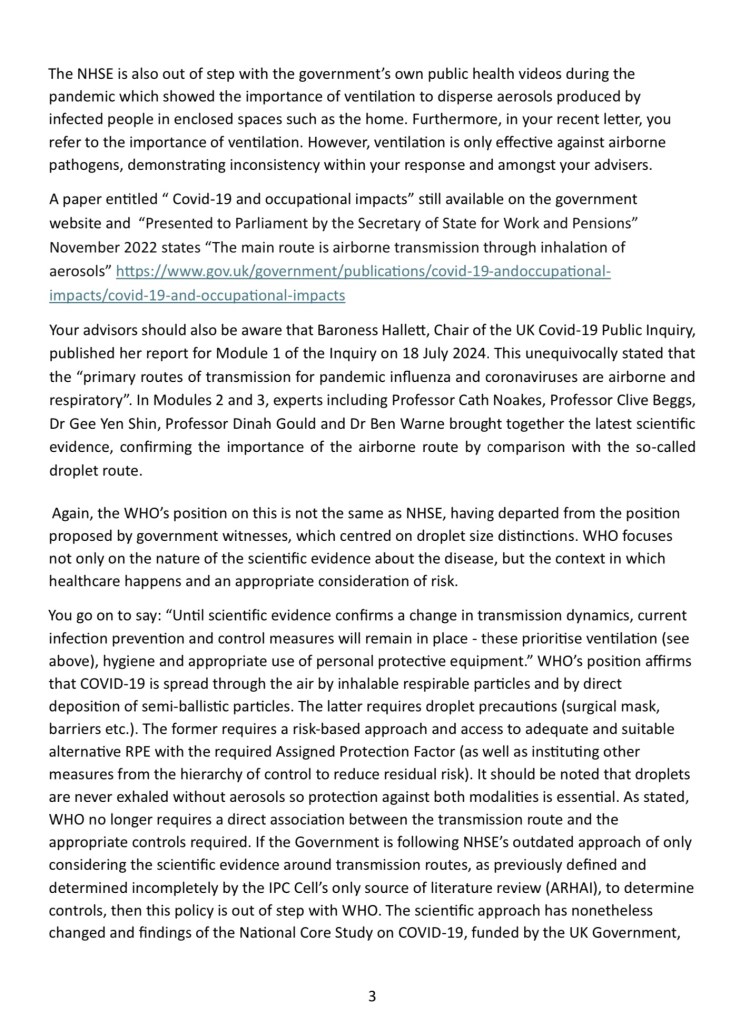
- In her report on module 1 of the Covid Inquiry, Baroness Hallett referred to ‘group think’ within government and its agencies and this letter from CATA argues that this is what we are seeing in this correspondence;
- CATA point out that NHS employers continue to be put at risk of breaking the law and that the Secretary of State and Dalton herself are being ‘set up’ to fail in their duty;
- It goes on to say that the focus should now be on working out how best to protect healthcare workers and lessen the pressure on them and on NHS finances;
- It calls for immediate revision of the IPC guidance by a competent, inclusive and multidisciplinary panel (see final para);
- The CATA letter also warns Dalton that her letter is a gift to those litigating against the NHS as it shows that the government is continuing to promote an unlawful position.

Conclusions
It is hoped that the latest letter from CATA will lead to some serious reappraisal within government and elicit an appropriate response laying out a way forward on much needed improvements to Infection Prevention and Control procedures in healthcare. It would be extraordinary if the Minster were to come back with the previous line taken on droplet transmission of Covid-19, yet again, but I would not bet against this happening. Perhaps I am being pessimistic?
Watch this space …
Gillian Smith 31 March 2025


 Living on Plague Island
Leave a reply to David Osborn Cancel reply