Update 9 February 2025. The Minister for Public Health was sacked yesterday and also suspended from the Labour Party. This was not for his stance on the airborne transmission of Covid, but for a series of offensive WhatsApp messages written in 2019. It is a remarkable coincidence, or perhaps something slightly sinister, that on Friday 7 February an organisation – the Covid Cover up – which has only recently appeared on the scene, posted a very powerful and accurate video about the pledges that Andrew Gwynne made whilst in opposition.
See 25 January and 1, 5 and 7 February updates below
I will not be posting any further updates on this blog but will produce two separate linked blogs when there is progress to report on the issues covered in this blog – namely 1. Pressure on the yet to be appointed new Minister for Public Health on the need for clean air, particularly in hospitals and 2. representations made to the chair of the Covid Inquiry to issue an interim report on the need to update the IPC guidance (Infection Prevention and Control).
It is important that we break out of this mess and make hospitals safer. To repeat what someone said on social media recently, we are currently in the ridiculous position of :
IPC say that it’s not airborne, but if it was we would need to wear FFP3 masks. UKHSA say it’s airborne, but that FFP3’s don’t work (they do actually). This era is supposedly one of evidence based medicine!
Background
How does Covid spread? Is it via droplets that fall to the ground or is it airborne hanging around in the air rather like cigarette smoke. As explained in other blogs on here, this question has important implications for the mitigation measures that need to be put in place to protect people from catching Covid-19 in indoor settings – ie if there is airborne transmission (outside of aerosol generating procedures usually performed in ICUs) it underlines the importance of good ventilation and air filtration systems and good quality close fitting masks (eg FFP2s or FFP3s).
During the Autumn of 2024 the Module 3 hearings for the UK Covid Inquiry heard extensive evidence about this which I attempted to summarise in a previous blog post.
The issue is complicated, and transmission can be by very small particles as well as by larger droplets but you can’t see either of these. Numerous expert witnesses presented convincing evidence that Covid-19 is transmitted predominantly via the airborne route. In contrast to these sessions backed up by supporting evidence based documents, the state witnesses and particularly Lisa Ritchie Deputy Head of the IPC cell (infection Prevention and Control) was hesitant, and unconvincing, failing to produce evidence to support her assertions that the primary mode of transmission is via large droplets, Moreover, she made no attempt to directly counter what previous witnesses, including Professor Beggs had told the Inquiry about the importance of airborne transmission.
Letter to the chair of the Covid Inquiry, Baroness Hallett requesting interim recommendations be made
Following the module 3 hearings a number of the core participants to this module, including the British Medical Association and the Clinically Vulnerable Families group, wrote to the chair of the inquiry to request that she publish an interim report calling for an urgent change to the IPC guidance – see below.


A reply was received on 28 January – please see 1 February update below.
On the same date, just before Christmas the BMA published a letter sent to Amanda Pritchard Head of NHS England calling for urgent changes to the IPC guidance which, as they point out, is itself internal inconsistent and confusing.
We are not aware of any reply being received to date.
Government stance – letter from Andrew Gwynne
In parallel to the initiative taken by the core participants to the Covid Inquiry there has been a lot of activity.
This issue is of course a matter of great concern to those of us who need to keep safe through the provision of clean air and an understanding of and deployment of good quality masks. I am personally dismayed at the lack of action by the new Labour government.
Many people, including myself, have made numerous attempts to try to engage decision makers on these issues. This includes a member of the public called Anne McConway who wrote to her MP (Tim Farron) about the matter which he passed onto the Minister for Public Health, Andrew Gwynne.
A reply was received on Friday 17 January and is dismissive of the idea of the need to change the IPC guidance which is based on the idea that droplets are the primary route of transmission.
More generally the reference to ‘information on social media’ is in the assessment of many people, including myself, incredibly offensive in tone and content. This letter has gone viral across several social media sites!
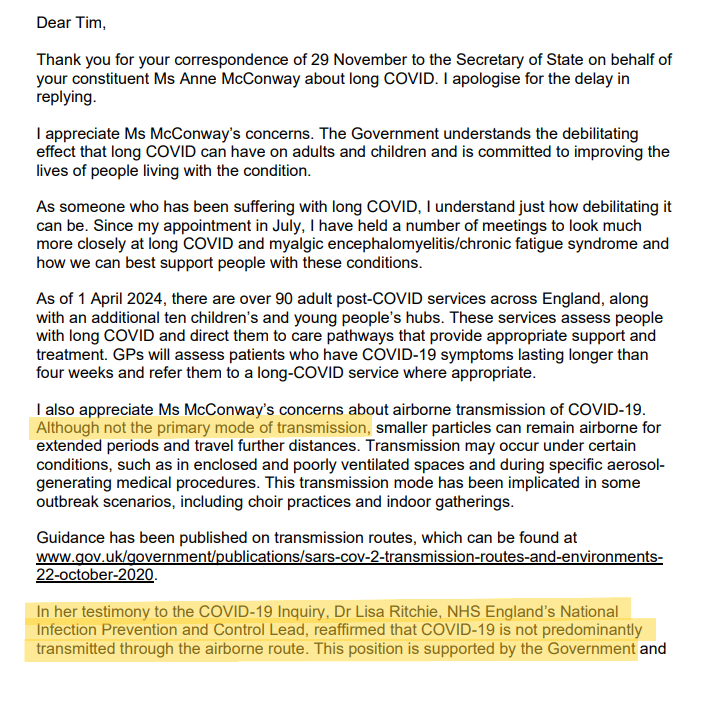

It is also worrying that the Minister for Public Health quotes the World Health Organisation position as being consistent with the line he is taking. In fact, the WHO changed what they were saying about the route of transmission of Covid-19 in December 2021 to acknowledge the key role of airborne transmission.WHO officials have subsequently given greater emphasis to the airborne route in various speeches and discussions on the subject and have emphasised the importance of ventilation and good quality masks. Surely over three years on from this change, the Dept for Health and Social Care should be aware of this?
Moreover, the following statement has been on the UK government website (gov.uk) since November 2022 – see para 16 (reproduced below).
‘16. Modes of transmission of SARS-CoV-2 are becoming better understood. In common with other respiratory infections, the transmission route involves transfer of the virus from an infected person to the recipient, predominantly through the respiratory tract. At the start of the pandemic the prevailing authoritative opinion stressed the potential risk from contact with contaminated surfaces (fomites), and inhalation of relatively large infective droplets. More recent evidence suggests that transmission from surfaces is less important and that droplet transmission is feasible only when individuals are in close proximity (SAGE-EMG, 2020a). The main route is airborne transmission through inhalation of aerosols (very fine particles suspended in air), which can be transmitted indoors over distances of several metres (Meyerowitz et al,. 2021; Stadnytskyi et al., 2021). Breathing, talking and singing result in the emission of fine aerosol, with higher vocalisation volumes substantially increasing the amount of aerosol emitted; coughing emits similar amounts of fine aerosol to loud speaking or singing (Gregson et al., 2021). The interconnection of the different routes is illustrated in Figure 2.‘ (of course the evidence on airborne transmission has multiplied since the data when this was published).
Concluding Comments
This is all very frustrating. It is far from being a purely academic issue as people are continuing to die or become seriously ill, and develop long term conditions due to poor infection control procedures and a more general lack of public information on the best ways to protect ourselves against Covid-19 against a growing evidence base on how easily Covid-19 spreads.
It is a particularly insulting kick in the teeth to the many experts who willingly gave their time to contribute to the Covid Inquiry. The reference to ‘social media discussions’ is especially insulting to these experts who are, in the main, senior professors.
It is also dispiriting that the DHSC seems to have completely rejected the ‘precautionary principle’ which was strongly advocated by several witnesses to the Covid Inquiry in Autumn 2024. In a nutshell, this is that were there is uncertainty about the scientific evidence (lets assume for the sake of argument there is uncertainty about the mode of transmission) that the most appropriate approach is to adopt protective measures appropriate to the worst case scenario (nb. in this case airborne transmission) until it is proven that the protective measure/s in question are not necessary. In saying ‘until scientific evidence suggests that the virus is predominantly spread through the airborne route, this stance will remain unchanged’ Andrew Gwynne is effectively rejecting the ‘precautionary principle.
Of course, it is all no doubt driven by the state of public finances and at a time when plans to rebuild crumbling hospitals are being shelved. But this unwillingness to spend public money on strengthening infection control measures is blinkered and short sighted given the potential economic gains from a healthier population and an NHS that is under less pressure.
This is all a particular problem for clinically vulnerable people, many of whom like my family member, have not responded to the vaccine. Last week Head of CVF Lara Wong took the stand at the Covid Inquiry and explained how airborne transmission is a particular problem for us – see the following clip.
In sum, this unfortunate letter from Andrew Gwynne is far from the last word on the subject.
Update 25 January 2025
There have been a number of developments over the last week. Firstly, we understand that Tim Farron MP has written to Andrew Gwynne requesting the evidence to back up his assertions about droplet transmission. Secondly, on 24 January, the lawyers representing the long covid groups at the Covid Inquiry wrote to the Minister about this serious matter – the letter is reproduced below.

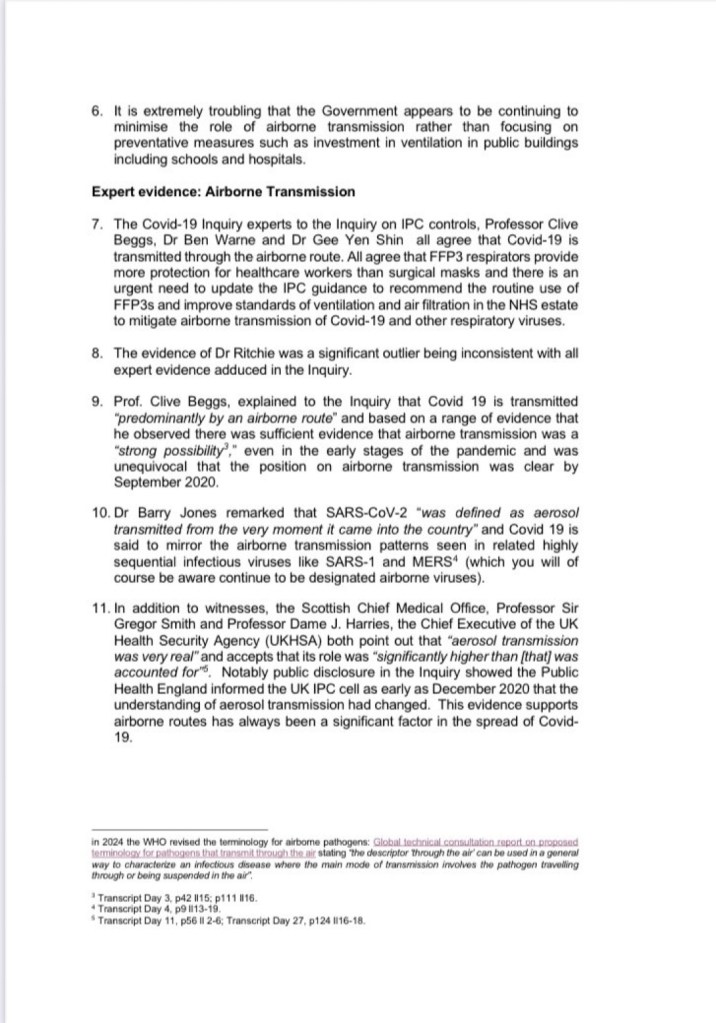

A response has been requested by 14 February and it is expected that this will need to be taken seriously by the Minister. It would also be helpful if he were to apologise for his flippant remarks which have offended so many people, including experts who gave evidence to the Covid Inquiry
Update 1 February 2025
This has been a very busy week at the Covid Inquiry in the middle of which a reply was received to the BMA co-ordinated letter of 20 December.
As anticipated it is bad news. The letter is couched in the usual cautious legal language. Baroness Hallett, chair of the Covid Inquiry has taken the view that issuing interim recommendations pertinent to current ‘seasonal winter pressures’ policies is not her role. She also notes that witnesses were not unanimous on the issue and she wants to fully consider all of the written and oral evidence presented before drawing any conclusions. The letter is below.


I understand that CATA (Covid-19 Airborne Transmission Alliance have written back to Lady Hallett asking her to think again, partly because guidance in different parts of the UK is confused. It also asks for the precautionary approach advocated by various witnesses to the Inquiry be adopted now, without delay. (5 February)
We are not aware of any reply being received to the various correspondence sent to Andrew Gwynne with a deadline of 14 February.
Also see a discussion paper from Anne Marie on the issues published on 6 February.
Gillian Smith
18 January 2025 (update 25 January, 1 and 5 February)


 Living on Plague Island
Leave a reply to David Osborn Cancel reply