
Whilst politicians, the media and the UK Health and Security Agency (UKHSA) continue to pretend that Covid-19 is now a seasonal illness that strikes in late Autumn and Winter, the UK, in common with many other countries, now seems to be entering the second significant wave of infections of spring/early summer 2024. This blog provides an update on what seems to be happening, based on the limited data available to us.
Situation in the UK in June
Although there is very limited data available on the prevalence of Covid-19 in the UK it is now clear that Britain is in a new wave. Bob Hawkin’s blog of 20 June helpfully reviews that available data concluding that:
‘The data this week shows that Covid levels are rising with both positivity rates and hospital admissions increasing‘.

On 21 June 2024 the i.newspaper also ran an article about the latest data:
‘The rise in case numbers is thought to be due to a combination of waning immunity built up from vaccines and previous infections and the rapid spread of an emerging variant known as KP.3.
Hospital admissions rose by 24 per cent in the week to Sunday 16/6, from 2.67 people per 100,000 to 3.31 per 100,000, according to new figures from the UK Health Security Agency.‘
“This is a wakeup call. The virus hasn’t gone away and is certainly not a seasonal infection,” Professor Lawrence Young, a virologist at Warwick University, told i.
“I don’t know whether the KP.3 wave will be bigger than the KP.2 May wave, but I am pretty sure that it will cause another wave making this summer a more Covid-prevalent summer than last year where June and July were very quiet months,” she added. (Professor Christina Pagel)
Scotland is the only part of the UK that continues to undertake analysis of wastewater, on a limited scale. The latest indications are that Covid is increasing and the Scottish government has decided to re-institute weekly monitoring and reporting in contrast to the situation in England.

Other Countries
The Southern Hemisphere is now entering winter and it is clear that Australia, particularly South Australia has been experiencing a big Covid wave in recent weeks. Adelaide appears to have been hit very badly with local hospitals cancelling all but the most urgent operations.
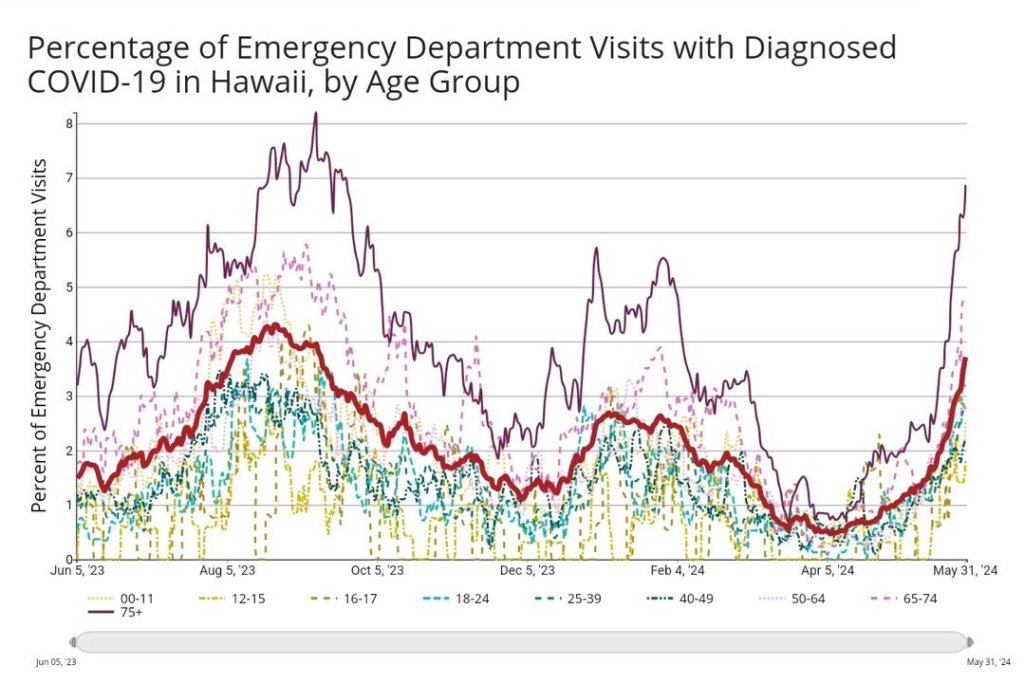
Hawaii and the Pacific coast of the USA have also been experiencing a large wave driven in the main by the KP.3 variant which many assess as particularly transmissible. This is also happening on the East Coast with New York particularly badly impacted.
In Europe the Iberian peninsula appears to be badly hit. The following graph illustrates the situation in Portugal.

Covid is also surging in Spain, far outpacing infection rates seen in 2022/23.

France is also in a summer wave after a long period of relative calm due to protective measures previously in place. People in France are being advised to self-isolate and wear masks, as an expert warns that “Covid is not gone”, and hospital cases continue to rise. The signs are that the rises in hospitalisations are over 50% a week which far exceeds the rate of spread seen in the recent past.
In Ireland a new surge appears to be underway with cases rising by an estimated 60% per week. Hospitals are also coming under increasing pressure, particularly in the Dublin area, as the number of hospitalisations with Covid is rising sharply.
Update 5 July
The latest indications set out in a blog from Christina Pagel are that the latest Covid wave may have peaked and be on a downward slope. However, the data this conclusion is based on is very thin to say the least. More data, albeit limited in nature, will be published on 11 July.
Meanwhile the UK has witnessed a change in government overnight. As Christina notes in her blog, the challenges faced by the incoming labour government are enormous and we do not know how successful they will be in attempting to restore the NHS, tackling poor public health and soaring health inequalities as well as sorting out social care.
As I discuss elsewhere on this website and in a forthcoming blog, reducing the prevalence of Covid-19 across the population is integrally linked to being able to get the NHS back on its feet. It will be interesting to see what the new government does.
Update 9 July
The i. newspaper ran a piece this morning about the need for year round monitoring data on the prevalence of Covid-19.
“Because Covid continues to be a threat and the virus is constantly changing, we need more robust year-round community testing,” Warwick University virologist Professor Lawrence Young told i.
“Currently we are blind to the spread of the virus in the general population and there are no control measures to mitigate against infection.
“This is particularly dangerous as we head towards the autumn and winter months as it is likely to lead to more widespread infection with serious consequences for the elderly and most vulnerable.”
He added: “It also means that the virus will continue to change as it spreads, throwing up new variants that could be more infectious and more able to evade immunity from past infections and vaccination.”
Update 21 July
In common with many other parts of the world the UK is still in the midst of a very significant summer wave and many of us, including myself, are taking significant additional precautions whilst on holiday and at other summer events such as Wimbledon tennis. On 11 July there was hope that the current wave may have peaked. However, these hopes were dashed on 18 July just before I returned from holiday when it emerged that the summer wave was taking off again. This is thought to be linked to the so called Flirt variants mutating from the original KP.2 strain.

Covid-19 is in the news across many parts of the world – including the US. T.A.C.T provide a useful update showing that the current COVID-19 wave is intensifying across the U.S., U.K., and many other countries, with the KP.3 variants becoming globally dominant. ‘This surge is surpassing last summer’s levels in the U.S. and other nations. Many regions in Europe, including Austria, Belgium, Denmark, Finland, Germany, Greece, Hungary, Switzerland, Sweden, the Netherlands, and Luxembourg, are also seeing rising prevalence’.

US President Biden has tested positive for Covid-19 yet again, and many commentators attribute his apparent confusion with brain fog/long covid. Most of the media prefer to claim that he is suffering from dementia despite this having been ruled out by medical tests, apparently.
The Tour de France has been badly disrupted by Covid-19 and key competitors have had to drop out. Indeed the situation was so bad that the authorities introduced a mask mandate whereby masks need to be worn by those in contact with competitors. Even countries such as Japan with good infection control systems appear to be experiencing a significant wave.
Update 27 July
The signs are that Covid is continuing to spread across the UK, Europe and the US, driven largely by the new Flute variants (which have evolved from Flirt).
The latest update from Bob Hawkins, based on a limited amount of data, is that Covid levels continue to rise but at a slower rate.
The situation in part of Europe is also becoming increasingly problematic. Popular tourist destinations including Greece, Cyprus, Malta and Portugal are seeing a surge in cases.
There has, nevertheless, been some good news over the last few days. Professor David Sprain of Exeter University has been appointed to the new position as parliamentary research lead on health:
Professor Strain said: “This new role gives an exciting opportunity to be working with the new Parliament to ensure that the latest research in delivering and maintaining health is understood by parliamentarians and, where appropriate, translated into policy.”
Whilst adapting a fairly low key profile to date, Professor Sprain has taken an active interest in Covid and Long Covid since the start of the pandemic, favours sensible mitigation measures and is well respected.
Update 3 August
The latest indications over the last week are not good. Christina Pagel notes that ‘according to the latest UKHSA data, hospital admissions with Covid decreased very slightly in the previous week but admission levels remain high’.
Of course data that relies on testing of hospital patients if symptomatic is a completely inadequate way of monitoring change. However, it is what we have to rely on in England and Wales.
Although wastewater analysis is far from a perfect method the fact that Scotland continues to do this is to their credit. However the latest data is alarming. It shows a huge spike in the prevalence of Covid in July on a scale not seen for at least 2 years.
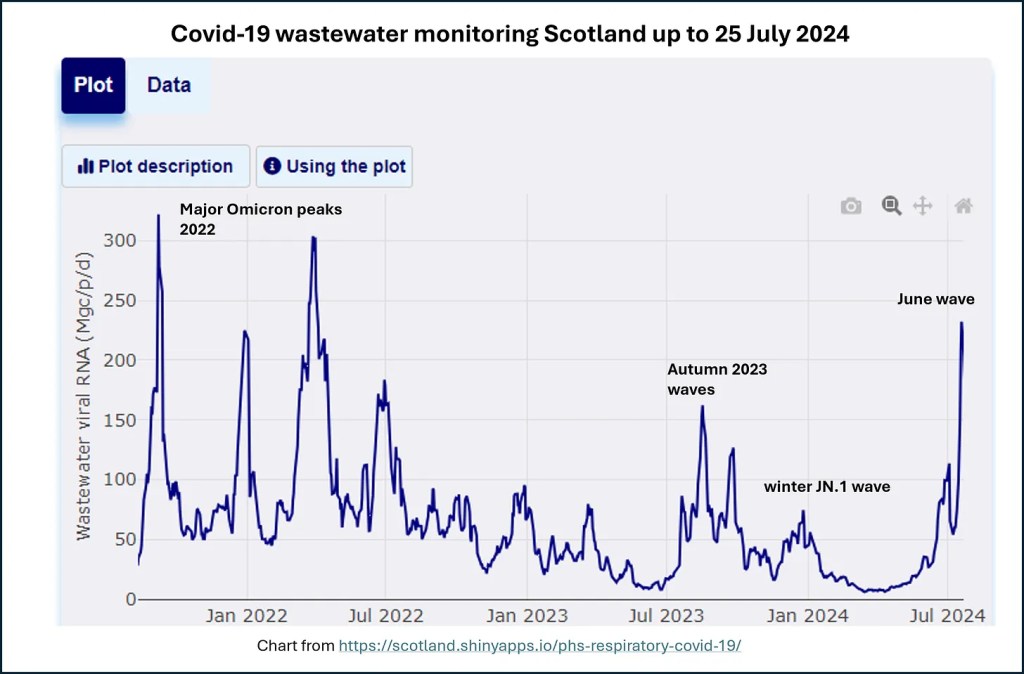
Meanwhile at the Paris Olympics increasing numbers of athletes have been testing positive for Covid, including swimmer Adam Peaty who probably failed to win a gold medal as a result, and German decathlon medal hopefulManuel Eitel who was forced to pull out altogether. Commenting on social media he said:
-“Today is one of the worst days of my life. What I’m feeling right now is beyond any defeat I’ve ever experienced…I no longer understand the world.”
Many teams have subsequently introduced measures to try to contain the spread of Covid including team GB but to seasoned commentators like me it feels like shutting the stable door after the horses have bolted. Why team doctors did not see this coming is beyond me I am afraid.
In the US there is a very significant summer wave as discussed by Eric Topal.
Update 9 August
The latest data for the UK shows some signs that the current wave may be coming to an end, although the lack of data and lack in consistency of trends across different parts of the country mean this is far from certain.
However, we are not necessarily out of the woods. In the US an even more transmissible variant – the KP3.1.1 is sweeping the country.
The Paris Olympics is still underway involving thousands of athletes gathering together in front of huge crowds. Some of the more clued up countries took action to protect their athletes and travelling staff. For example the Belgium team are required to wear a mask when outside their bubble. And mask wearing has subsequently been extended to many other teams. A likely 100’s of athletes has been infected with Covid-19 with the Australian team reporting as many as 40 due to them having access to a portable PCR testing machine.
Several athletes have sparked controversy by competing when they knew they had Covid-19 including Britains Adam Peaty who had to make do with a silver medal. As the games have progressed TV commentators have moved from a dismissive ‘it’s a sniffle’ stance championed by Clare Balding, to become somewhat more willing to discuss the health and ethical questions posed by athletes competing when ill with Covid-19. On 8 August for example, there was even discussion of whether Noah Lyles US sprinter should have been competing given the possibility that he would infect other athletes or damage his long term health.
Meanwhile, the Australians have discovered another new variant – the LB.1.
No one seemed to notice but earlier this week the World Health Organisation (WHO) issued another stark warning about the dangers of currently high rates of Covid-19, particularly in Europe and the dangers of letting Covid-19 rip through populations. WHO also issued a stark warning about the potential for Covid to mutate into a form that it is more dangerous and difficult to treat.
Update 24 August
The latest, abiet limited data, suggests the current wave in the UK is in decline. A blog by Bob Hawkins confirms that Covid rates appear to have declined in all regions.
This is in contrast to the USA, for example, which is seeing a big surge at present.
What Next?
This is probably a suitable point in time to bring this blog to an end. The weather is getting a bit chilly and the summer wave is on the wane. I will of course be reporting on developments as the Autumn progresses in subsequent blogs.
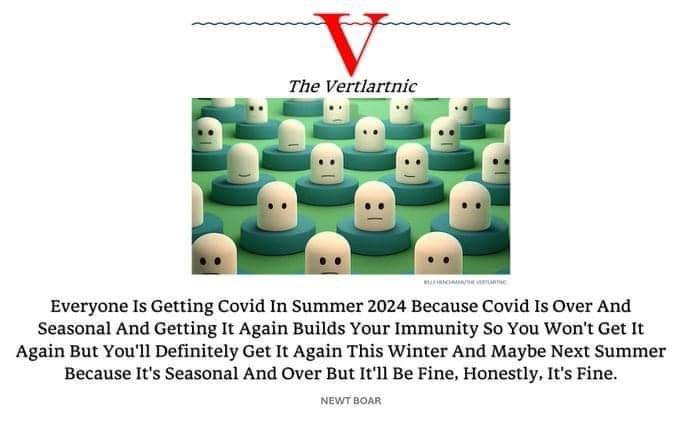
It is now surely clear beyond doubt that Covid-19 has not settled down into a predictable, stable and seasonal virus and many doubt it ever will. Indeed, many scientists think it is becoming less, not more stable and predictable. The KP.3 variant, for example, is as different from the original omicron variant as the omicron variant was from the original Wuhan variant. This is, of course, completely at odds with the picture presented by most of the UK media, particularly the BBC.
The UK is now at a significant disadvantage compared to some other developed nations as we have very little data available on the prevalence of Covid or early warning systems that would allow us to spot new variants of concern. The termination of wastewater testing and all surveys designed to monitor infection rates is a significant problem. This and household based data needs to be reinstated in order to underpin effective public health messaging, policies and to protect the NHS.
Moreover, even routine data on hospitalisations and infection rates in hospitals has been further curtailed.
In addition to better intelligence and data, the new incoming UK government needs, in my assessment, to urgently review policies that have restricted access to free Covid-19 vaccines to a very small group of older and sick people in sharp contrast to continuing policies in many other Western countries including the USA. This is despite the evidence that Covid-19 remains one of the key drivers of pressures on the NHS, including A and E departments. There is also mounting evidence on the economic damage being done by increasing number of middle aged – older age people withdrawing from the labour market due to ill health linked to waves of Covid-19 and the after effects on wider health and wellbeing. Please see my forthcoming blog on this issues.
The tragedy is that we know what needs to be done to control the spread of Covid-19 as will be evident from the blogs on this website. We need the new incoming government to start to work collaboratively with international bodies and other countries to tackle Covid-19 at the global level. And we need policies such as clean filtered air in indoor spaces – particularly in hospitals and schools, and a supportive attitude to the wearing of effective face masks where appropriate. Above all we need effective and accurate public health messaging.
To sum up:


 Living on Plague Island
Leave a reply to Lee McAulay Cancel reply