On 7 February it was announced that there would be a spring 2024 Covid-19 booster programme covering the same groups as were covered this time last year. However, the really alarming news came later in the release where it emerged that a smaller programme was likely from Autumn 2024. This has happened at the same time as plans are underway to offer vaccines privately from the spring.
Spring 2024 Booster programme
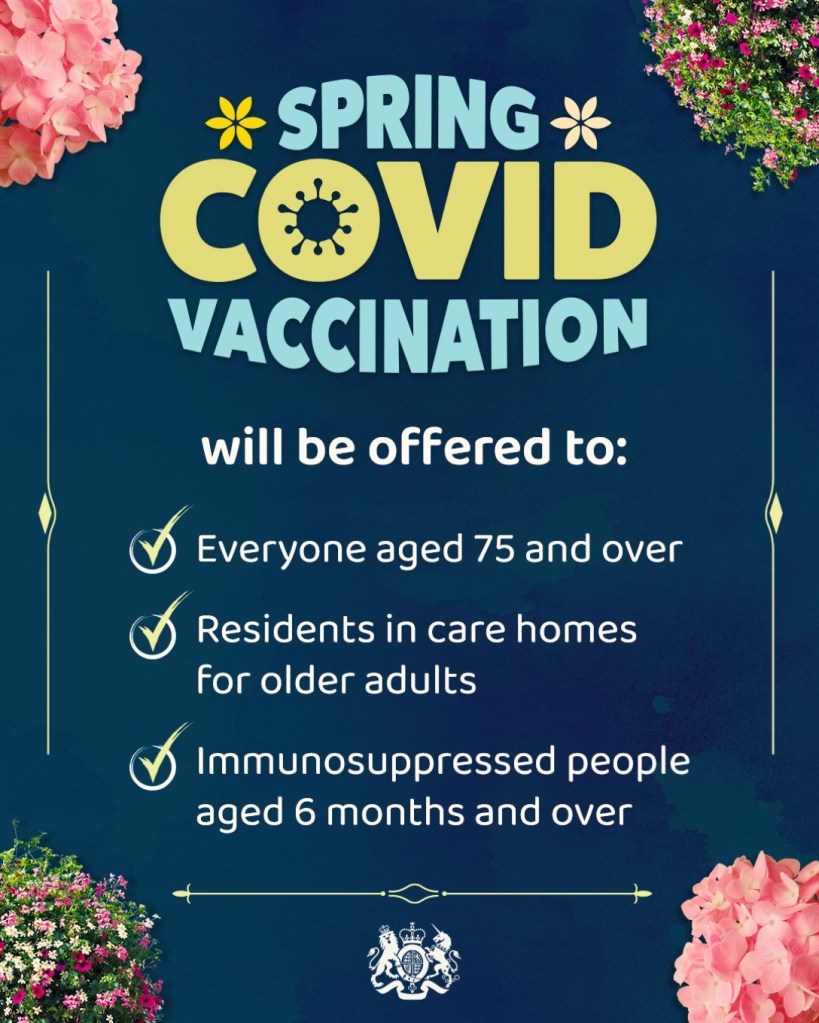
This programme will cover the same groups as the spring 2023 programme as outlined in the following diagram. Although I am not particularly happy about this, it is probably the best we could have hoped for in the circumstances.
Future Booster programmes
The really alarming news comes later in the document reprinted below. Namely that ‘cost effectiveness will become a major determining factor and based on the most recent cost-effectiveness assessment, it is anticipated that any autumn 2024 campaign would likely be smaller than previous autumn COVID-19 campaigns.’
To recap the Autumn 2023 campaign covered the following groups which in turn was considerably smaller than the Autumn 2022 campaign.
- Residents in care homes for older adults
- All adults aged 65 years and over
- People aged 6 months to 64 years in a clinical risk group, as defined in tables 3 and 4 of the Covid-19 chapter of the UKHSA Green Book on Immunisation
- frontline health and social care workers.
- People aged 12 to 64 years who are household contacts of people with immunosuppression, as defined in the UKHSA Green Book
- People aged 16 to 64 years who are carers, as defined in the UKHSA Green Book, and
- staff working in care homes for older adults
It is unclear what this means. It is hinted that it could exclude all NHS and care workers currently eligible for the Autumn boost along with household contacts of immunosuppressed individuals and carers. These are all very serious omissions because household contacts, carers and front line NHS staff could all pass on the virus to those they are caring for. There are also significant worries that it could go further and even restrict vaccines to those over 80 or even 90, the immunosuppressed and who knows what else.
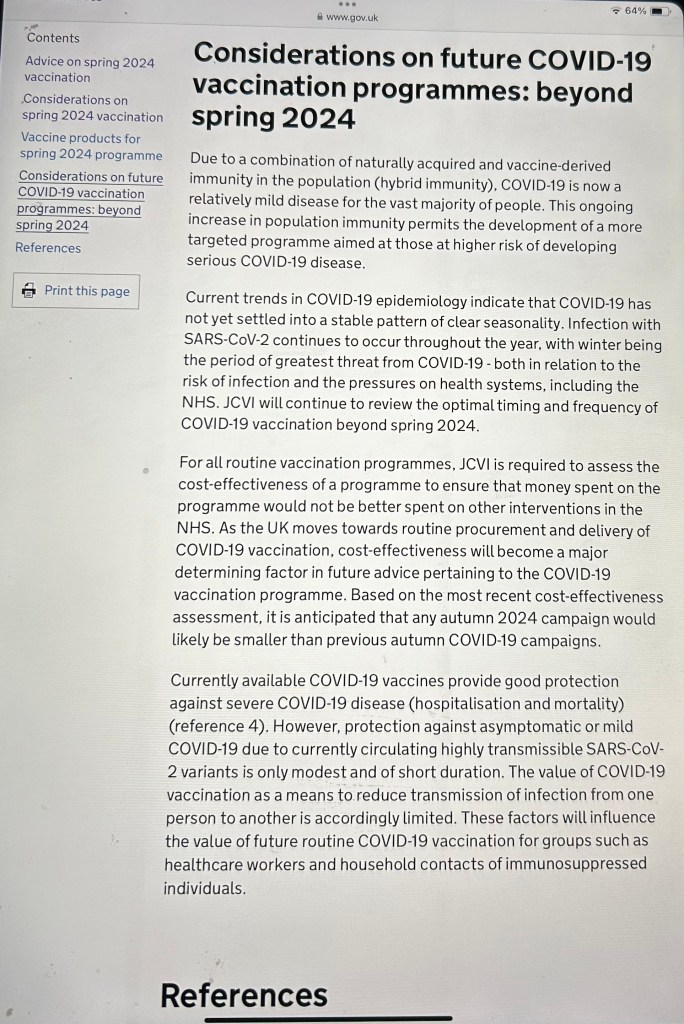
I have looked at all the annexes released yesterday and cannot find any updated cost – benefits assessments and assume they are using the same methodology as for last years Autumn programme, the details underpinning which were heavily redacted as explained in my blog Vaccinations against Covid-19: where did UK policy go wrong.
My key concerns are firstly, the complete lack of transparency behind the cost benefit calculations, secondly, the omission of any consideration of the bulk of Long Covid cases generated by allowing the virus to rip and the wider implications for society, the NHS and the economy and thirdly, the impact of further fuelling the spread of infections on the health, safety, wellbeing of clinically vulnerable people and their families.
I have sent a letter to Jenny Harries head of UKHSA the body which is responsible for the JCVI cover the first two of these points. This is self explanatory.
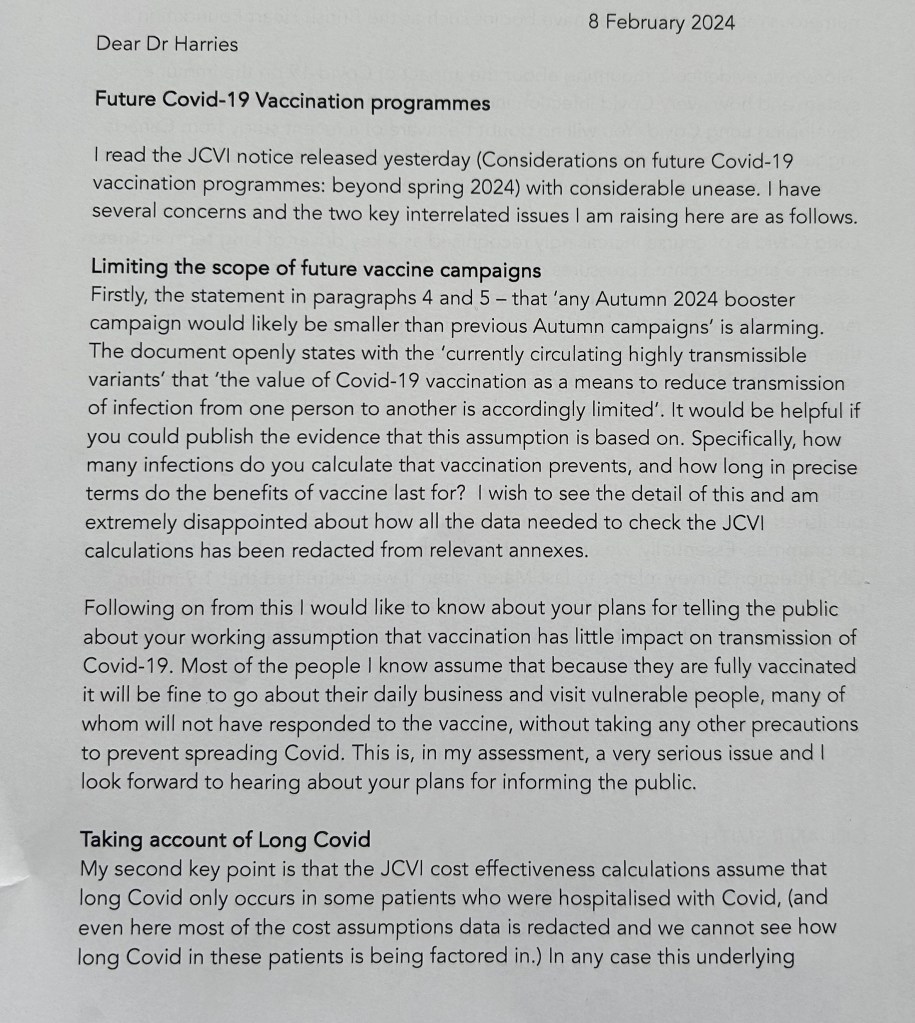
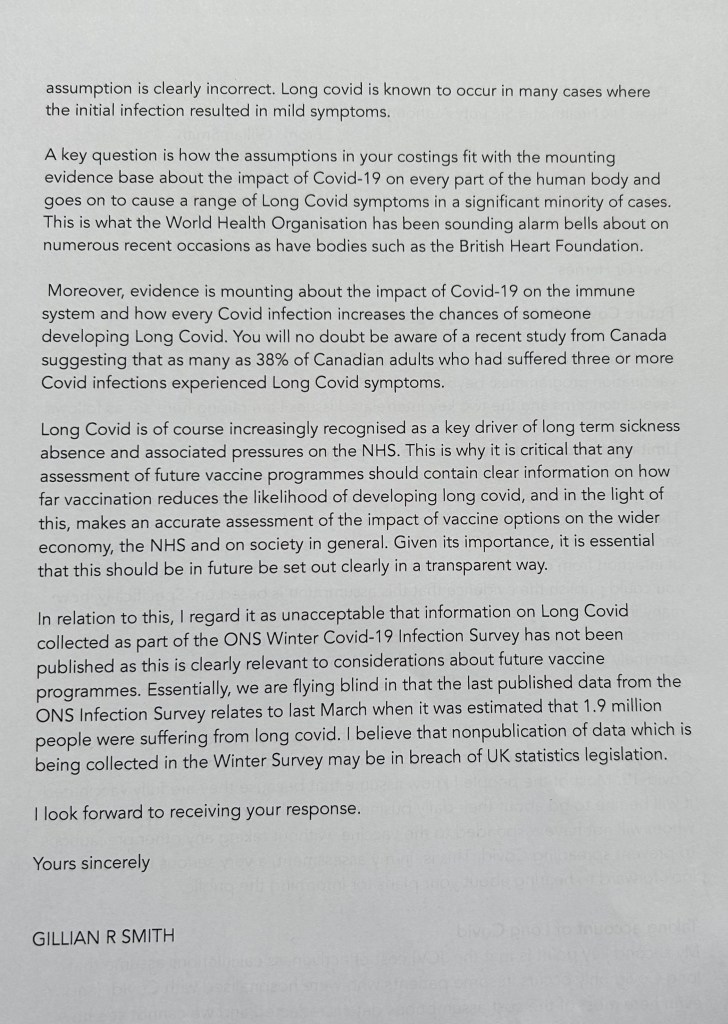
I am of course fully aware that the vaccine does not offer anything like 100% protection against catching the virus or developing Long Covid which is why I have repeatedly said that a vaccine only strategy on its own is likely to be ineffective.
However, surely it is worth having the vaccine if it reduces the chance of infection by a given percentage; and also reduces the chance of developing Long Covid in those that develop the virus?
I will post a reply if and when I receive one and also update this post with news on on-going developments in terms of emerging policies and news on the price and roll out of private vaccines in my blog Vaccination against Covid – April 2024 update .

 Living on Plague Island
Leave a comment