The module eight hearings ended recently after a busy schedule including an appearance by the former PM Boris Johnson appearing for the first time since Autumn 2023. This short blog outlines selected highlights from the hearings, focusing in the main on the interests of the core participant group, Clinically Vulnerable Families. The following video montage produced by Lara, head of CVF captures the issues very well.
Binary Choices?
Media reports of the hearings were few and far between, and those outlets that did produce coverage focused on the misleading binary debate which is often presented in simple terms of how to balance killing large numbers of mainly older people versus damaging the educational progress and mental wellbeing of children and young people through lockdowns and school closures. The following quote from the evidence session with the Permanent Secretary at the Department of Education – Susan Acland-Hood illustrates this binary point very well:
‘There are some things where the impact ..is so great, that it genuinely should be weighted up against the risk of mass fatalities‘
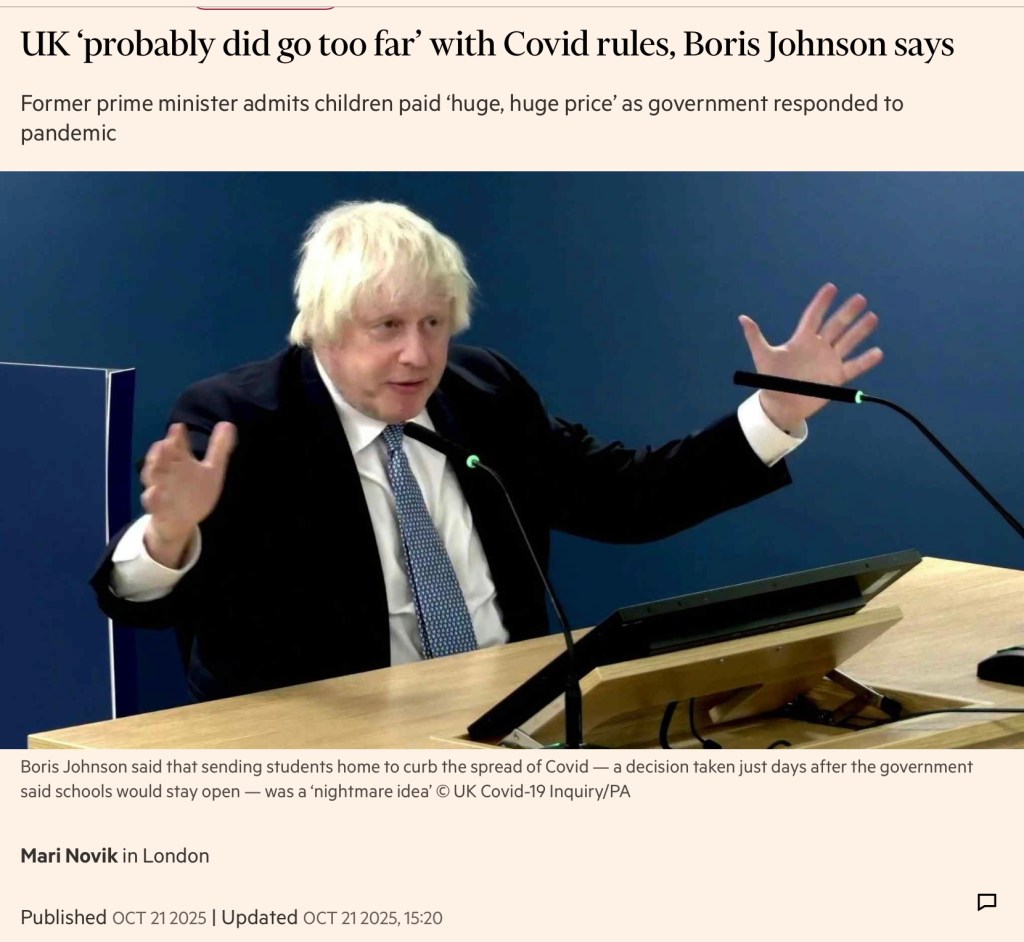
Several witnesses, including the former PM took a similar stance and attempted to rewrite history several times claiming that the rules went too far, at the same time as often avoiding questions posed to them about the realities of the situation at the time and their failure to act sooner. Nevertheless, the CVF lawyer did manage to get Boris Johnson to admit that in July 2020 things could not go back to normal for those children who were still shielding or those living in CV households. He was also questioned about whether children might take Covid back to their CV relatives, yet he blindly restated the mantra that children were better off in schools despite the known risk. See the following video clip of Johnson under questioning from the CVF KC Adam Wagner.
In reality the picture presented by many witnesses to the Inquiry was far more thoughtful and nuanced.
Children not harmed by the virus??
The Inquiry heard evidence clearly demonstrating how that narrative that children were not harmed by the virus itself to be a false, hence automatically undermining the binary choice narrative.
i. Core participant group Long Covid Kids and other witnesses described how the lives of significant numbers of children had been devastated by catching Covid-19 and by Long Covid. In response to questions, a number of witnesses once again attempted to rewrite history and claim they did not know that significantly numbers of children were suffering from LC at various points in 2020 and 2021.
ii. We know that at least 88 children died from Covid-19 in the UK. About 90% of these children had underlying health conditions and yet all of our sources of informal evidence suggests that the risks to CV children was diminished in the rush to get back to the old normal particularly in the context of severely delayed access to vaccines for this group. These CEV children were rarely supported by medics to continue to shield often resulting in pressure from schools to return to in person learning which was dangerous to them.
iii. Sir Hamid Patel, chair of the Star Academy group of schools said that about 20% of their pupils had lost a close family member to the virus. This well illustrates that the more people that are allowed to die in tragic circumstances, the greater the number of children and young people that will be left grieving and suffering. This will be especially acute where children perceive they had brought the virus home with them and passed it on and, for example, ‘killed mum’.
iv. And last but not least the founder of the Clinically Vulnerable Families group, Lara Wong, laid bare the damage done to clinically vulnerable children and children living in clinically vulnerable families particularly following the mantra that came into play in September 2020 that every child must be physically back in school – for a series of clips from the evidence see this twitter thread. The stress experienced by children and their families was often off the scale with examples of the bullying of children who continued to wear a mask, attempts, many of them successful, to illegally off-roll children from the school register, and the level of bullying and fines imposed on parents of clinically vulnerable children or children living in CV households who were kept at home in order to protect others. Numerous pretty horrific examples of this and the consequences can be found in Lara Wong’s written evidence report to the inquiry. The following video played to the Inquiry, of Seren whose sister is clinically vulnerable, well illustrates the problems and subsequent loss of educational opportunities faced by many children.
The Third Way – making schools safer and supporting continuing access to education and supporting families
As is evident from the discussion so far, the binary model of lockdown verses killing off lots of people is still stuck in the minds of the key players called to give evidence. Despite the passage of time it was evident from questioning that many of these people had never seriously stopped to consider their failure to plan for what was coming down the track, nor to develop an alternative way forward – namely how to make schools safer for everyone through measures including better ventilation. Moreover, few of the state witnesses seemed to have reflected on the wisdom of the ‘one size fits all’ mantra that all children must attend school in person regardless of the safety risks despite clear evidence of needs and priorities varying hugely between children depending on their circumstances. These two points should be central to the conclusions of the subsequent inquiry report on this module.
Turning to ventilation and other safety measures first. The potential of ventilation used in conjunction with other measures to reduce the spread of the airborne virus Covid-19 is not an idea that is new to the inquiry. Extensive evidence was presented to module 3 on healthcare on the failure to capture the potential of ventilation backed up by air cleaning devices throughout the emergency years of the pandemic and beyond to the current day. And the potential of better ventilation/air cleaning, has obvious benefits in educational settings for everyone, including teachers given that schools operating normally tend to be more overcrowded than many other settings. This is the reason why, following a trail, the Mayor of London, Sadiq Khan recently announced the roll out of air filters across hundreds of London schools.
In her evidence to the Inquiry Professor Cath Noakes was at pains to stress that many schools already had the means, including good ventilation to create safer environments and sometimes did implement these successfully. However, the slowness to recognize the importance of airborne transmission across governments and societies served to act as a break on the implementation measures to make schools safer. Lack of awareness amongst school leaders and teachers about on how to implement safer environments was also a barrier highlighted in Cath’s evidence.
Alongside better ventilation and other safety measures it is evident that the policy of trying to force all children back to school failed with very high consequences, including complete loss of educational opportunities being paid by students like Seren. Surely it would have been better to offer an alternative strategy including, for example provision of remote and on-line learning for CV children and those from CV families, perhaps including safe provision for them to attend school for practical subjects combined with opportunities for outside play. Yet even where they wanted to, schools, particularly those in England, were banned from doing this because of the ‘one size fits all’ mantra being dictated from on-high.
Concluding Comments
In his closing statement to this module of the Inquiry Adam Wagner KC on behalf of CVF made the following key points captured in this video.
- Safety – making schools safe through better ventilation is perhaps the most important recommendation that could come out of this module. Safer schools would considerably dampen the stark choices that many CV families had to face between keeping clinically vulnerable members safe and enabling children to attend school. Safer schools would be of benefit on an on-going basis, not just in addressing Covid risks but also in making schools safer to attend during the season of normal winter viruses such as influenza and protecting children with asthma. Improved cognitive performance is also a proven positive spin off from having clean air in schools.
- Support – CV families need support to enable children to continue to benefit from education. This requires a more flexible attitude than the ‘one size fits all mantra’ and includes things like hybrid and remote learning opportunities geared to the needs of the child and family.
- Status – CV families need status. Clinical vulnerability needs to be a recognised characteristic, and groups representing CV families need a voice at the table when policies are being decided. We also need data that measures the impacts of measures on us – clinical vulnerability needs to be a standard category used in collecting and analysing official and other data. In order to achieve this, clinical vulnerability needs to be a protected characteristic reflected in equalities legislation.
Finally it is important to highlight that this has been a brief canter through some of the key issues and I do not pretend to have captured the full detail of important evidence presented to the Inquiry. Further details can however be found in various clips on social media channels – particularly the CVF feeds on X (twitter) and BlueSky. See for example, key points set out in one of the many twitter threads.
Gillian R Smith
3 November 2025

 Living on Plague Island
Leave a comment