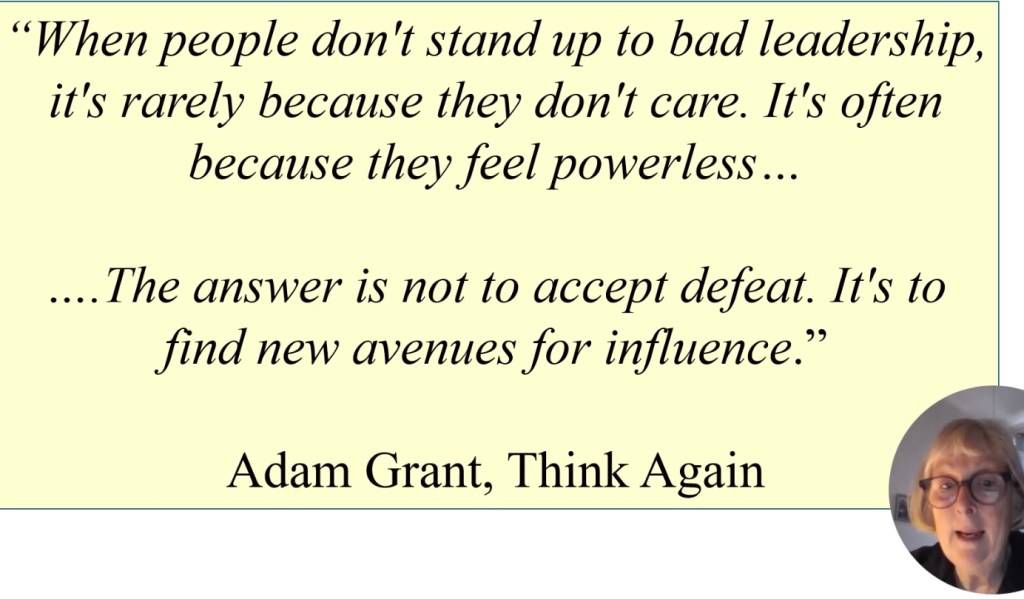
As we enter the second third of 2025 many people feel powerless to carry on the fight for policies such as clean air in healthcare against a backdrop of the world around us continuing to pretend to move on from the pandemic. Indeed it sometimes feels as though all our campaigning has been to no avail. This is particularly relevant this morning as many people are feeling flat and disappointed that a petition calling for new rules on air quality and infection control in health and social care settings failed to reach the 10,000 signatures required to necessitate a response from the government. We also received the news that a fellow campaigner – a transplant recipient, has contracted a respiratory infection whilst recovering from an operation in one of the country’s most famous hospitals. Also a letter I wrote to The Observer about an outrageous article in a previous edition was not acknowledged or published (letter reproduced below.)
The piece by Philip Collins ‘Signed off sick : The parts of Britain that are not working’ fails to mention the obvious ‘elephant in the room’, namely the on-going impacts of Covid infections on the health of the nation. It seems extraordinary to claim that the causes of the huge growth of long term sickness absence post 2019 are unclear, when the latest data from ONS suggests that Long Covid is a growing, not a diminishing problem, which is impacting hardest on the age groups and deprived areas mentioned in your article. The most recent data from the National Patient Survey suggests that as many as three million adults, or perhaps more, may be suffering from Long Covid and Cambridge Econometrics estimate that Long Covid is a significant drag on the economy costing billions of pounds per annum. Covid is far from from being a simple respiratory virus and there is a high degree of consensus that it can impact on all key organs in the body as summarised in a recent Delphi study involving well over 150 experts from 76 countries.
The fact is that the Covid pandemic continues to have a profound impact on the lives of millions of clinically vulnerable families who continue to be at higher risk, and on the millions of people living with Long Covid. Isn’t it time that well respected media outlets such as the Observer started to highlight the continuing damage being done rather than sweeping Covid under the carpet as an inconvenient truth that no one wants to hear about?
But there is now more reason than ever to carry on as the evidence base on the damage being done by Covid is growing by the day.
However, we need to recognise that we are not in 2020/21, and that multiple opportunities to develop a safer, inclusive, set of post emergency pandemic policies have been missed. We therefore need to learn from the last 3-4 years and in the words of Adam Grant: ‘find new avenues for influence’.
A presentation from IPC expert Evonne Curran and an excellent short thread on X tackle the issues very clearly. Evonne’s key overarching point is that we cannot achieve change in one step – there are a series of logical steps that need to be worked through if we are to achieve change.
So what are these stages? Evonne likens the current situation with Covid and the failure to introduce mitigations to pre seatbelt days and uses a range of historical lessons she sets out the steps to achieving change .
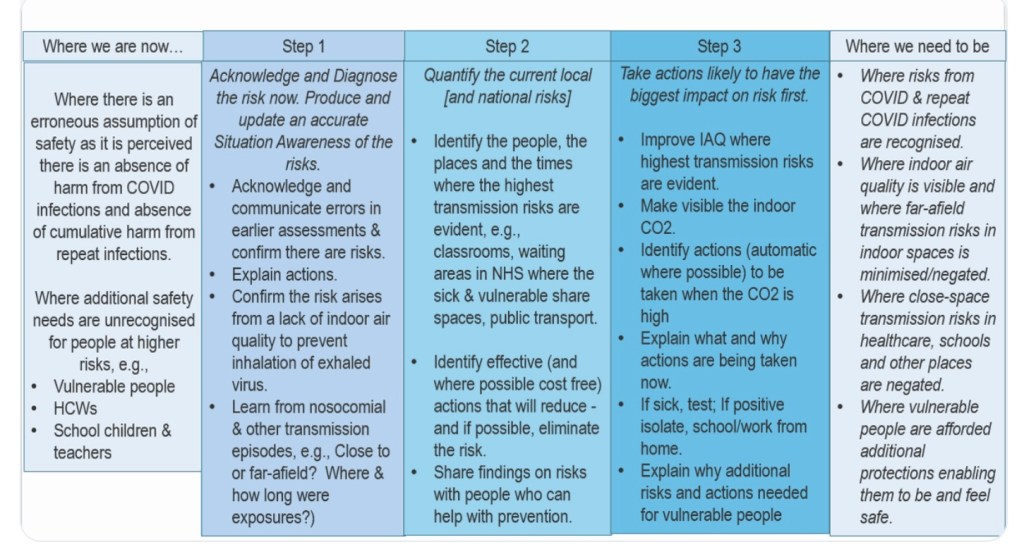
Evonne’s summary slide of where we are now is re-produced below. We will all recognise this as the survivor bias we encounter every day where people continue to spout the message that Covid is now like a cold and it is OK for everyone to keep getting infected and that mitigations in hospitals/ schools etc are unnecessary.
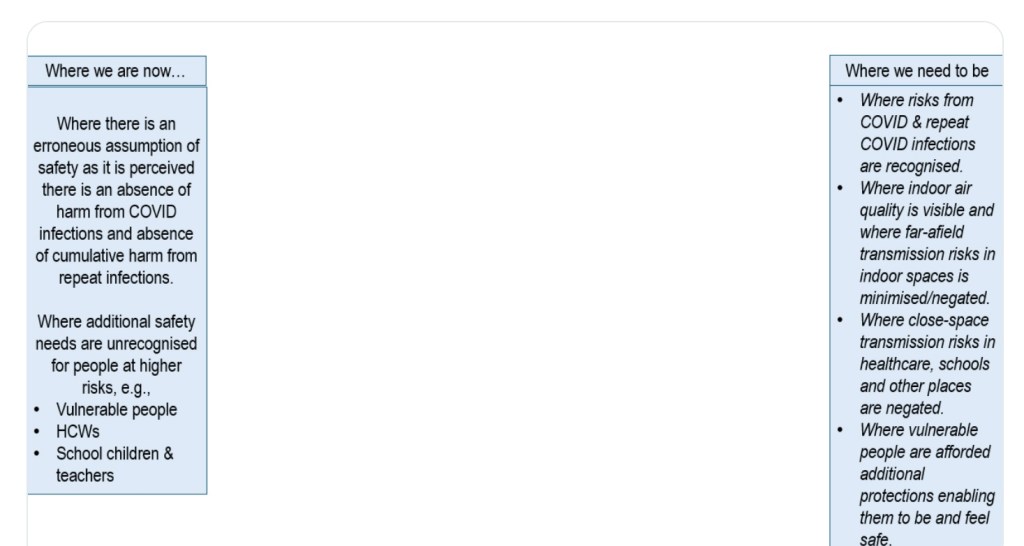
The column to the right – where we need to get to. Again, there is nothing new or surprising here and it is what groups such as CVF have been striving for, including a recognition of airborne transmission and implementation of measures such as ventilation and air filtration in healthcare settings, schools and other places etc and where the needs of clinically vulnerable people and their households are recognised and addressed .
The key is how to get from A to B.
Evonne’s steps to achieving change are :
1. Acknowledge and diagnose the risk now;
2. Quantify current local and national risks;
3. Take actions that would have biggest impact on risks first;
Taking each of these in turn:
Step 1 Acknowledge and diagnose the risk now
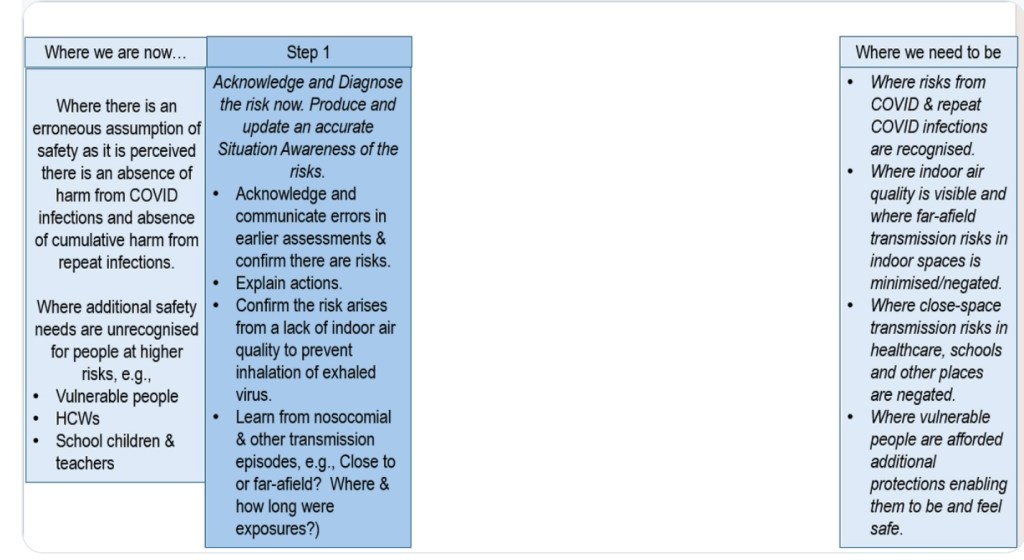
Actions here include being frank and upfront about the mistakes made from the start of the pandemic, particularly around how Covid transmits and the missed opportunities to improve indoor air quality. I would place explaining why measures to improve air quality centre stage in this step 1.
Step 2 Quantify current local and national risks
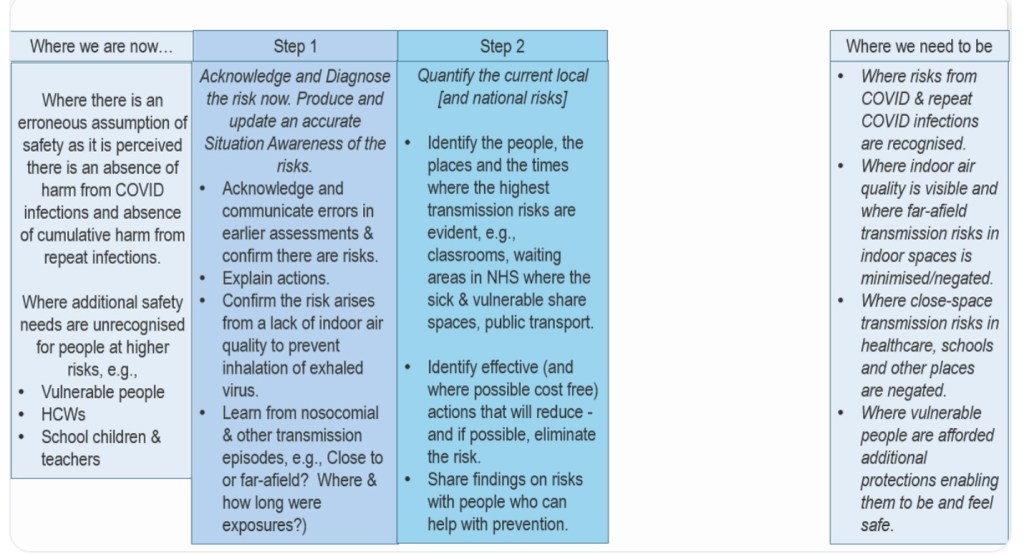
Actions under step 2 might include getting across where and when the risks are greater. I for one am constantly stunned at how little most people (outside the well informed Covid conscious communities) know about how to assess risks and reduce them at the same time as incurring little or no additional cost or reduction in enjoyment. This quantification is essential if we are to break through the ‘head in the sand’ attitudes of many of those blindly wanting to get back to exactly how things were in 2019.
Step 3 Take actions that would have biggest impact on risks first
As with any policy area it is important to have some early wins where impacts are visible for all to see and which act as a springboard to tackling more entrenched problems. This stage will require quite a bit of thinking through and prioritisation of actions at the national and local level as appropriate.
Concluding comments
I find this conceptual framework very helpful in thinking through the actions that need to be taken at national and local levels in what is a messy area of policy/practice that is full of contradictions. At the same time I am not suggesting that the steps should act as a straight jacket or serve to curtail campaigns that people wish to engage with. It is simply that reaching for a solution without working through why and how combined with effective targeting of actions may prove to be of limited value in some contexts.
Unless there is another emergency which hastens the need for action, we should have no illusions that it will be a hard slog and it is essential that groups campaigning for change work together as far as possible. My judgement is that step 1 is the toughest nut to crack given the culture wars that are in evidence around most discussions about the pandemic, along with a more general desire to bury the pandemic in the sand and forget about it.
We should not forget how important this is. Public hearings for module 7 of the Covid Inquiry started this morning and the following harrowing video from a lady whose mother spilt boiling water down herself and had to go into hospital well illustrates when the issues raised were important then in late 2020/early 21 as they continue to be today.
It is hoped that the Covid Inquiry, due to be published next year, will be helpful, but the crunch will come when the long push to implement the recommendations against the political backdrop/s in place at the time starts to happen. It is hoped that the report will be convincing and watertight about why any recommendations made are important and pass Evonne’s step 1 essentials as set out above. In the meantime we need to press on with actions and campaigns to bring about improvements at the local and national levels.
Gillian Smith
12 May 2025

 Living on Plague Island
Leave a comment