There is now a very extensive evidence based on how Covid Infections can impact on all organs of the body as discussed in my blog on the Tragedy of Long Covid. There is also little doubt in the minds of many scientists that this is what is driving a significant proportion of the increased demand for health services, including from younger age cohorts. Yet the UK government continues to bury its head in the sand about this, as do large sections of the media, and parts of the medical profession. And members of the public often seem happy to play Russian roulette with their health rather than push against a system that is antagonistic to them trying to protect themselves.
We have recently passed the third anniversary of the publication of the “Living with Covid Plan‘ but this has not worked. Action is now needed to raise awareness of the need for a renewed emphasis on protecting everyone, not just the clinically vulnerable, from the long term harmful impacts of Covid-19.
Impacts of Covid-19 on over 200 Organs
This morning ‘the Covid Cover-Up’ published a powerful video on the long term impacts of Covid-19 and the need for better protections.
The key message is that there is an extensive evidence base on the way in which Covid Infections damage the various organs in the body including the kidneys, liver, digestive system, pancreas and many more, as well as weakening the immune system more generally, and the CDC maintain a hub weblink here, which is still live (despite the Trump administration), bringing together nearly half a million pieces of research on the subject. However, those in power in the UK continue to ignore it.
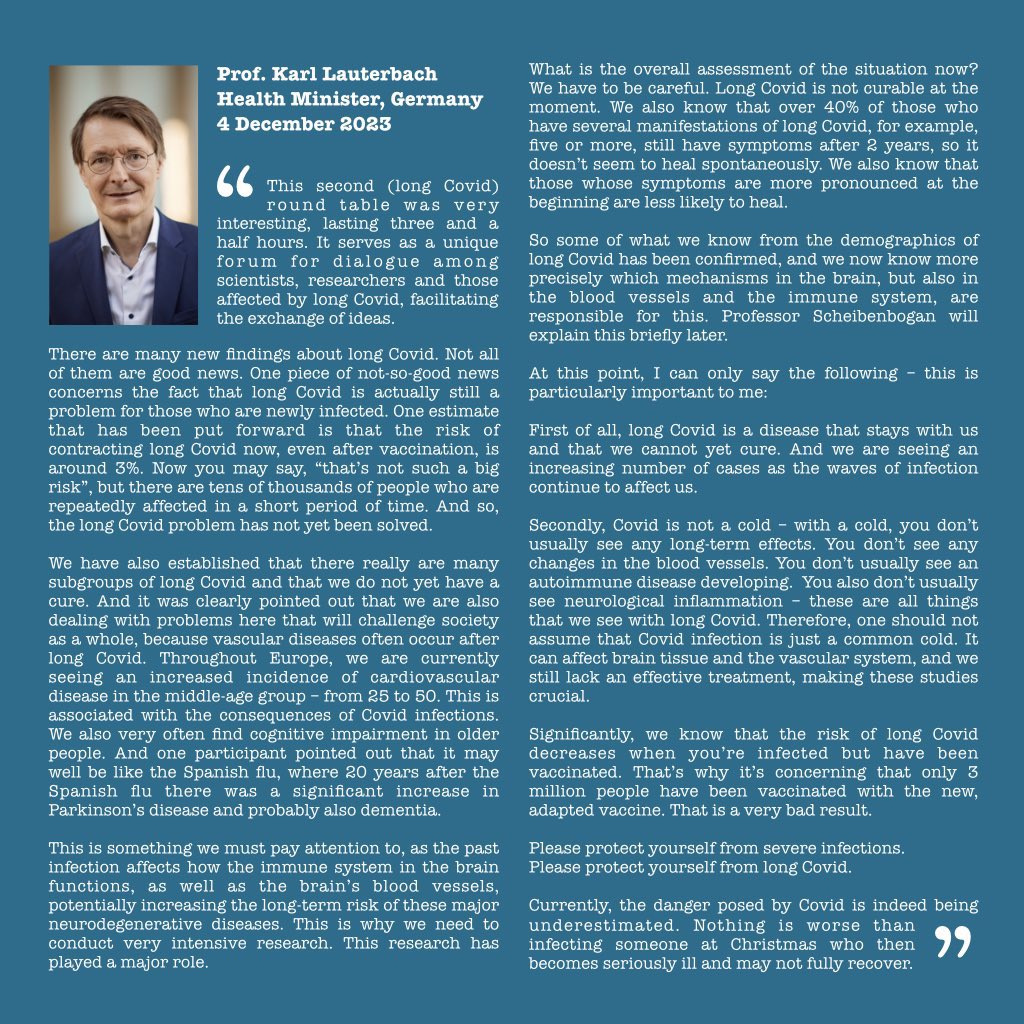
The most researched areas are the brain, the heart and lungs.
The Impacts of Covid-19 on the brain have been in evidence since the very start of the pandemic. The following video briefly explains the evidence.
The impacts on the heart have also been well understood and documented from the start.

The impact of Covid-19 on the lungs is heavily researched but until recently the impacts on children were less so. However, yesterday researchers published a piece on how an advanced type of MRI uncovered significant lung abnormalities in children and adolescents with long COVID.
The impacts of Covid-19 beyond the initial infection can be loosely described as long covid, though many sufferers will not recognise that this is at the root of their problems. And there is now extensive evidence to back up the earlier finding that the chances of developing long covid are greater the more Covid Infections a person has had – see my earlier piece on long covid.
Whilst some people may go on to recover from long covid we know from the ONS infections surveys and other sources that many more do not, and a recent study published in the Lancet highlighted the need for more research on this phenomenon.
How prevalent is Long Covid in the UK?
The UK based evidence that we have suggests that the incidence of long covid is growing, not declining. Data from the 2023/24 ONS Winter Covid-19 Infection Survey covering England and Scotland found an estimated 2 million people or 3.3% of the population reported self reported long covid. When one factors in broad estimates for Wales and Northern Ireland the figure is likely to be in the region of 2.3 million – roughly one in 30 people. This compares to an estimated 1 in 34 people reported in the ONS infection survey in March 2023. The 2024 publication also showed an almost doubling in the number of children suffering from Long Covid.
Whilst the initial survey will have been subject to all the usual problems of asking people to self define ‘long Covid’, including question marks over whether their problems were caused by Covid, thereafter this should not have impacted on the results because the survey was panel based ie. The same people were repeatedly asked the question along with other questions and a Covid test. Given this and the fact that it was a random probability survey it was probably the best method we will ever have of measuring changes in the prevalence of long covid over time. However, ONS took the extraordinary step of ceasing to collect data on Long Covid after the end of the 2023/24 Winter Infection Survey despite the fact that this showed prevalence to be growing, something that should be of concern to anyone working in the field.
The only information we currently have on current rates of long covid is a new question added to the annual NHS GP National Patients Survey (NPS). Please note the populations surveyed by ONS and NPS are different eg. NPS does not include people under 16 and the NPS is not a random probability survey. The key results from the 2024 survey are presented in this thread and have been further analysed by a group of academics writing in the Journal Health Expectations. The results suggest that 4.6% of the sample reported suffering from long covid which is higher than the percentages in the ONS survey. This might suggest a picture of long covid continuing to grow, but we don’t know for sure because the data are not comparable. However, what is particularly intriguing is the NPS survey also found that a further 9.4% of respondents were not sure whether they had Long Covid or not and analysis in Health Expectations suggests patients with no long term conditions were particularly likely to answer in this way rather than giving a firm yes. This is potentially fascinating and deserves further scrutiny. .
Who gets Long Covid?
Anyone can develop long covid but the following groups continue to be more at risk. ;
- people with a history of allergies,
- signs of autonomic nervous system dysfunction,
- pre-existing conditions including immune system issues,
- chronic infections,
- diabetes,
- being slightly overweight,
- Cardio-vascular condition
- A pre-existing history of anxiety or depression,
- joint hypermobility (being “double-jointed” with pain and other symptoms).
- Those who have had multiple infections.
The Response of the Media
As we have seen from various posts on this website this will all be having profound implications for the NHS and for the economy and wider society.
However, in common with most politicians the vast majority of the media are in complete denial about the problem/s. Even when hospitals appear to be over run with people suffering from infections, media outlets often try to bend over backwards not to mention the C word at the same time as being happy to talk about flu.
To take an example, the following article appeared in the i. newspaper last week.
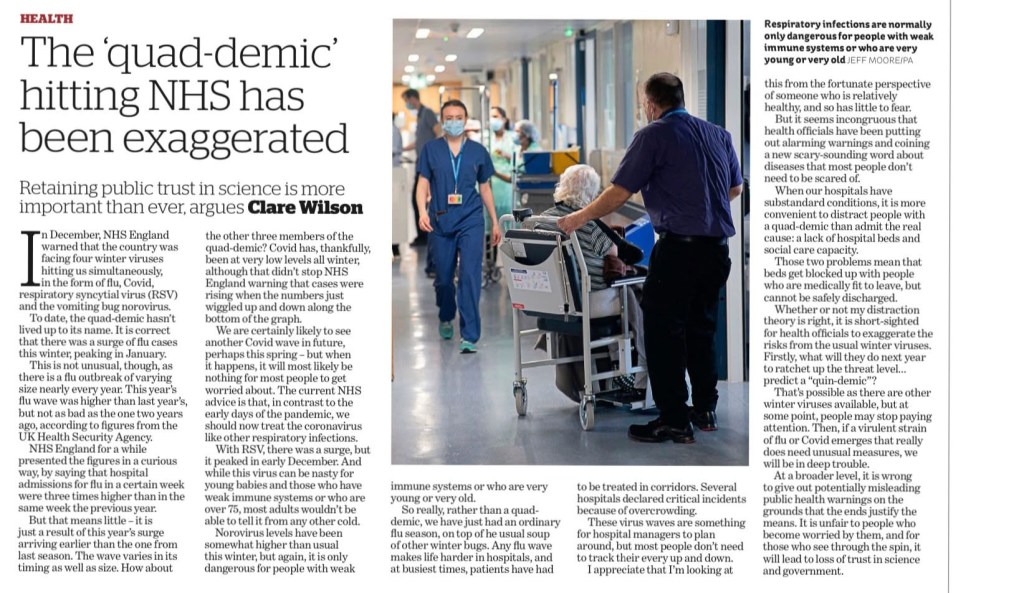
Along with many other people I am active in trying to rebut misinformation, but my response below was not even acknowledged let alone published.
“In her piece ‘The quad-demic hitting NHS has been exaggerated’ Clare Wilson acknowledges that we will probably see another Covid wave, possibly in the spring, but she goes on to say it’s nothing for most people to get worried about and we should now treat it like other respiratory infections.
What she does not say is that the groups listed as at risk – including those with weak immune systems, older people and young babies – actually make up a big ,and growing percentage of the population. They should not be brushed off so lightly and if they catch Covid it will place even more strain on the NHS.
She also fails to mention that Covid can impact on over 200 organs in the body, including the heart and brain, this can hit anyone, and the latest data on Long Covid shows a growing – not falling – percentage of the population suffering which will inevitably have knock on consequences for the economy as well as for the NHS.
It is even more difficult to understand her flippant remarks given that it is relatively easy to reduce the spread of infections through cleaning the air and by wearing good quality masks where appropriate. ” GS
And whenever issues such as pressures on the NHS, high levels of withdrawal from the labour market, high sickness absence, poor school attendance etc come up in the media it is common to blame anything other than the lingering impacts of Covid infections. Sometimes they reach for plausible partial explanations such as the ageing population or NHS waiting lists, but at the same time increasingly bizarre explanations are becoming more common.
Earlier this month Sky News surpassed itself by running a piece that appeared to blame increasing anxiety post Covid – see the following clip.
This is a careless comment particularly as this is a respected national news channel. We know that there is an increasing mental health crisis which is being driven by a range of factors, but what this doctor appears to be saying is that people are more anxious ‘post covid’ and goes on to imply that they are wasting the time of doctors and driving the record growth in appointments post 2020.
I have listened to the full interview and the discussion with the other doctor on screen, and I confirm there is not a single mention of Long Covid or illnesses caused by Covid. Yet this is an obvious question to ask given we are still in the non emergency phase of the biggest pandemic for over one hundred years, and we knew long ago that SARs 1 in the far East led to a significant proportion of patients going on to suffer long term conditions, including brain damage. There is also no mention of the evidence on the impact of Covid on the brain (see above) which could be driving any apparent anxiety observed.
Unfortunately this is typical of the ‘lets airbrush out Covid stance’ taken across much of the media.
Those familiar with the issues will know that the BBC are foremost amongst the news organisations that regularly try to mislead the public about the long term effects of Covid-19. Readers may therefore be surprised to learn that the BBC recently installed upgraded air purifiers in its offices and studios – the kind of air filters that would make a huge difference to Infection, Prevention and Control in our hospitals.

Bringing about Change
Clearly we need to continue to pick up the media and others when they make mistakes, even though it often feels like banging ones head against a brick wall!
And scientists and others need to find more innovative ways of getting across their findings. In doing this it is of course important to be professional and explain the limitations of any evidence presented. But this goes to the crux of the issue – our ‘enemies’ don’t care about the robustness of what they are saying and therefore get away with putting out completely false clear messaging on the dangers of vaccines etc.
We do have good scientists who communicate well, but we need to work at this. The problem is no one in the media is interested and I fear it will take another crisis – possibly a new dangerous variant or disease, to open up the opportunity to get the messages across. If this happens we need to use the opportunity well.
The Clinically Vulnerable Families Community also needs to bat on to highlight the problems we face. On this third anniversary of the publication of the Living with Covid Plan which lifted all ‘restrictions Lara Wong from CVF produced the following thread . The key points are:
- when the government scrapped all ‘protections’ life became harder for clinically vulnerable people and their families.
- Covid was treated as a personal problem – not a public health issue.
- By deciding not to buy evusheld they abandoned us and antivirals are often difficult to access and mired in bureaucracy.
- Air Quality was suddenly no longer a priority for businesses, schools and hospitals.
- Three years on sickness absences have increased and clinically vulnerable people remain disproportionately impacted by severe disease and death.
- It didn’t need to be this way – we could have invested in ventilation, supported mask wearers and made public spaces safe.
- When will we finally recognise that protecting the most vulnerable by providing clean air not only creates a more inclusive society but also benefits everyone.
Part of the strategy for bringing about change is to continue to influence the work of the UK Covid Inquiry.
Next week the Inquiry hearings resume with module 5 on Procurement. This will be followed by module 7 on test and trace and module 6 on the care sector. CVF will be core participants in module 8 – Children and Young People and were last week confirmed as a core participant in the final module – Module 10 – The Impacts on Society. Here is a thread on the CVF legal teams final submission setting out the case for CVF involvement in module 10.
The following clip is particularly helpful in stressing the point that we need to learn the lessons of the last three years drawing on the seatbelt analogy which stresses normalising measures -and not presenting them as ‘restrictions’ – in order to keep everyone safe.
Gillian Smith
26 February 2025

 Living on Plague Island
Leave a comment