Despite the fact that we are in the second half of February, the entire healthcare system remains under significant pressure. This is being driven by a range of factors, but part of it is due to the numbers of people needing urgent medical help for flu, RSV and Covid-19; and there is growing evidence that many of these infections are acquired in healthcare settings when people attend with other illnesses.
We know that it is possible to reduce the prevalence of infections within the community and in medical settings by adopting relatively simple, non restrictive measures, yet most people do not know this. Neither do some medical professionals, senior advisors and politicians. Moreover, even when they are aware, there is often a great deal of resistance to doing something. And even when patients take steps to protect themselves when attending healthcare – through the use of portable HEPA filters, for example, they sometimes meet with resistance.
This short blog discusses some of the issues and offers advice on countering resistance to you taking steps to protect yourself whilst in hospital or attending healthcare.
What are HEPA filters?
HEPA filters are “high-efficiency particulate air” (filters) discussed in my blog on How to Avoid Catching Covid.HEPA filters are explained in this short summary from SmartAir
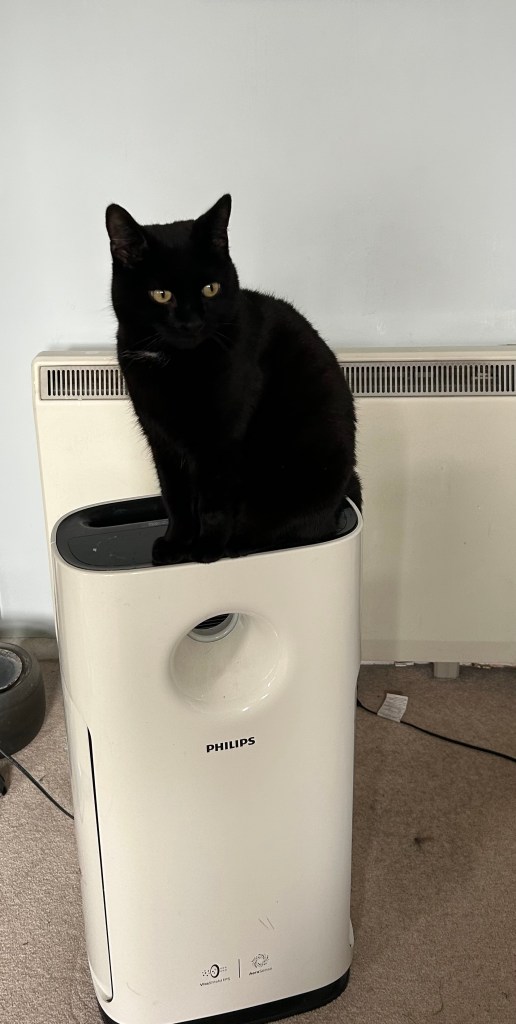
They are usually plug in devices that can be moved about, and there are a range of different models on the market designed for home and commercial use. We have two mid range Philips machines (see photo) that can clean a large room, whilst devices capable of cleaning far larger areas including clinical areas, include the Smart Air Blast.
Effectiveness
Many of us have been aware of the potential of HEPAs since well before the start of the pandemic. However, the first strong UK based evidence to emerge about their potential to reduce the spread of Covid-19 in hospital settings came from the Addenbrooks trial in 2021 when a team of doctors, scientists and engineers placed an air filtration machine in COVID-19 wards, they found that it removed almost all traces of airborne SARS-CoV-2.
NHS guidance acknowledges the importance of movable or semi movable HEPAs (eg those mounted to a wall) in improving ventilation and safety in healthcare settings with poor ventilation. See the following clip from the guidance.
“It is therefore important to bring these facilities up to the minimum specification of current standards, particularly recognising the challenges of COVID-19 and other infections.
Local HEPA filter-based air cleaners (also know as air scrubbers) are one option for improving and supplementing ventilation. The installation of a high efficiency particulate air (HEPA) filter air cleaner can reduce the risk of airborne transmission.“
Barriers
Yet HEPA filters have not been deployed across the NHS. A large part of the reason for this comes back to that old chestnut of whether Covid-19 is airborne or spreads via droplets that fall to the ground. It is argued that HEPAs are designed to deal with airborne particles and it seems that part of the resistance to their use comes from people who cling to the idea that Covid spreads primarily via droplets (incidentally HEPAs can deal with droplets as well and they can also deal with flu).
A wider explanation is, of course, that despite the evidence people want to believe that Covid-19 is no longer a problem – and as with masks, they see HEPAs as a reminder of traumas encountered during the height of the pandemic.
Covid Inquiry
In September 2024 Professor Clive Beggs told the Covid Inquiry that deploying HEPA filters represented the ‘ low hanging fruit’ for tackling infection rates in hospitals. And CVF Head, Lara Wong explained the benefits in an article published at the same time. Yet despite this, Module 3 heard numerous witnesses talking at length about the difficulties of implementing better ventilation in hospitals whilst ignoring the, at least partial solution, that was staring them in the face.
Then on 11 November 2024 one of the Clinically Vulnerable Families legal team asked Amanda Pritchard, head of NHS England, about the potential of HEPA filters. If one listens to the video clip below it seems fairly clear that she does not know what they are and does not mention the NHS guidance – see above – on the subject – see video below.
We are not aware of any response providing the promised detail being received by the Inquiry despite it being over three months since it was promised by a witness under oath.
Individual Initiatives for Protecting ourselves in healthcare settings
In the absence of action by the NHS many of us attempt to take steps to protect ourselves whilst attending healthcare settings. The most common protection deployed is to wear a good quality mask, but this is not always possible depending on your treatment.
Some people attempt to take full sized plug in devices into hospitals in wheelie suitcases. However, if you are planning on doing this it is important to be up front with the hospital or clinic about it and arrange for your device to be tested for electrical safety. Some hospitals will do this but others have been known to refuse. Whatever you do it is important not to take matters into your own hands and to stick a fake electrically checked label on your device!
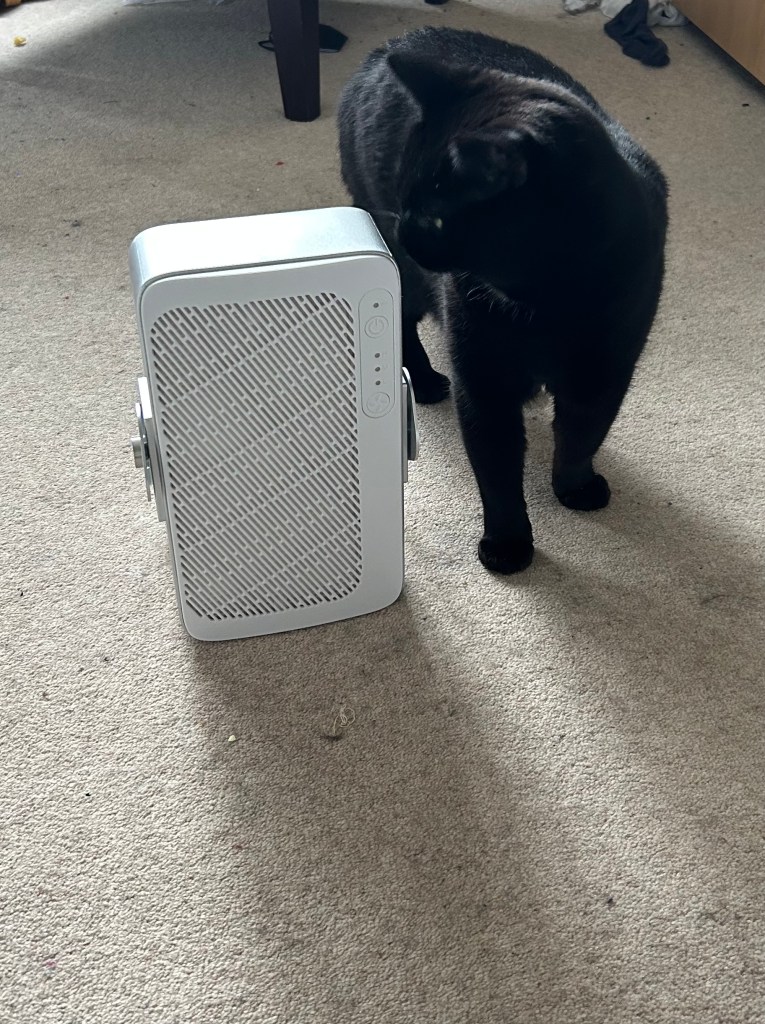
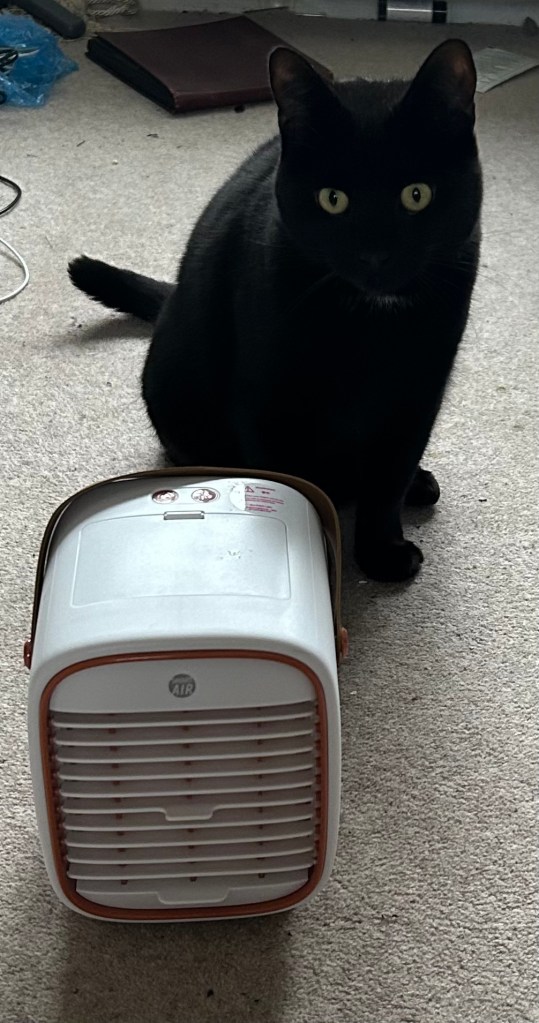
The other more common strategy is to take a small fully portable device with you. We now have two of these devices – see photos below – the Air Fanta 4light (left) and the Smart Air QT3. The advantage is their portability and the fact that they can be charged up using a small power bank rather than plugging into the hospital electricity supply.
Whilst my household has never had any problems in taking portables into medical and other settings I am aware of a number of people who have encountered problems with NHS staff. In particular, I am aware of the following lines of resistance:
Resistance 1 misunderstanding about HEPA filters and in particular the fact that they clean the air as opposed to blowing dirty air around like fans (this is why fans are often banned in healthcare).
Counter by showing staff the manufacturers description of your device and what it does, as well as the NHS guidance referenced above. If you can’t convince local ward based staff escalate to the ward sister, matron or to the hospital Director of Infection Prevention and Control.
Resistance 2: small portable HEPAs do not clean the entire area – only a small space around a person.
Counter say you are aware of this which is why you or the person you are advocating for stay close to it. And/or ask – can you provide me with a full sized HEPA or allow me to arrange for my own full sized HEPA to be brought in? Again escalate as necessary and back up your concerns by using evidence from a small CO2 monitor if you have one – see my blog on How to Avoid Catching Covid for information on these.
Resistance 3 Staff raise concerns about the fire safety of your device (this seems illogical because if you are using a well recognised brand, especially as hospitals allow all types of phone and iPad chargers in without checking- including fast chargers that are known to be a fire hazard)
Counter ask whether they can arrange for it to be tested or point out that you are running it on a number of power packs which are being recharged outside the hospital – ie your device is not being plugged into the hospital electrical sockets.
Resistance 4 – irrational objections to your device (probably being driven by the objectors own desire to ignore Covid -19)
Counter keep calm and respond to irrational arguments with rational facts and arguments, refer them to relevant guidance above and if you have approval from the hospital authorities show it to them.
I hope that you do not encounter difficulties of this nature in trying to protect yourself in healthcare settings, but if you do I hope that the above is of some help. However, please don’t expect to achieve a 100% success rate as some staff can be very determined. It is up to you to decide how hard to push depending on your assessment of the relative safety levels in any particular setting – see reference to CO2 monitors above.
Concluding Comments
This has been a short attempt to summarise the benefits of HEPA filters, the misunderstandings, ignorance of and barriers around their use. This is despite the fact that deploying them across the NHS, particularly where ventilation is poor, could save many lives. It is true that this will incur costs, but compared with other running costs HEPA’s are relatively inexpensive and their deployment could yield tangible cost savings from reducing staff absences and preventing nosocomial infections acquired in healthcare settings which will almost invariably lead to longer hospital stays.
However, before this happens staff on the front line need to be convinced of their safety and value and this would require an initiative to educate staff about HEPA’s. This needs to be backed by and driven forward from the top and we await a response from Amanda Pritchard on the CVF question on HEPA’s with interest.
Gillian Smith
15 February 2025

 Living on Plague Island
Leave a comment