
The approach of the five year anniversary of the start of the Covid-19 pandemic provides an opportunity to reflect on the previous year and look forward to the new. In my blog post Happy 2024 I called for far more proactive public health communication about the dangers posed by Covid-19 and better preparedness for the future. But has any progress been achieved over the last 12 months?
The UK
The UK has continued to be hit by a series of waves of Covid-19 infections all year round as illustrated in the following graph.
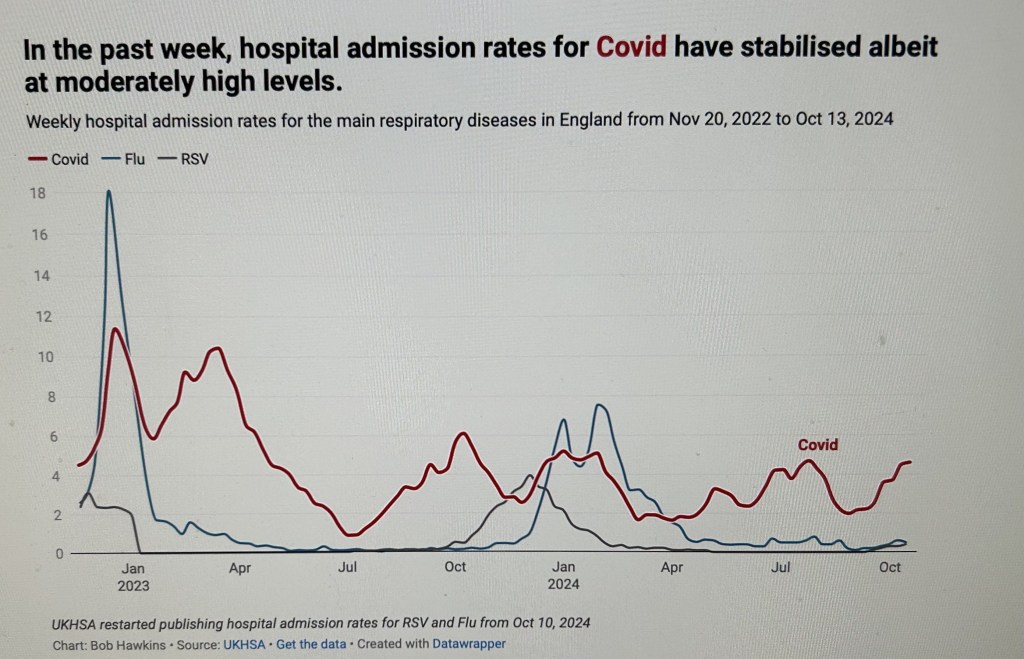
Lack of data and lack of testing in hospitals and in the community is becoming an increasing problem, but it is probably true that the UK is enjoying a slight lull in Covid infections at present as the number of people with influenza surges. However, at the same time the USA is experiencing the start of a potentially big surge in levels of Covid-19 so who knows what is coming our way soon.
On a positive note, the UK general election resulted in the resounding defeat of the previous conservative administration that had been responsible for the very high Covid-19 related death toll, the longest period spent in lockdown in the world, and a health service which has not recovered and lags behind comparable western countries. The publication of the report of Module 2 of the Covid Inquiry on Core Decision Making and Political Governance may be imminent, and this is expected to shine a light on the political failures during the first two years of the pandemic including the failure to lockdown earlier in March 2020 – which was the subject of a blog post I published earlier in the year.
Many people, including myself, are very disappointed in the lack of immediate action from the new government, whilst acknowledging the scale of the economic and other challenges they faced upon taking the reins of power.
In my assessment action to reduce the spread of and severity of year round Covid infections is essential if the government is to stand any chance at all of achieving a visibly different standard of healthcare in the UK, including faster access to GP appointments, shorter waiting lists and A and E departments that do not resemble war zones. We cannot deliver any of this if , on top of everything else, the system is clogged up with people suffering from Covid-19, high levels of staff absence, delayed discharge from hospital due to patients becoming infected whilst in hospital, high rates of long covid, and long term conditions caused by Covid-19 which may not always be acknowledged as Covid related.
Indeed on 29 December 2024 , no doubt unimpeded by usual editors who were on holiday, Sky News ran a long piece with a former NHS trust executive Roy Lilley. In the following short clip Roy highlights the problems with current messaging and policies.
I tried to raise some of these issues directly with Secretary of State for Health, Wes Streeting, at a presentation for Labour Party members held on zoom just before Christmas. Alas I was not successful in getting my question asked – but here it is:
“Infection rates from Covid 19, flu etc are high and are a key driver of the winter crisis. This is preventable in the short term, as well as long term, through revamped infection control procedures in hospitals, medical settings and public buildings – we need clean air via HEPA filters, good quality masks now and the government needs to tell the public how to protect themselves. We can do this, but by accepting advice from the UKHSA, and others you are failing to learn the lessons of the last 5 years so admirable illuminated by most witnesses who appeared before the Covid inquiry this Autumn. I urge you to watch the hearings this Christmas and implement the lessons without delay?“
The failure to replace some of the key figures who have been responsible for the very poor advice given to Ministers and the public over the last few years is, in my assessment, a key error by the new government. And the very recent appointment of Sir Chris Wormald as Cabinet Secretary and Head of the Civil Service is worrying. Sir Chris was of course Permanent Secretary at the Department for Health and Social Care throughout the height of the pandemic and recently put in a really bad performance at the Covid Inquiry. However, the press have tended to present his selection as ‘a safe pair of hands’ which is ironic really when one considers the UK’s appalling record in handling the pandemic.
On a positive note, it is early days. In particular, the new government is talking proactively about the importance of preventative measures in general . Module 3 of the Covid-19 inquiry on healthcare shone a light on the need for radical change in the underpinning assumptions behind Infection Prevention and Control (IPC) policies, which if implemented, would have ramifications way beyond healthcare settings. A letter from a number of core participants to the inquiry dated 20 December 2024 requests that the chair issues early interim recommendations on the need to change the IPC guidance – see the end of my recent blog post.
The USA
It is difficult to find anything positive to say about developments in the USA at present. The election of Donald Trump has brought a blizzard of bizarre nominee appointments to key positions of power, not least the appointment of vaccine sceptic Robert F Kennedy Jr as Health and Human Service Secretary. This is a potential disaster for public health in the US as pointed out in a recent letter signed by 77 Nobel Prize winners and by other commentators.
Apart from the obvious implications for rates of infection in the US there are a number of wider ramifications on a global scale. These include the consequential impacts on the likelihood of the US co-operating with world wide initiatives from bodies such as the World Health Organisation to protect the health of people from new emerging health threats.
There are also implications for the pharmaceutical industry as US companies make up a considerable portion of the world’s largest pharmaceutical companies, and the US has been a leader in pharmaceutical innovation. Any disruption of the largest market in the world, and reduced demand within the USA, would probably have implications for work to develop new and better vaccines and treatments against Covid-19, though companies based in India and the far East may continue to make gains.
Policies and treaties to address the global threat of man made climate change are also likely to be undermined by the President elect’s appointees. This potentially makes the world a more dangerous place as many scientists believe that climate change increases the likelihood of another global pandemic in the short to medium term.
We will no doubt be returning to the issues posed by the new US administration once they take over in the third week of January 2025!
New Threats
Regular readers will be familiar with the reasons why Covid-19 could evolve into something even more serious so I won’t repeat the points here, except to say that continuing to allow people to become infected multiple times with so called ‘mild’ infections is in the view of many scientists very dangerous indeed. It is well worth reading this recent interview with respected expert Dr Arijit Chakravarty who explains very clearly what is wrong with the assumptions behind current policies in place across much of the world. The Pandemic Accountability Index also does an excellent job in compiling the mounting evidence on the dangers and their latest update provides a clip from the Head of WHO which makes it very clear that we cannot talk about the Covid pandemic in the past tense. Lit Covid also provides a very extensive compendium of sources.
Bird Flu
The key threat that is talked about the most as the year grows to a close is bird flu i.e.H5N1. This intensity of commentary is particularly true of scientific journals and media in the USA. Much of this commentary is critical of how the Biden Administration has allowed a dangerous pathogen that originated in wild birds to spread across dairy cattle herds in the US. In a recent development reported in the Guardian website edition on Boxing Day, the US has reported its first serious human infection arising from rare mutations of the virus which Newsweek also reported. Also on 27 December the CDC’s wastewater program detected H5 bird flu in wastewater samples from Iowa and Illinois, despite no known active cases of bird flu in dairy cattle or humans in these areas. This is a worrying puzzle.
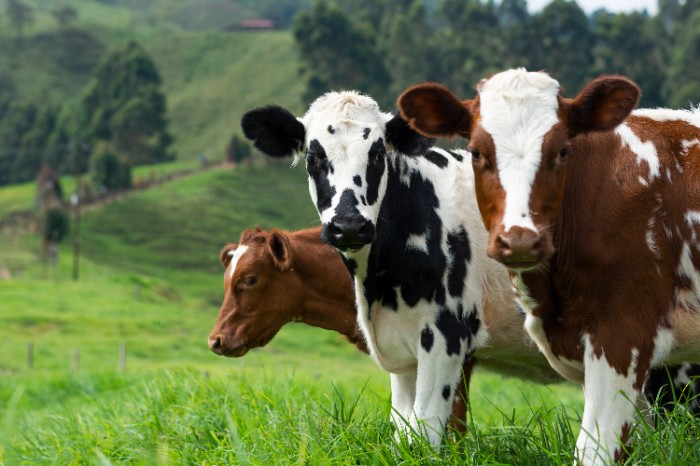
Earlier this month Professor Christina Pagel of UCL provided a balanced overview of the situation. This points out that ‘the virus’s move into high volume animal farming, particularly cows, is concerning for two reasons: firstly, it means the virus comes into contact far more often with humans (mainly farm workers) and secondly, large cow herds mean it has a greater opportunity to adapt to mammals and develop mammal-to-mammal transmission’.
The good news is there is no evidence of the kind of human to human transmission that could trigger a 1918 type flu pandemic, but the world is taking big risks. It is broadly agreed that a handful of further mutations are all that is needed. Christina, who is not known for being prone to exaggeration sums up the situation as: ‘Essentially, it’s a numbers game. The more mammals – and people – are infected, the higher the chance that the H5N1 virus will take the mutational steps it needs to spread easily between people. The conditions are as conducive to an emerging H5N1 pandemic as they’ve ever been’.
Public Attitudes
As we prepare to enter the sixth year of the Covid-19 pandemic it seems clear that most of the world, and particularly the populations of the UK and USA want to move on and forget about it. This issue is discussed in various posts on this website including my recent blog on ‘calm mongering’. And this suits businesses with short time horizons who want minimum disruption to their operations, and it suits governments, with similarly short horizons and who don’t want to spend money on public health measures.
In another clip from the 29 December 2024 Sky News interview, Roy Lilley pin points the problem of wanting to forget about Covid and its direct link to the failure to learn the lessons.
This desire to move on is essentially what is at root of many of the problems Clinically Vulnerable Families have to navigate in our daily lives be it mask abuse, some healthcare staff denying Covid is still a problem, public denial of the problem and, more generally, a despicable lack of respect for those who need to or want to stay safe.
Concluding Comments
In conclusion, for me to be universally upbeat at the current time would be pretty difficult!
However, I believe there is also hope.
Despite the difficulties of funding, there are a few signs that the global scientific community may be becoming better connected and organised in some respects. On the other hand a recent conference highlighted how efforts to uncover insights into Covid-19 and viruses more generally were often met with antagonism.
The challenges that lie ahead, not least the inauguration of Donald Trump as US president will also no doubt ignite and invigorate the loosely defined ‘resistance movement’.
In the UK the Covid Inquiry is providing a platform for previously unheard voices, including the clinically vulnerable families group. In this respect the next year is going to be a hard slog with public hearings on modules 4, 5, 6, 7, 8 and 9 scheduled to take place. The reporting and recommendations are likely to happen mainly in 2026 but it is hoped that the key messages emerging will trigger actions before then. This may include individual authorities and others implementing their own measures.
Another reason to be cheerful is that we have a relatively new government in the UK and need to remain hopeful that 2025 will begin to see a clear evidence informed approach emerge that places the UK in a better position to tackle the existing pandemic as well as preparing for future threats.
And we are also likely to see new medicines, possibly new vaccines, as well as new gadgets coming onto the market. I know that many of those in the clinically vulnerable and covid cautious community/ies have had the chance to enjoy a near normal christmas at home thanks to the Pluslife machine and range of mitigation measures on the market – if you are not familiar with this -for an explanation see my blogpost on how to avoid catching Covid .
In other words there is a lot of work to do on the Inquiry and more generally on working to systematically counter the nonsense that is directed at us, and to address the underlying issues we face.
The Clinically Vulnerable Families group have an exciting programme going forward and ambitions to extend our influence. Many thanks are due to Lara Wong who holds it all together and drives it forward, and to all the volunteers. The group is without doubt a lifeline for many people. Once the festivities are over please don’t forget our crowd funder.
This time last year I called for more proactive messaging from government and others about the dangers posed by Covid-19 in both the short term and long term. The evidence base on what Covid can do to over 200 organs in the body is already judged to be robust, but it may be that scientists will come up with even more convincing evidence next year that captures the public imagination.
We keep saying this, but surely five years on there is a limit to how far the public will continue to swallow messaging that blames lockdowns for the high levels of ill health being experienced. Surely it will start to dawn on people that the one or two Covid-19 infections they get every year might be the root cause of the other illnesses they or those they know keep getting and maybe those respected scientists who put their heads above the parapet and say this might just have a point. You never know.
Happy New Year.
PS Please don’t forget our winter socials.

Tuesday 31st December, New Year Eve. 7pm – Quiz and drop in
Wednesday 1st January. 7pm – New Year’s Social
Monday 6th January. 7pm – Social
Wednesday 8th January. 7pm – Weekly Wednesday socials restart
For information see the CVF private Facebook page.

 Living on Plague Island
Leave a comment