The pandemic had a serious impact on the economy during the lockdowns of 2020 and early 2021, but it has continued to cast a long shadow over the economic performance of the UK and far more so than many other western economies. So what is going on? This blog focuses on the labour market impacts, something which is particularly serious given the tight labour market conditions following on from the UK’s departure from the EU.

Trends in Inactivity
A recent blog Bob Hawkins has done an excellent job in summarising what we know about the lingering impacts of Covid on the labour market and I draw heavily on this.
As we can see from the graph below, the number of economically inactive working age people has continued to rise since the start of the pandemic. Moreover, the dip observed in early summer 2023 mirrors the fall in the number of Covid cases during that period before it started to rise again as Covid cases took off again.

No other Western economy has suffered this level of decline, and indeed, economies that had a relatively low number of Covid cases due to more effective management of the virus, combined with good public health services, experienced a fall in economic inactivity.
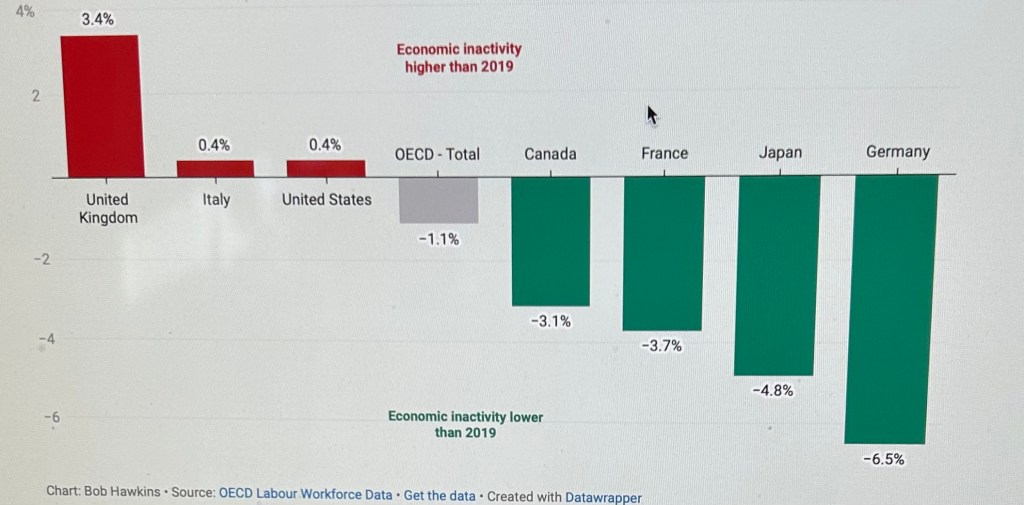
There are some problems of definition when drawing comparisons between countries of course. In the USA most of the attention has been on ‘excess retirees’. We can see from the graph below that the number of excess retirees grew dramatically after the start of the pandemic.

If we look more closely at these patterns we can see that the rate of increase in ‘excess retirees’ mirrors the Covid waves almost exactly. Commentators acknowledge that we cannot attribute all of the increase in excess retirement to Covid, but it is thought to account for a large proportion of it.

Who is leaving the Labour Market?
Looking at the UK in more detail, we can see that apart from students, those aged 50 -64 are by far the largest economically inactive group.

Causes of the rise in economic inactivity
We can see from the graph below that long term sickness has moved from being the third more important reason for leaving leaving the labour market (in 2018) to the most important reason by Dec 2023 when over 30% identified long term sickness as the main reason for leaving the labour market.
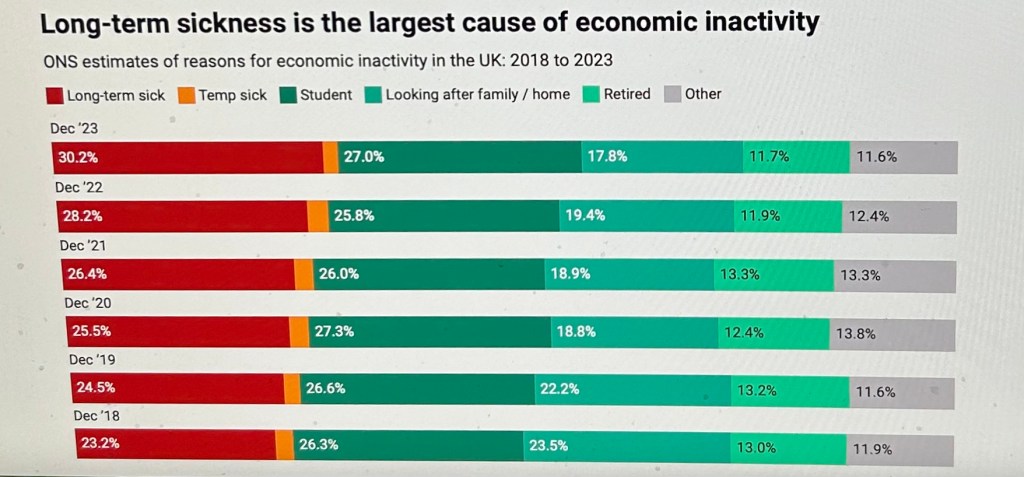
Looking at statistics on this 50-64 group more closely reveals that being sick, injured or disabled was the main reason given for economic inactivity by 42.3% of this age group.
Of course not all of these cases will be due to Long Covid but the fear is that most of the excess will indeed be due to conditions associated with and made worse by LC. See my blog on the subject for a list of conditions.
The Clinically Vulnerable and their households
One factor that is not discussed at all in the media or in the literature is withdrawal from the labour market due to underlying conditions that mean people are classified as clinically vulnerable CV or CEV, including the immunocompromised, the immunosuppressed and people who have not responded to the Covid vaccines for various reasons. These people are not always ill and will therefore represent a significant and unnecessary loss to the labour market.
Similarly the household members of the CV or CEV ability to participate in the labour market is often impacted on because they need to avoid catching Covid and bringing it home. Again this is a completely unnecessary loss of potential employees.
Although most clinically vulnerable people and their families know plenty of people who have withdrawn from the labour market due to concerns about Covid at their workplace, we have little or no quantitative evidence and we urgently need more data.
If those in power could be convinced of the scale of the problem we could work towards alleviating it by measures such as safer workplaces, more flexility and home working.
Home-working is causing particular angst at the moment as more and more employers are apparently attempting to get workers back into the office often on spurious ‘presentism’ grounds cited by parts of the media. This is despite the fact that home working can have many positive impacts with associated economic benefits. For example, over 1000 research papers summarised in a recent Observer article concludes that home working can bring many positive benefits, including healthier eating, lower stress and blood pressure, although there was an increase in snacking. Homeworkers are also less likely to take time off sick, tend to work longer hours and to work evenings and weekends. However, higher paid home workers were generally happier than lower grade employees and a great deal seems to depend on the home working environment. Employers therefore need to work at this to ensure employees have an optimal working environment geared to their needs.
Other Covid related factors
It is important to remember that long term withdrawal from the labour market only represents part of the likely impacts of Covid/Long Covid on the labour market. Other possible factors include enforced reduced hours working due to poor health, on going health issues impacting negatively on productivity when people are at work, increased time spent caring for others who are sick, as well as the increased ‘short term’ and ‘long term’ sickness absence occurring across the economy at present. Again it would be good to quantify the scale of all this.
Economic Analysis – Quantifying the Costs
Most of the literature on the economic costs of Covid/Long Covid has focused on sickness absence. In 2022 for example, McKinseys estimated that Covid reduced the number of days worked by as much as 2.6% representing a significant productivity loss. In the UK Oxera economic consultant estimated that ‘the total economic cost of lost output among working-age people due to ill health is around £150bn per annum, equivalent to 7% of GDP’. Moreover, it is clear that absence has increased by 60% since 2016 when DWP had previously produced estimates.
Oxera’s main conclusion is:
‘the challenge has already changed and continues to change with the acute impact of long COVID, an ageing population, and the rising prevalence of mental health and musculoskeletal conditions among the working population. It is therefore vital that policymakers adapt and tailor interventions to these changing needs to unlock the full potential of the working-age population. ‘
Cambridge Econometrics have also attempted to quantify the costs of Long Covid based on available evidence on the cost of Long Covid treatment, and economic inactivity among those living with the condition. The main conclusion drawn is that Long Covid is likely to reduce GDP by around £1.5bn and 138,000 jobs each year. In the event of prevalence increasing to 4 million people per year by 2030, the negative impacts would increase to a reduction of around £2.7bn in GDP and 311,000 job losses each year.
Moreover, this study did not consider the costs of spells of shorter and longer absences by those ill employees still in employment, nor the costs of under performance whilst at work. Moreover, the measure of the cost of LC treatment was based very narrowly on treatments specifically for LC, but we know that this is only the tip of the iceberg in terms of the long term health conditions that Covid can cause and will require treatment.
Media Coverage
As will be familiar to regular readers of this website, a striking feature of the post Covid-19 emergency period is the extent to which the government, the media and others are keen to airbrush anything to do with the continuing and wider impacts of Covid out of consideration. This is despite continuing high rates of infections and millions suffering from Long Covid.
Indeed, press reports about the shrinking labour market have tended to bend over backwards to avoid mentioning Covid or post covid conditions, preferring instead to blame long term sickness on poor habits picked up during lockdowns, poor mental health due to lockdowns and disruptions, delays in NHS treatment, austerity and poor mental health due to the cost of living crisis, housing shortages and of course lockdowns!
However, things may be beginning to change. Even Larry Elliott writing in the Observer a few weeks ago, and probably for the first time, acknowledged that Long Covid may be part of the explanation for high rates of absence from the labour market.
Concluding Comments
This blog represents a short canter through the issues and I intend to update this blog at regular intervals as more and more evidence comes to light.
Clearly, all of the attempts at quantifying the costs of LC so far have been partial because they focus down on particular aspects of the problem, ignoring others. There is also a general lack of data to base estimates on. However, it is pretty clear that LC is causing a very significant hit to the UK economy and this is likely to grow in the future, unless of course infections are brought under control or better treatments/cures are found for the multiple damage being done to the body and immune systems of many people.
At present the fact that the government and most of the media largely ignore the likely link between the economy and covid/Long Covid does not bode well for finding policy solutions that could bring very positive economic benefits.
This analysis also highlights how wrongheaded the JCVI and UKHSA decision making on narrowing down who is eligible for a Covid vaccine actually is. We know that vaccination lowers the risk of getting infected and also getting Long Covid if you become infected. It is true that it is no where near 100%, and it may be becoming less effective over time as the virus gets better at dodging immunity, but surely anything that helps is worth having? The analysis also knocks on the head the idea running through UKHSA modelling that only costs associated with Long Covid in hospitalised patients (a tiny minority of the total) be taken into account in the cost- benefit calculations underpinning entitlement to vaccine boosters. See my blog on the subject.
March 2024

 Living on Plague Island
Leave a comment