Summary
Recent evidence suggests that the boosters administered to people living in the UK in September 2023 are not particularly effective against the JN.1 variant currently causing problems across the world. Clinically vulnerable people and healthcare workers who had their Covid – 19 boosters in September 2023 after the Government brought forward the booster programme are now, if they are well informed about the issues, feeling regretful that they did not wait until October when a new booster was due to become available. But what can they do about it? This short blog discusses the issues.
‘Planning’ for the 2023 Autumn Booster programme
Most of the criticism about the recent booster programme has been directed at the very narrow eligibility criteria – see my blog on vaccination. However, what about the type of vaccine administered? Most experts and drug companies agree that the evolving nature of Covid means that vaccines need to be updated regularly.
Over the winter/spring of 2023 Pfizer undertook the development work for a new vaccine that would match better the fast changing nature of Covid-19. This was rolled out into production and is known as the (BNT162XBB1.5 adapted vaccine (Pfizer-BioNtech 2023-2024 formulation). The only snag was that it would not be available until late September 2023. As we have seen from my blog on vaccination, the UK government ordered enough doses for all UK residents over 50 and other specified clinically vulnerable groups.
Late in the summer of 2023 the UK Government and UKHSA started to worry that Covid cases were rising and that the programme for starting to administer booster doses to older and clinically vulnerable people and front line health and care workers was not scheduled to begin until October. They therefore took the decision to bring the programme forward to start on 11/18 September and cited the newish BA.2.86 variant as the reason. This was probably done with the best of intentions.
All care home residents started to be vaccinated in the week starting 11 September and many of the most vulnerable, including the over 80’s, and some healthcare workers will have come forward in September. Nearly 2.5 million doses were administered in this period.
There was no information from the UK government at this time except to say that all vaccines offered protection against serious illness.
At the time clinically vulnerable groups and others were engaged in endless discussions amongst ourselves about whether to get their vaccine in September or wait until the new one was available. The key problem was we did not know when this would be. My household was in this position. Although my husband had received the spring 2023 booster on the grounds that he is immunocompromised, I had not received a boost since September 2022. In the end I decided to book an appointment early in the morning of 2 October 2023.
We turned up at the vaccination pharmacy as planned at 9.30 a.m.and when our turn came we were greeted by an enthusiastic vaccinator who informed us that they new adapted vaccine had arrived and we would be receiving it. This was happening all over the country and social media was buzzing. But the UK government said nothing. Indeed, it subsequently emerged that vaccination centres were sworn to secrecy that this would be happening and were threatened that their contracts would be terminated if they said anything about it before 8 a.m. on 2 October.
Evidence on Effectiveness of Different Vaccines
The Autumn booster programme formally ended on 15 December 2023. However, also in mid December new early evidence on the effectiveness of different vaccines emerged from Yale University. It paints an alarming picture for countries that rolled out their booster programme early because it concludes that:
Our findings reaffirm current recommendations for broad age-based use of annually updated COVID-19 vaccines given that (1) XBB1.5-adapted vaccines provided significant additional protection against a range of COVID-19 outcomes and (2) older versions of COVID-19 vaccines offered little, if any, additional protection, including against hospital admission, regardless of the number or type of prior doses received.
It should be stressed that these are initial findings, but they are based on a large sample size from the US and well respected commentators, including the medics have been highlighting the report.
Indeed, it is now well established that the JN.1 variant is as different from the original omicron strain as omicron was from the original Wuhan Covid-19 variant. Most scientists expect the highly transmissible JN.1 to be given its own greek letter and for subsequent mutations to develop from JN.1.
What can people do now – early January 2024?
The UK government has said nothing about this and maintains the line that all vaccines are effective. Many clinically vulnerable people and others are, however, alarmed.
So what can we do if we received a jab in September or think we received an older version of the vaccine at a later date? The obvious solution is to get another booster. There is no medical reason why you can’t do this as long as it is over 3 months since your last boost – but how?
Although the booster programme is closed, some walk in vaccine centres are still open until 31 January. I know of at least one person who spoke to a centre about the the issue and they told her to come along in early January and they would administer the new vaccine because they ‘have plenty’. It is worth a try.
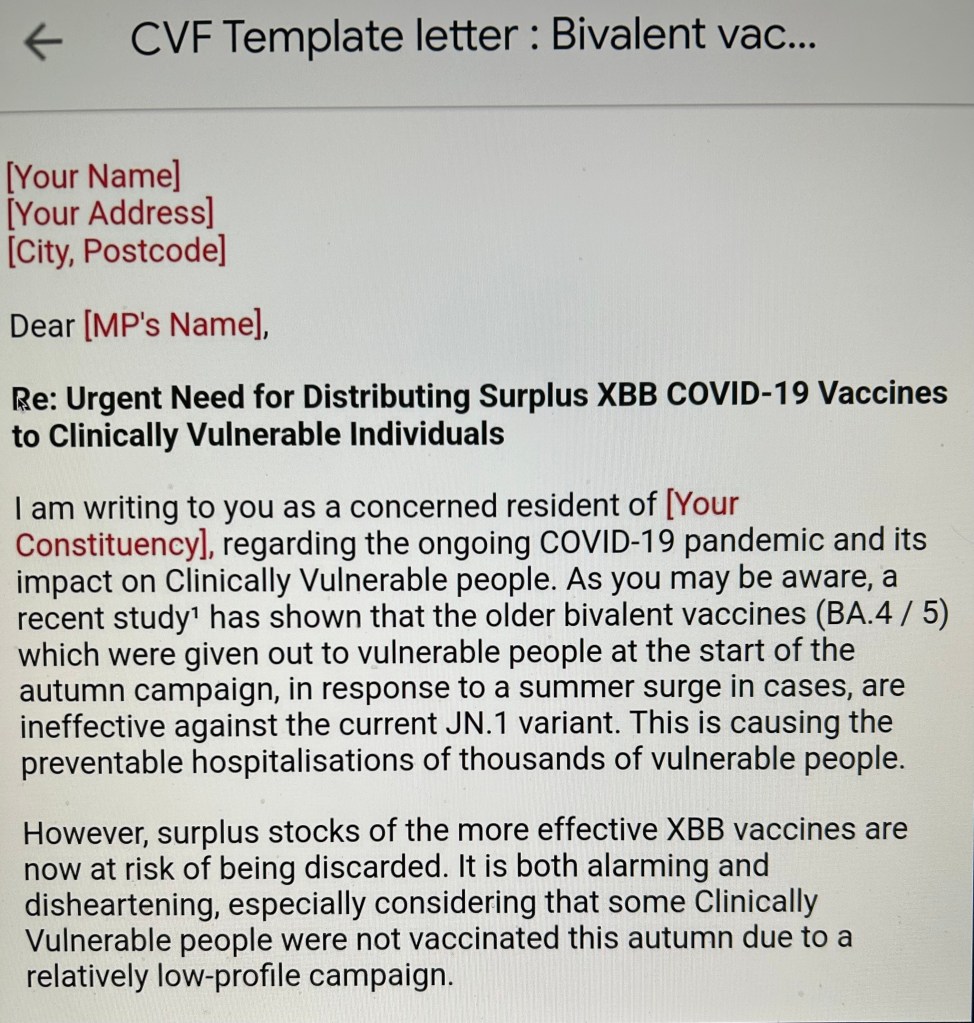
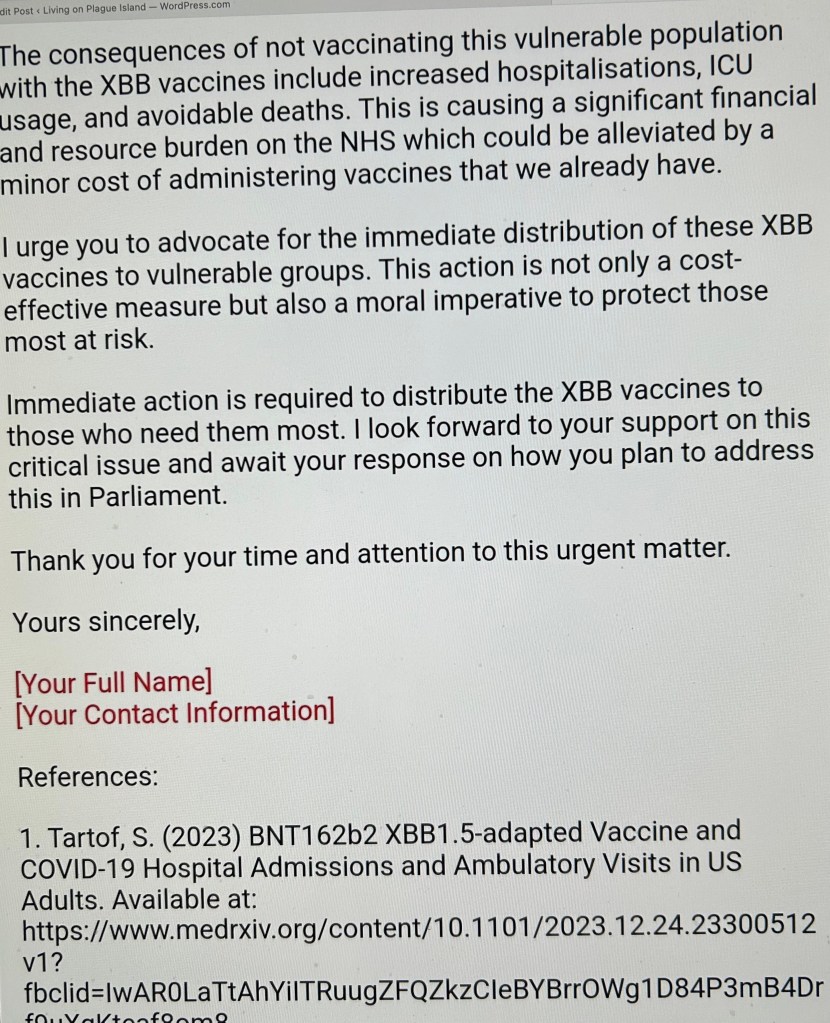
The other thing you might do is write to your MP and join the campaign to bring about an urgent change in government policy. A template for writing to your MP is here.
Latest Trend in Infections
Meanwhile, in Christina Pagel’s analysis, published today, the JN.1 variant could drive the biggest surge in infections ever. This is because all of the safeguards such as free testing etc have been dismantled and we have unlearnt the lessons from the height of the pandemic.
The key message is take care out there – and this is particularly pertinent to clinically vulnerable families, and particularly those who feel unprotected by the Autumn booster campaign.
Update 5 January
Many people from the clinically vulnerable families network who were vaccinated in September have been searching out vaccination pharmacies still open. Some have been successful in getting a second Autumn boost – particularly if they are immunosuppressed and can prove it. Others have been having less luck and have run up against a wall of ‘it’s against the regulations’ reasons.
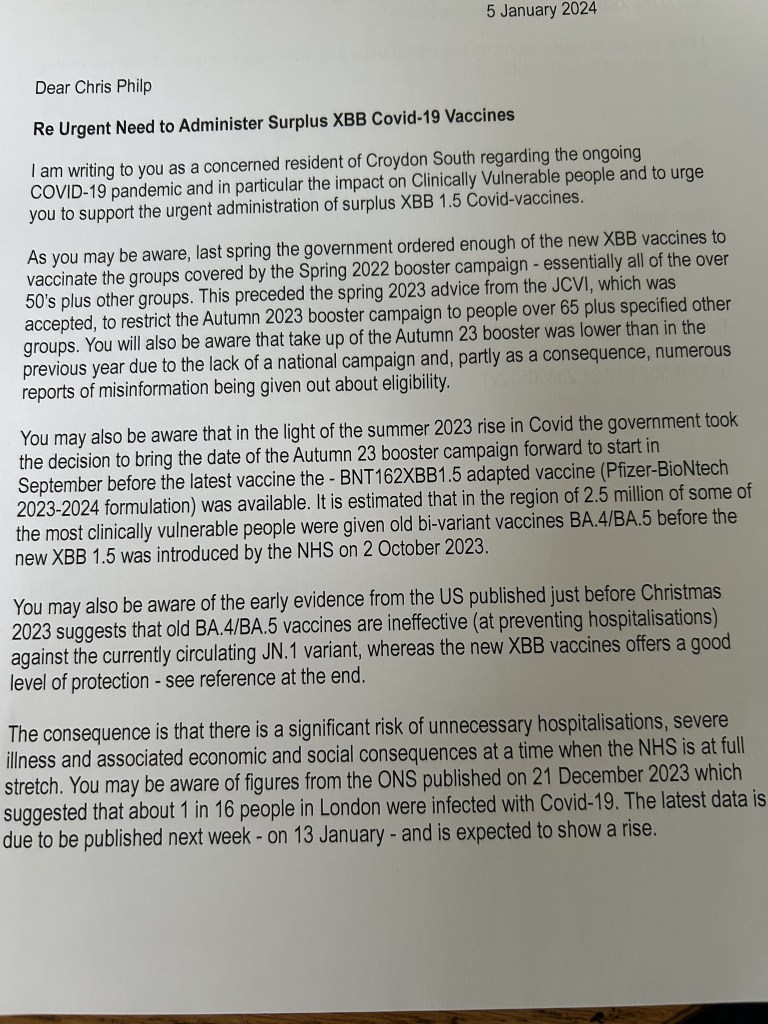
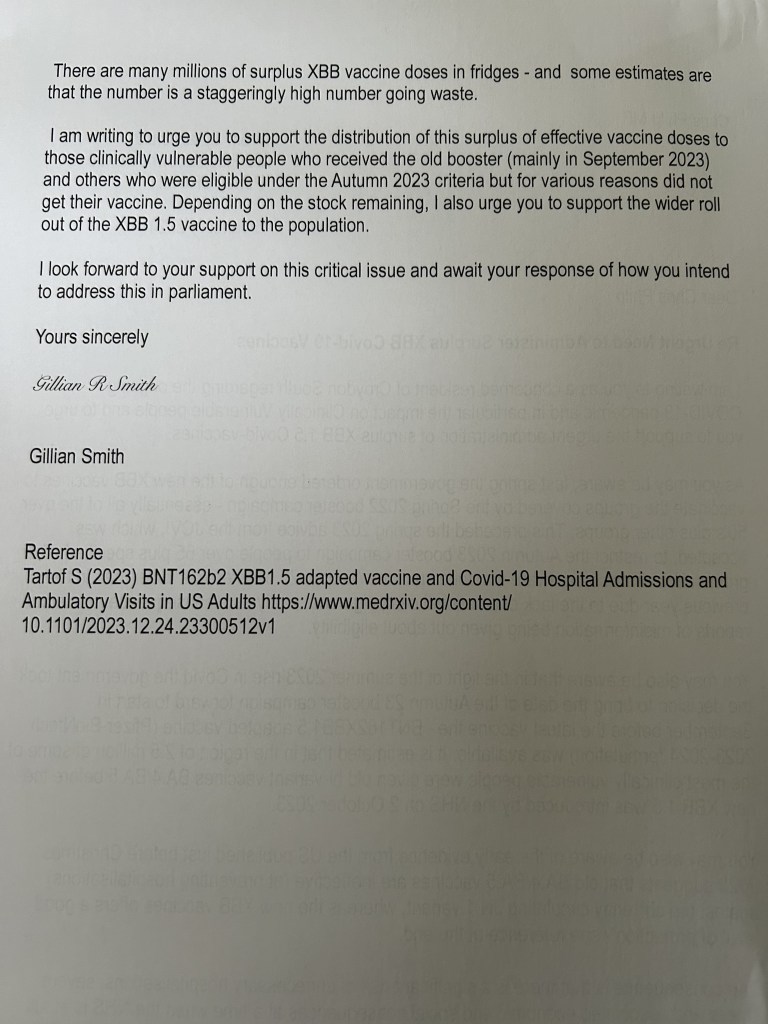
I have also written to my MP about the matter as the UK parliament returns next week.
.
Update 9 January
I have received a response from my MP. It completely misses the issues I raised about evidence on the old vaccines not working against the JN.1 variant and also the issue of surplus vaccines. I am considering sending him a complaint and requesting that he addresses the issues raised (see update below).
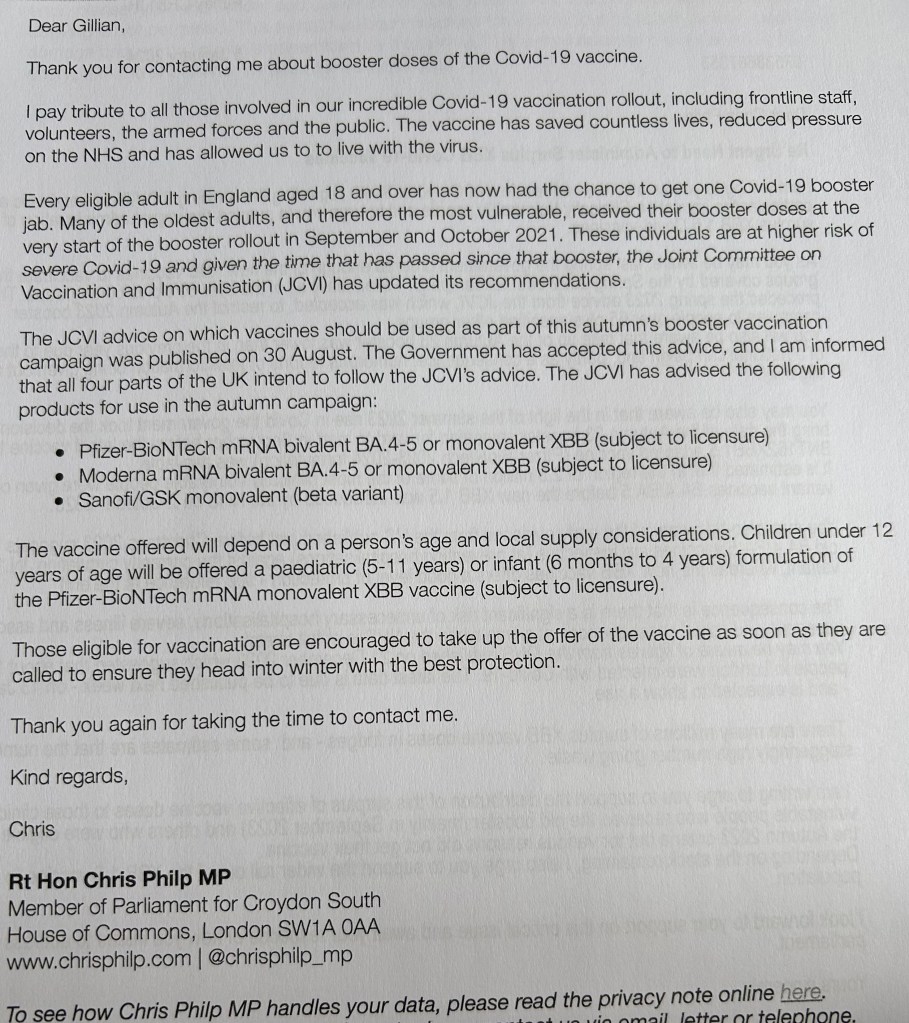
Update 10 January
I have written again to my MP about this issue.
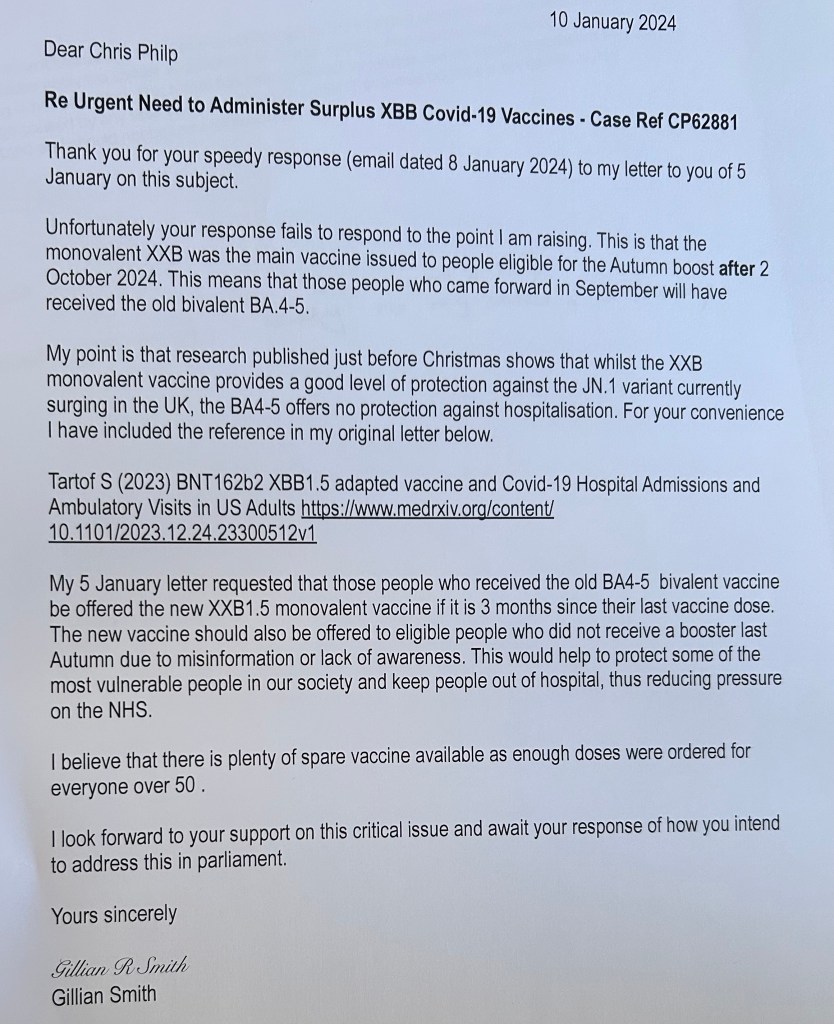
Update 11 January
I received a holding response from my MP this morning expressing concern. I have to admit to being pleasantly surprised. I will post the response received from the Dept of Health and Social Care.
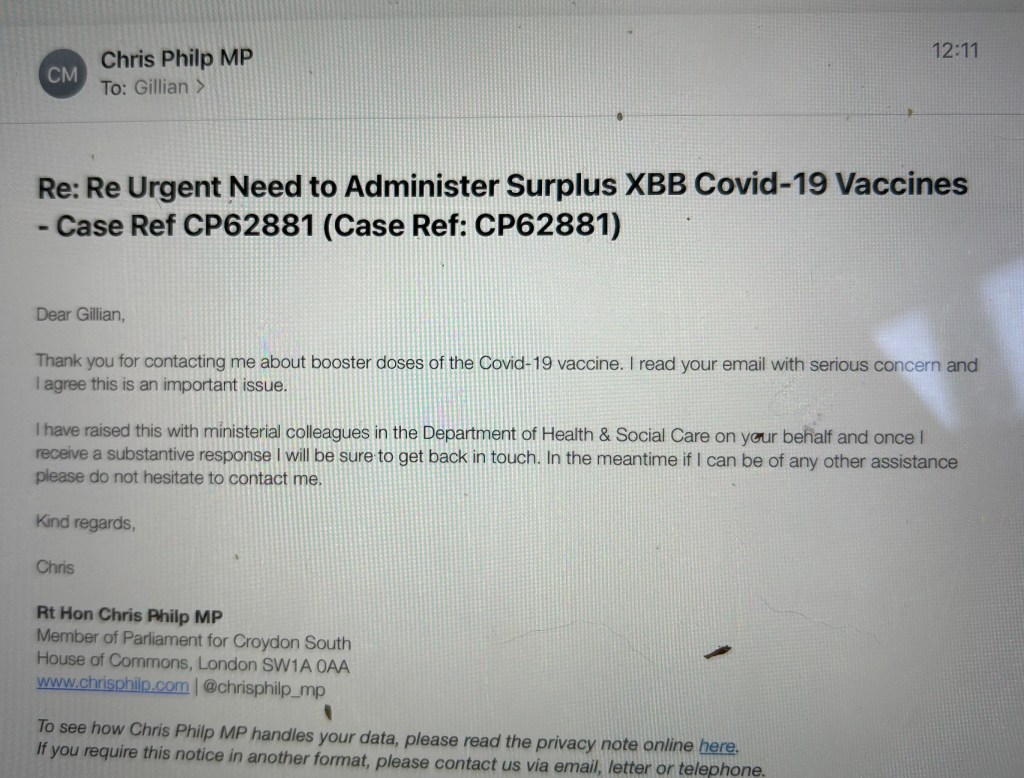
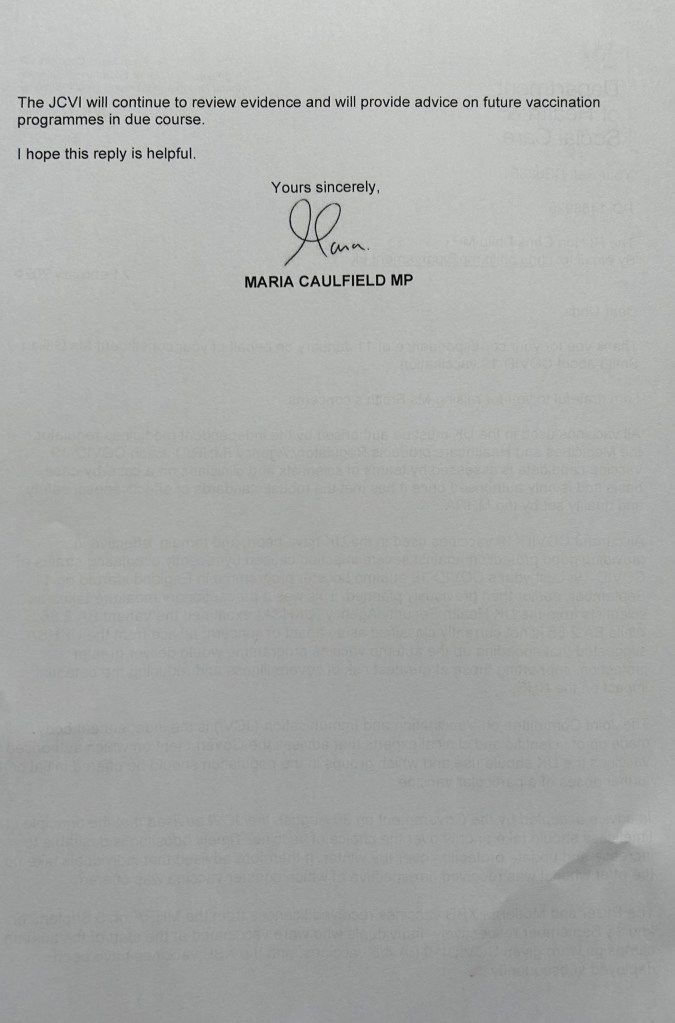
A reply from Maria Caufield, Health Minister, was received on February. It took the standard line that all vaccines are effective and failed to address the points I raised regarding research evidence.
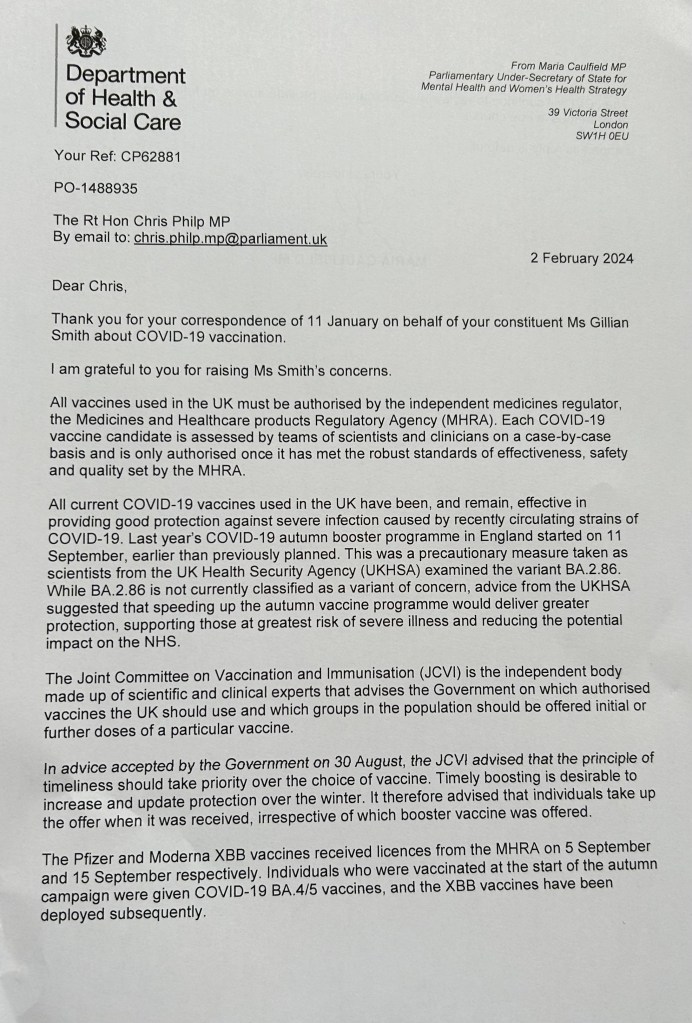
Update 26 March
For those who received the old vaccine in September there are now two options.
If you are eligible for a spring booster, it has been confirmed that the XBB1.5 vaccine used from 2 October 2023 will be given. The process for getting a spring booster is less than transparent but your GP should be in touch or I understood from the clinically vulnerable families network that the NHS website and /or NHS app will open for bookings on 8 April.
If you are not eligible for the spring booster – but were eligible for the Autumn boost but received the old vaccine or if you are not eligible but would like one you could consider buying one privately from next week via Pharmadoctor (£75- £85) or Boots (£99).
For the state of play regarding the new novavax see my blog on the issue (end of blog 11 March update). The latest information is that it may or may not be available via pharadoctor from 22 April.

 Living on Plague Island
Leave a comment