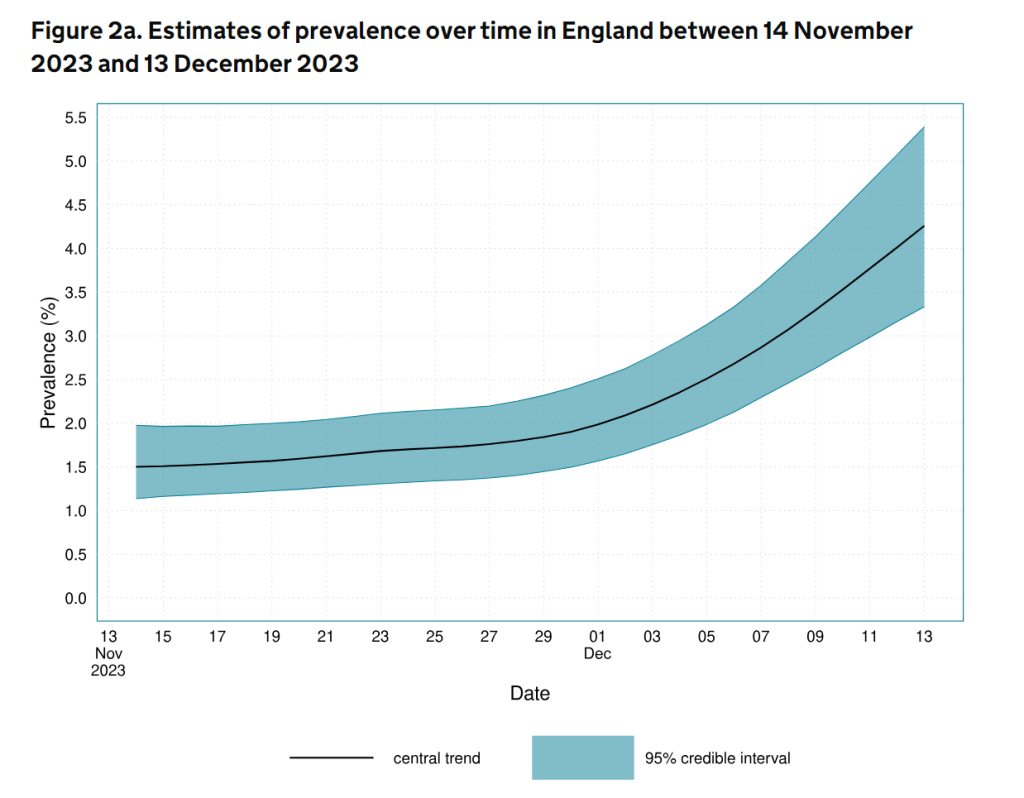
UKHSA published the results of the Winter Covid-19 infections survey this morning 21 December. It paints an awful picture of soaring Covid-19 infections across England and Scotland. It is estimated that about 1 in every 24 had Covid at the week ending 13 December, with infections highest amongst younger adults and in London where it is estimated that about 1 in every 16 people are infected with Covid-19.
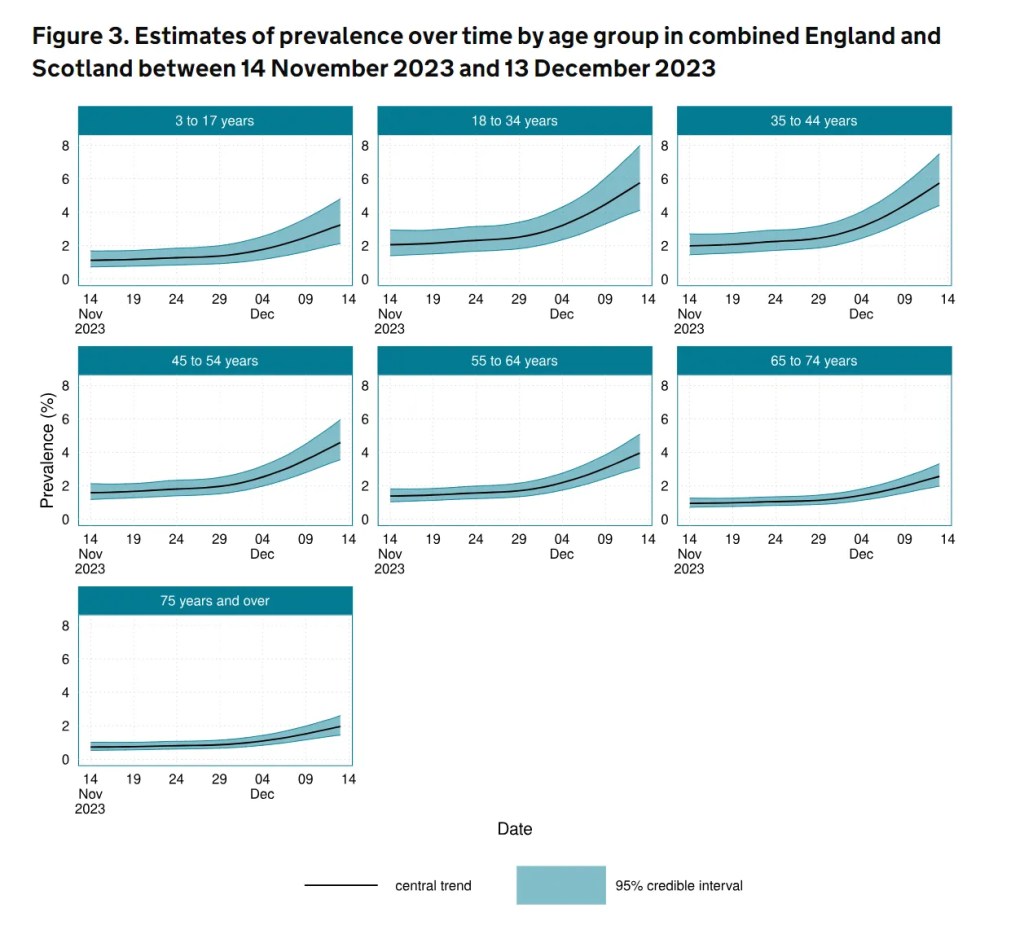
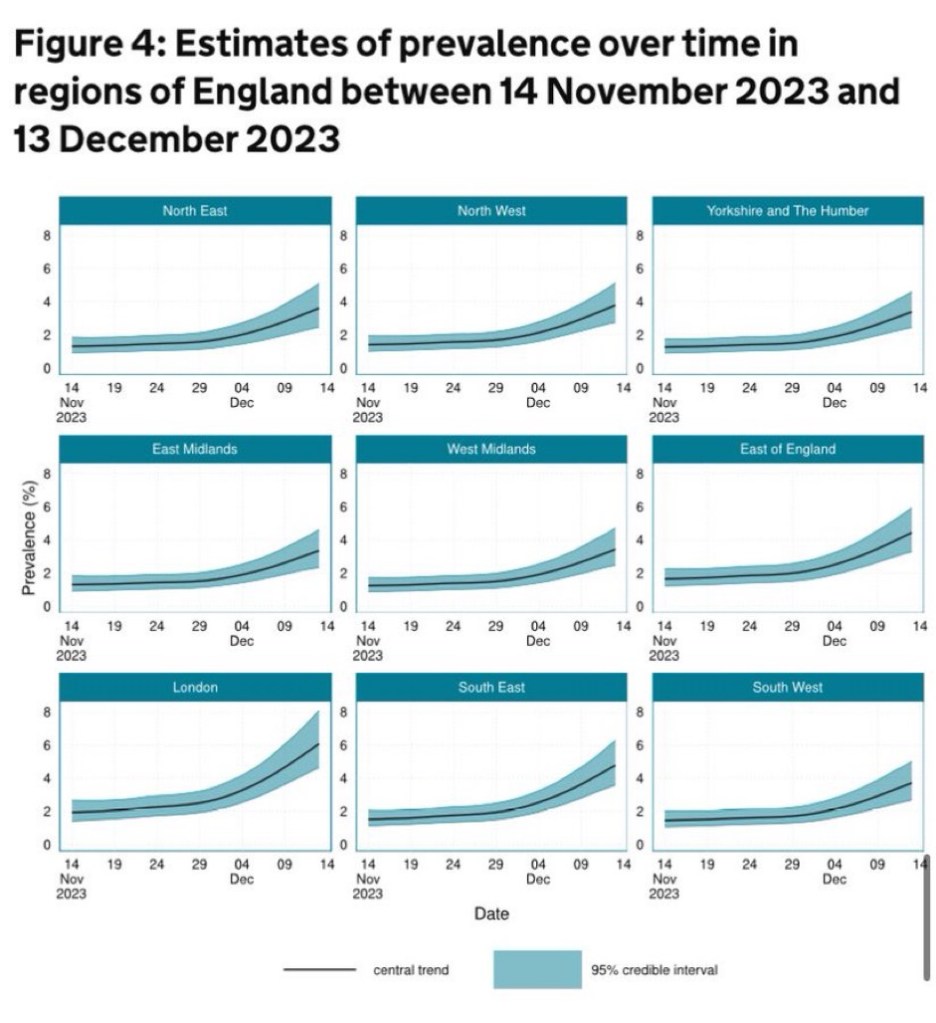
The release is based on modelled data following on from the problems reported in my previous blog the ONS Winter Covid-19 Infections Survey- update. Overall, ONS has done a good job in getting this out into the public domain following all the cost cutting they have endured, which was not of their making.
Christina Pagel has produced an overview of what the results say. In the words of Christina the results are, frankly eye-popping. She concludes that :
This will be the most serious wave of infection since March 2022 by the time it’s over – and perhaps even higher. Hospital admissions are unlikely to reach the peaks seen then (almost 2000 admissions a day), but will still increase significantly. Certainly Covid is reminding us it’s not “just a cold” and has plenty of stings left in its tail.
Concluding Comments
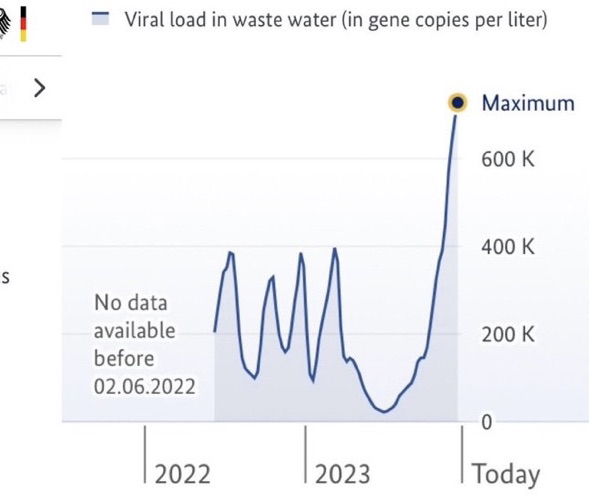
The UK is clearly in for a bumpy ride into Christmas and into the New Year as are a number of other countries. For example, the left graph below is Austria waste water and the right graph is waste water analysis for Germany for w/e 13/12.

A good part of the blame for why we are so unprepared can, of course, be laid at the UK government’s door.
This is clearly a terrifying time for clinically vulnerable families who are entering their 4th Covid Christmas period at the same time as NHS being under intense pressure. If you can, please take note of all of the advice on this website and elsewhere to keep yourselves safe.
Update 12 January 2024
UKHSA published updated data to 3 January 2024 yesterday. My assessment is that the data needs to be treated with some caution due to the shortfall in responses during the holiday period and the nature of the modelling that the data has been subject to. ONS and UKHSA acknowledge this in the following paragraph:
‘There were temporary changes to participant testing behaviour over the winter holiday including changes in response rates on certain days. This required statistical adjustment (refer to the quality and methodology information document). While accounted for in the modelling, caution should be taken when interpreting values in this period particularly in relation to peak timing and magnitude’.
UKHSA source – see above
Due to these problems ONS/UKHSA are planning to publish an update report next week on 18 January.
Results
The data published yesterday suggests there has been a slight dip in the proportion of people testing positive for Covid-19.
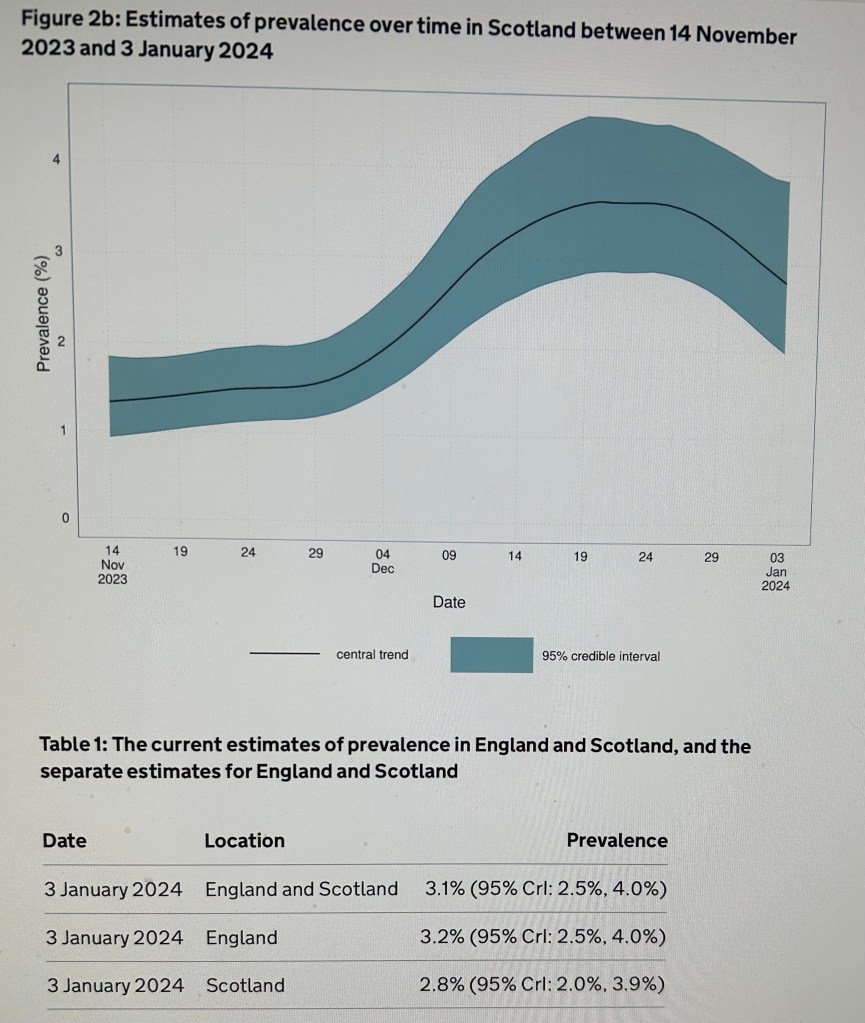
However, the published data also suggests that positivity amongst the oldest age group has gone up. We can see from the tables below that positivity amongst this group has increased to 2.9% compared with 2.0% in w/b 13 December.

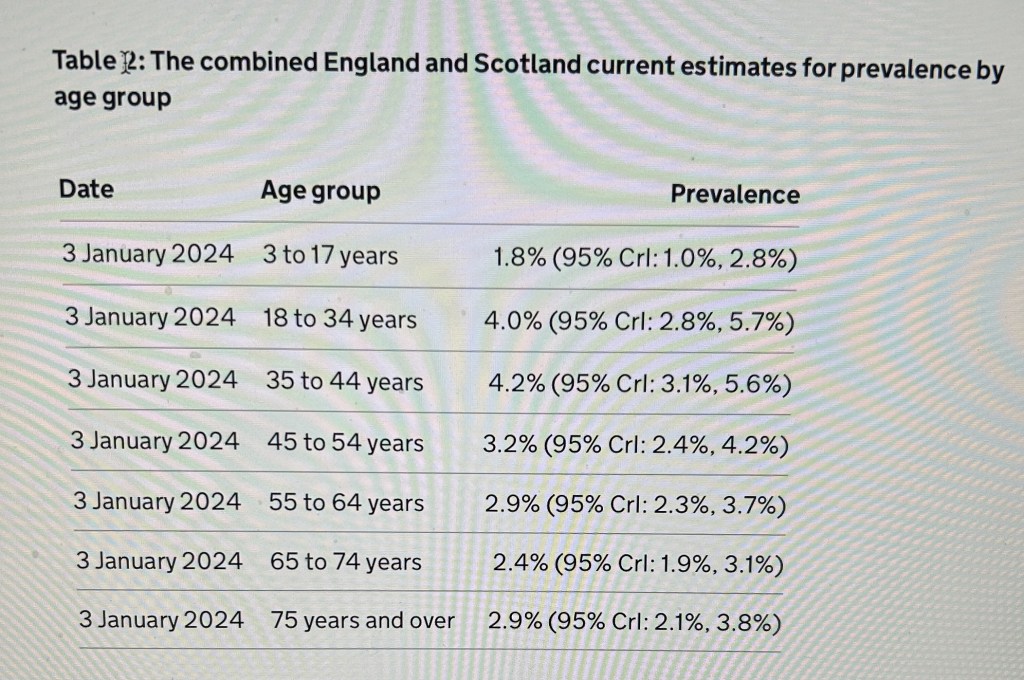
Overall, I suspect we cannot make anything of any of this data collected during the Christmas period and subject to very heavy modelling of results in order to correct for bias. This really demonstrates the weakness of the new approach compared with the old Infection Survey based on PCR tests and where respondents were paid for responding.
Next weeks report should provide a bit more certainty about what is happening.
Other data
The latest data on hospitalisations with Covid in England to w/e 28 December. This shows a 7% rise over the week. Again, this may be impacted by the amount of testing done by hospitals during the christmas period and it is difficult to know whether the rate of admissions is slowing or what.
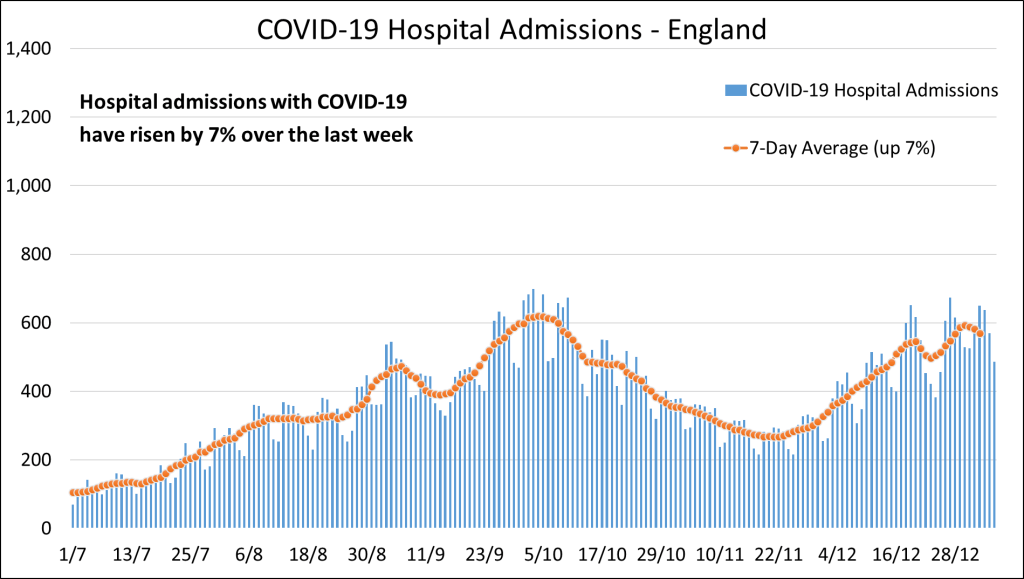
Overall, putting the two sources of data together, I think it is safe to conclude that we are not seeing an absolutely massive wave capable of overwhelming the NHS completely. Nevertheless we are still in one of the biggest waves ever, and given weaknesses in the data sources I don’t feel I can comment further, at this point in time.
Update 20 January
The latest results from the ONS Winter survey were published by UKHSA on 18 January and suggested there has been a continued decline in the prevalence of Covid in the week ending 10 January. UKHSA estimate that about one in every 43 people are infected with Covid-19. Rates of infection fell in all age groups 18 – 74, but this was not the case for the over 75’s.
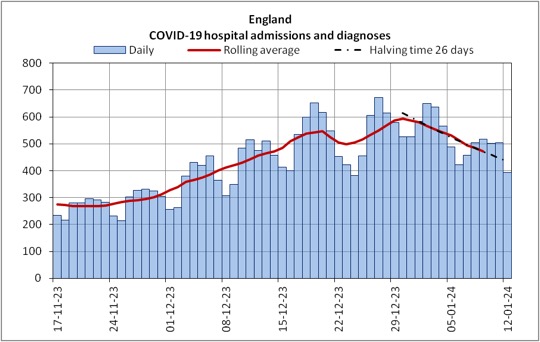
Last week was also a better news week on Covid related hospital admissions which continued to fall. See the graph below.
However, the SIREN study of NHS staff based on PCR testing showed a continuing rise in Covid-19 infections to the last week in December and estimates that about 1 in 23 NHS staff were infected with Covid-19.

Discussion
The apparent fall off in Covid levels is potentially good news. However, a word of caution is appropriate. Firstly, the number of responses to the ONS survey continues to be well below target and actually fell between 3 and 10 January when one might have expected it to pick up after the Christmas break.
This means that the sample is likely to be highly biased. UKHSA are continuing to subject the data to very significant modelling. My key worry with this is you can’t accurately re-weight data if interest in the subject is a key driver of response and the parameters of this are unpredictable. It does not help that UKHSA are less than transparent about the modelling.
Secondly, the disconnect between UKHSA and ONS in the reporting of the results is interesting. The reports of the old ONS infection study used to be available via the ONS website. All that appears on the ONS website about the Winter survey is the raw data buried in a spreadsheet and a health warning about the data.

 Living on Plague Island
Leave a comment