
The last few weeks have seen a frenzy of media reports about the clusters of pneumonia cases amongst children in parts of China and in the UK and elsewhere as well as a general rise in infections which the media has variously labelled’ long cold’, ‘new Covid’ and similar.
These apparent rises in infections has led many media outlets to claim that this is part of a ‘immunity debt’, in other words that people’s immune systems were weakened during lockdowns and the era of significant mask wearing because adults and children were protected from all viruses, not just Covid. Immunity Debt is therefore the idea that we have developed a reduced immunity from other illnesses because they were not exposed to them during the height of Covid – hence the concept of a debt which needs to be repaid by children and adults.
Despite the fact that the term is not recognised in the scientific literature the theory of immunity debt has obvious attractions, to parts of the media including the BBC, because it fits with the narrative that lockdowns did more harm than good. It also fits with the idea that getting infected with diseases is better for children and adults than achieving protection by vaccinating them.
As might be anticipated, the usual small number of anti lockdown academics have been rolled out to speak out in support of the immunity debt theory, with the British public seemingly willing to swallow that someone who was presented as an expert on the effectiveness of HEPA in filtering the air one week, can then claim to speak authoritatively about the complex and specialist subject of immunology the next week!
Before moving on to discuss the science there are a number of obvious questions that anyone with an inquiring mind – including news presenters – should be asking themselves about the barrage of reporting attributing the increases in illness to Covid restrictions.
These questions include:
i. Growing Time Lag since lockdowns

The length of time since the last UK lockdown ended is now two and a half years and it is well over 2 and a quarter years since so called ‘freedom day’. Surely it is pertinent to ask ourselves how Covid restrictions can be responsible for the growing levels of illness after all this time?
ii. Young Children
Also why is it that children who were not alive during lockdowns are being hospitalised with other illnesses? Why is it that excess deaths amongst children gone up in recent years?
iii. Astronauts and hermits
Also, shouldn’t we be asking why people who live very isolated lives protected from society – astronauts for example, do not suddenly fall ill when they are back home?
iv Sweden
As we discussed in the blog on ‘Is Sweden a shining example’, Sweden did not have a lockdown and is sometimes held up as a model to adopt in future pandemics. So, if immunity debt is what is driving the current apparent surge in other illnesses, what is happening in Sweden where one would expect a far lower level of debt to be repaid? The answer is that Sweden has experienced surges in RSV as well as a range of other illnesses.
v. Historical Lessons

Also what about the historical context? To follow the theory to its logical conclusion, we would surely have learnt the lessons of the damage of clean water legislation and gone back to having open sewers and infected drinking water in order to build up our immunity to waterborne diseases? This may sound daft, but it is no different from the statements currently being banded about the implications of ‘immunity debt’.
Indeed, in the 19th century the barriers to improving the provision of clean water look remarkably similar to some of the issues surrounding attempts to improve the quality of air and protect people from dangerous airborne pathogens as well as from pollution more generally. I will be writing a separate blog on the quest for clean water and the parallels with the current situation drawing on various historical sources with the help of my husband who is an economic and social historian.
Scientific Evidence
So we have raised serious common sense questions about how logical or otherwise the term ‘immunity debt’ is but what does scientific literature say? The short answer is that the term ‘immunity debt’ is not recognised as a concept in scientific literature.
As explained by Dunn Walters, the immune system is not like a muscle. It does not weaken because people are not being exposed to common viruses. She argues that what we are seeing, however, is an ‘immunity gap’ which is means that infections that would have occurred are simply being delayed. Once restrictions are lifted one would expect to see the normal level of winter viruses, for example.
‘So, wearing masks, social distancing, and other non-pharmaceutical interventions simply delayed infections until people began interacting again, thus enabling the spread of viruses, once again. There is no evidence that those interventions weakened the immune system’.
Dunn Walters Why using the term ‘immunity debt’ is problematic for reporters. Journal of Health Journalism 12 December 2022
Many other academics, including Professor Stephen Griffin of Leeds University have also publicly attacked the idea of immunity debt as nothing more than something invented by the popular press to suit their own arguments – for a light hearted run down on what is wrong with the theory see a twitter thread. And internationally renowned immunologist, Danny Altman confirms this, as summarised in the quote below.
‘Immunity debt has never been a chapter in a … textbook. The idea that somehow our immune systems are designed to be frequently topped up by dangerous pathogens, and that’s somehow a good thing was never part of anything I learnt, or I suspect anyone else. ‘
Danny Altman speaking at Independent Sage 19 November 2022.
Covid related damage to the immune system
It is very hard to judge to what degree the non Covid respiratory infections being reported in the UK and internationally are exceptional or just the media hyping up infections such as RSV in children, for example. It is true that last season’s flu season in the UK and elsewhere was severe, but it is questionable whether it was exceptional by historical standards. It seems likely that the poor state of the NHS that had to struggle with multiple infections, including Covid, helped to draw attention to the prevalence of flu.
On the other hand an alternative explanation that does have credibility on the basis of a growing number of recent scientific studies is that Covid 19 damages the immune systems of adults and children and it is this that is driving an increase in a range of other diseases.
It has been established since 2020 that Covid damages the lungs and that Covid infections are associated with an increase in heart attacks and other heart problems, as well as blood clots. It is also well established from multiple studies that Covid impacts on the brain and central nervous system. Recent research also suggests that we may be storing up problems that will only strike in the longer term. And that it is associated with brain fog in patients which may be caused by fusion of the brain cells. There is also evidence that Covid infections are associated with the early onset of Alzheimers disease.
There is also an increasing amount of evidence that points to an association between Covid and autoimmune diseases. In fact there is now robust evidence to suggest that there is no organ or system that is untouched by the virus. And there is mounting evidence that re-infections with Covid-19, no matter how mild, become a more serious risk the more infections you get.
Some scientists have also suggested that the apparent rise in the number of people experiencing respiratory symptoms may be to do with CVID – Common Variable Immune Deficiency. This is a little researched condition caused by a range of factors, including infections, which in turn causes low levels of the proteins which are essential to help fight infections. If you have CVID , you’ll likely have repeated infections in your ears, sinuses and respiratory system. However, there is insufficient evidence to say whether or not there has been a recent rise in CVID.
Update 11 January 2024 – A recently published review ‘from immunity debt to immunity theft’ has coined the term ‘immunity theft’.
immunity debt refers to the ramifications of reduced exposure to a variety of pathogens resulting from efforts to rein in SARS-CoV-2, immunity theft refers to the notion that SARS-CoV-2 itself steals immunity, leaving some people who’ve had COVID-19 more susceptible to other infections.
See above reference
A catchy title – ‘immunity theft’ – might actually be helpful in countering the nonsense which continues to be written about immunity debt.
Concluding comments

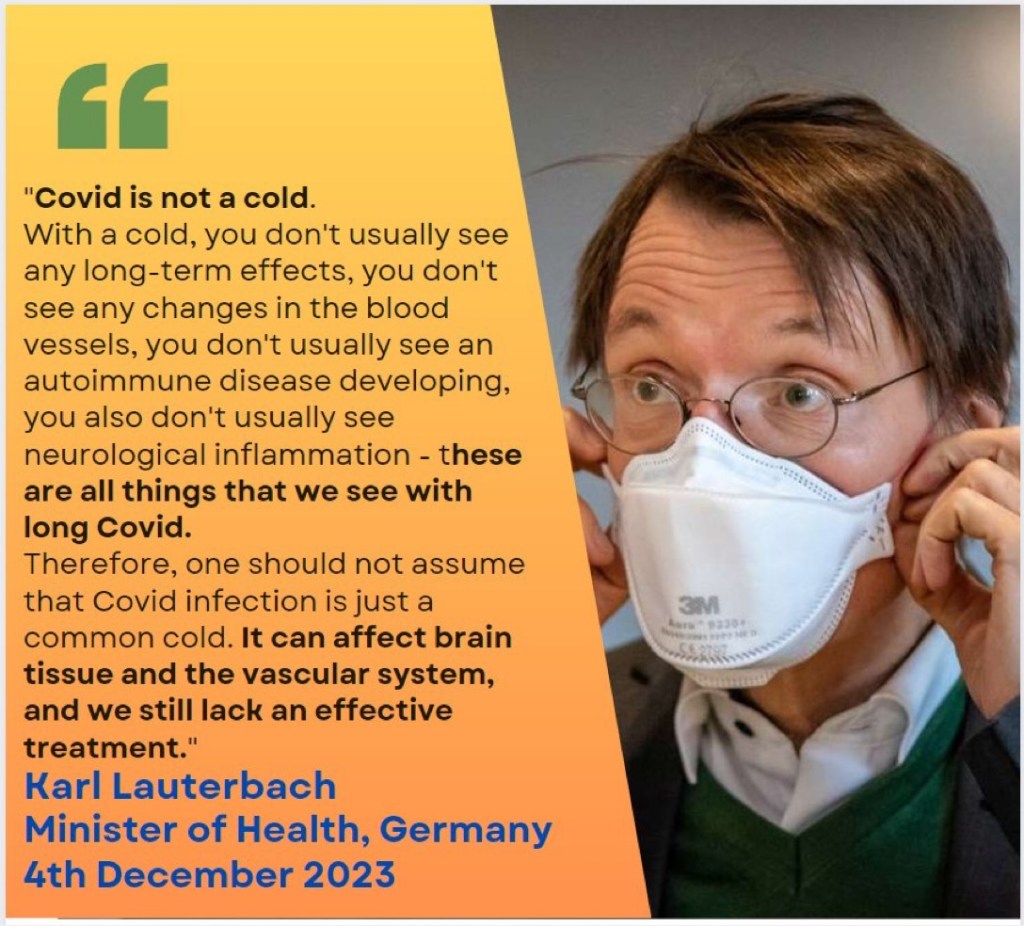
The lack of constructive discussion in the UK about the apparent rise in illness is frustrating, because if commentators were willing to open up and talk about it we would be able to do something about it by tackling the root causes of the observed problems. However, at the moment everyone seems very keen to grasp at the theory of ‘immunity debt’ despite the illogicality and lack of scientific evidence to support it. This is in contrast to the situation in many other countries where the links between Covid and damage to the immune system and links to other illnesses is openly acknowledged and discussed. For example, even Good Morning America, the most watched morning news show in the US, acknowledges it. And the German health Minister, Prof Karl Lautebach, who is himself a doctor, openly acknowledges it. He recently stated that:
Gillian Smith
3 December 2023. NB I am a social scientist, not a medic nor an immunologist. I am however, scientifically literate, as I spent years at the Dept for Transport collaborating with scientists from various disciplines on cross disciplinary projects.

 Living on Plague Island
Leave a comment