
A great deal has been written about Swedens approach to the pandemic. Indeed, critics of compulsory lockdown tend to grasp at the Swedish case as an example of how we should be approaching pandemic management in the future. But how good an example is Sweden?
In an interview in the Telegraph recently, Jenny Harries, Head of the UK Health and Security Agency, more than hinted that we should take the lead from Sweden in future:
‘if we were to face another pandemic tomorrow the UK would take a more Swedish approach to social distancing, she suggests. Social contact fell broadly to the same extent in both countries during the pandemic but, while stay-at-home orders were legally mandated here, in Sweden they were voluntary for the most part.’
The Telegraph 24 September 2023
Then when she was asked why not adopt the South Korean approach she said:
‘I think this is where we need to be really careful because the culture in South Korea was very different,” says Harries. She is not ruling out that we may be more like them in future but does not think Britain would have bought into more interventionist plans ahead of the pandemic, even if they had been proposed.’
The Telegraph 24 September 2023
What is really striking to me about this comparison is that Harries readily jumps on the differences in culture and society between South Korea and the UK but does not even mention the stark differences between Sweden with its very good health provision, strong sense of ‘the collective good’ and societal obligations and the very individualistic, non interventionist UK.
Did Sweden perform better?
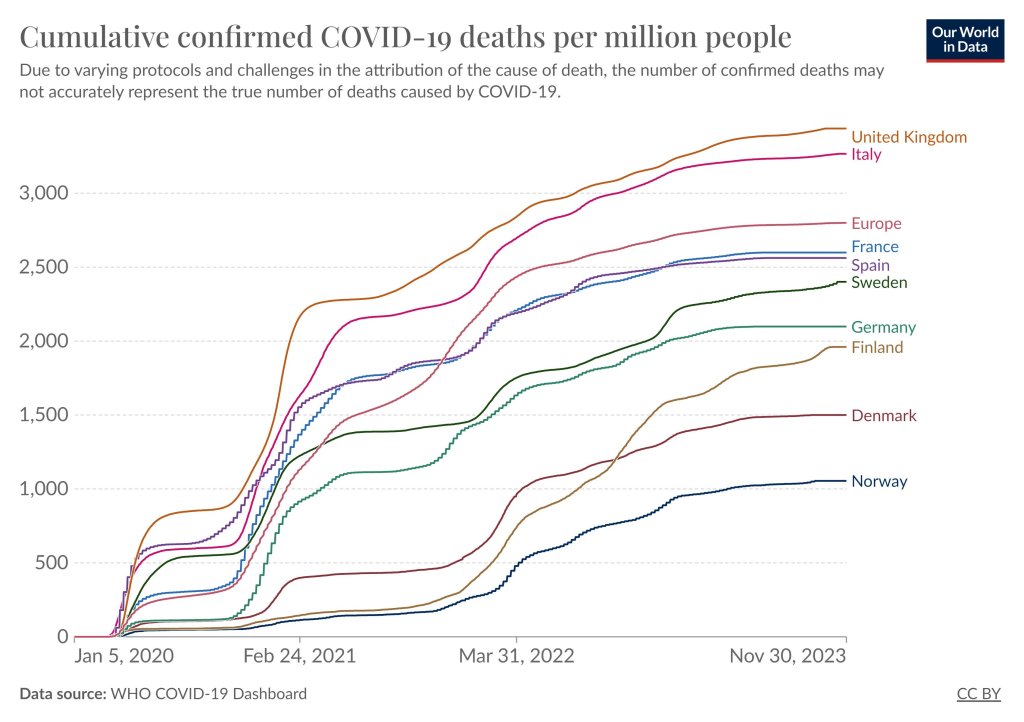
Several international studies have shown the Swedish example to be a disaster in preventing unnecessary deaths. A study led by Nele Brusselaers and published in the well respected Nature journal as well as reported on in the LA Times concluded that:
‘Sweden was well equipped to prevent the pandemic of COVID-19 from becoming serious. Over 280 years of collaboration between political bodies, authorities, and the scientific community had yielded many successes in preventive medicine. Sweden’s population is literate and has a high level of trust in authorities and those in power.
During 2020, however, Sweden had ten times higher COVID-19 death rates compared with neighbouring Norway. In this report, we try to understand why, using a narrative approach to evaluate the Swedish COVID-19 policy and the role of scientific evidence and integrity. We argue that that scientific methodology was not followed by the major figures in the acting authorities—or the responsible politicians—with alternative narratives being considered as valid, resulting in arbitrary policy decisions….
The Swedish pandemic strategy seemed targeted towards “natural” herd-immunity and avoiding a societal shutdown. The Public Health Agency labelled advice from national scientists and international authorities as extreme positions, resulting in media and political bodies to accept their own policy instead. The Swedish people were kept in ignorance of basic facts such as the airborne SARS-CoV-2 transmission, that asymptomatic individuals can be contagious and that face masks protect both the carrier and others. Mandatory legislation was seldom used; recommendations relying upon personal responsibility and without any sanctions were the norm.
Many elderly people were administered morphine instead of oxygen despite available supplies, effectively ending their lives.
If Sweden wants to do better in future pandemics, the scientific method must be re-established, not least within the Public Health Agency. It would likely make a large difference if a separate, independent Institute for Infectious Disease Control is recreated. We recommend Sweden begins a self-critical process about its political culture and the lack of accountability of decision-makers to avoid future failures, as occurred with the COVID-19 pandemic.’
Nature Journal
A recent book from Routledge available on open access also exposes the flaws of the Swedish experiment.
Concluding Remarks
Clearly the case of Sweden is not a shining example despite the mythology that has grown around it by far right commentators. Deaths were far higher than they needed to be. In real life and in common with the UK, this means people lost parents, spouses, siblings and grandparents before their time in the most stressful of circumstances. Indeed the King of Sweden has said that the approach taken was a failure and cost many lives. Moreover, many people were left with the legacy of Long Covid and Sweden now has a big problem with diabetes in children.
Many Swedish people have been left bewildered by the entire approach and wonder how it could have happened in Sweden. Rather than relishing the fact that they were able to go out to bars when most of the rest of the world was in lockdown, many Swedish people are lamenting the level of suffering due to the number of deaths and legacy left by increased illness that is evident in other countries that failed to get to grips with the virus, including the UK.
The fact that Jenny Harries and many right wing commentators in the UK regard Sweden as an example of good practice to be emulated in future is frightening.
Most decent people in the UK should find the idea of a public policy based on deliberately letting people die, (many of who will have a good few years left in them,) deeply repugnant.
It is clear to me that the full facts about Sweden need to be widely disseminated ie that despite all the natural advantages of the society and good health and public services the rate of death and illness was so high, and this reflects a deliberate policy on the part of government and those in authority.

 Living on Plague Island
Leave a comment