As discussed in my previous blog of yesterday – Don’t Look Up: 2023 in Denial, the BBC have this morning published a disgraceful inaccurate and misleading piece on the Changing Nature of Covid. Despite the fact that it is a sunny Autumn day perfect for a long walk, I and many other people I know have been triggered into spending time complaining to the BBC. Here is my complaint which is necessarily shorter than I would like due to the number of characters allowed by the BBC.
Complaint wording – here is what I have sent
15 October 2023
This article is factually incorrect about the dangers posed by Covid. The virus is not, as stated a normal respiratory virus, and neither is it seasonal.
The numbers of people dying from Covid dwarfs those dying from flu (where deaths are often lumped together with deaths from pneumonia which are mainly due to frailty and age, and sometimes due to Covid!) by a margin of x 32. The BBC knows this but chooses to produce an eye catching large chart regardless.
The article relies on one or two ‘experts’ including Paul Hunter who is known for his strong views. Why does the BBC not see fit to bring in a wider range of real experts who would be happy to provide you will a full balanced analysis of what is going on? Numerous of these expert commentators are spending their sunny Sundays on social media starting with ‘I really don’t know where to start with this – it is so bad’.
The article then goes on to say that the only situation where testing is useful is if you are vulnerable with a lung condition and eligible for anti virals. This is outrageously misleading. Many people with lung conditions are not eligible for anti virals, whilst people who are immunocompromised from cancer treatment and other illnesses are. These people, like my husband who cannot produce antibodies from multiple doses of vaccine are, like 100’s of thousand of people forced to shield or semi shield. Because I live in the same household I am forced to shield as well.
What sticks in the gut more than anything else about the article is the story of Sally. Sally is taking sensible precautions given her age. It feels like the BBC sees people who are being careful about Covid are somehow suffering from anxiety. This view written in the media then encourages people to continue to gaslight and abuse people, including no doubt Sally for just for trying to protect their health and the health of loved ones from a virus that can and does kill.
The article makes no mention of the damage being done to the population and economy by Long Covid. Have the BBC not watched the Covid inquiry hearing of 3 days ago on 13/10 in which the full horror of the damage done to people suffering from LC were laid bare?
More generally there is no mention that Covid is proven to cause a range of serious illnesses including heart attacks, brain damage, blood clots and more.
I will post the response from the BBC when I receive it. The complaints department are probably very busy ….
Update
The above complaint was sent on the 15th October. In under 48hours, on 17th October I and everyone I know who complained received the following completely inadequate reply.
17 October 2023
Dear Ms Smith
Thank you for getting in touch regarding our article about the changing nature of Covid-19 where we posed the question as to whether it was now just a regular winter bug and sought the views of a number of experts.
We are sorry to hear you were disappointed with our coverage. Some people felt we minimised the dangers posed by Covid. Our intention was to examine the evidence, compare the data on deaths from flu and Covid, and look at seasonal patterns.
All three professors we interviewed told the BBC there were positive signs about the evolution of Covid.
However, some did express caution and warned that Covid is still dangerous, which we reflected in our reporting. We quoted Prof Paul Hunter who felt Covid was “well on its way” to becoming seasonal; Prof Adam Kucharski who we said “ remains a little more cautious” and Prof Mike Tildesley who said Covid “could still end up causing more deaths than flu this winter.”
A chart in the story showed the recorded winter deaths from Covid and flu between October 2022 and March 2023 where deaths from flu outstripped the Covid death toll.
Some people were unhappy that we did not mention long Covid however this is an issue we have covered previously on the website.
The BBC also interviewed Sally, a woman who is still heavily impacted by Covid. She expressed her fears about Covid and how it has stopped her from doing things she usually enjoys.
We hope this addresses your reservations and would like to thank you again for contacting us to make your views known.
All feedback from readers is appreciated and shared with senior editors so that they are aware of audience concerns.
Kind Regards,
BBC Complaints Team
www.bbc.co.uk/complaints
I and others were furious at this from the UK public service broadcasters and it has also resulted in a great deal of comment on social media. On the 18th I felt the need to respond as follows.
18 October 2023
Thank you for your response to my previous complaint of 15 October. Your response is totally inadequate and fails to address the issues raised. I am aware that exactly the same response has been sent to many people regardless of the points they raised.
1. You mention that you consulted 3 professors. But these are people who are known to subscribe to the government approach of letting Covid infections spread throughout the population. Most mainstream top scientists do not subscribe to this and the BBC should be bringing in a range of evidence and views in its role as a public service broadcaster.
2. Unlike flu, Covid is not a seasonal virus as it continues to cause deaths and other problems, not least for the NHS, throughout the year. Your chart comparing deaths from Covid and flu is highly misleading – you ‘cherry pick’ a time period when the UK was in the midst of a particularly bad flu season and you fail to acknowledge that flu and pneumonia are lumped together in the same statistical category – we don’t have reliable data but it is clear that most of these deaths will be due to pneumonia, some will even be due to pneumonia contracted from a Covid infection.
3. You misunderstand the point I made about long covid. My point is that it is estimated that between 5 and 10% of Covid infections lead to long covid which can lead to heart problems, blood clots, diabetes, brain damage and more, and scientific evidence on this is mounting up by the day. This is a fundamental reason why Covid is not like flu, it is not the same as a winter virus which is why it is so very dangerous to let it rip through the population.
4. You misunderstand the point I raised about your reporting of the case of Sally. Your article presents Sally as anxious rather than as rational. You say you interviewed Sally. Wouldn’t it have been better to report why Sally is embracing life when she can whilst remaining cautious, rather than automatically presenting her as anxious?
I received an automated response to this saying they would try to reply within 20 working days but could not guarantee it. I think we need to watch this space… I am many others are not going to give up on this one.
Update 11 November
I and others received this response to our complaints on 9 November. My responses are in italics
Dear Ms Smith
Thank you for getting back in touch. We are sorry you were unhappy with our first response regarding an article about the changing nature of Covid-19 and if it was now just a regular winter bug.
1. BBC :Some people were unhappy that the article did not mention the risks Covid still poses for immunocompromised people.
We have decided to add the following paragraph to the article: “All carry risks – particularly to those with certain health conditions and compromised immune systems, who are advised to take precautions, including getting the available vaccinations and limiting contact with people with symptoms.”
My response: This fails to acknowledge that Covid constitutes a far bigger risk to the clinically vulnerable than flu – x 32, not least because of its novel nature and the fact that it is present in significant numbers throughout the year. So in order to avoid it vulnerable people need to take precautions all year, not just for a couple of weeks or so a year. This also fails to grasp that 60% of Covid infections are asymptomatic which, in the absence of mass testings makes avoiding people with covid almost impossible. It also fails to acknowledge that 2% of the population (and a higher proportion of vulnerable people) do not produce anti bodies in response to the vaccines.
2. BBC We believe this addresses the additional risk some people face as well as the extra precautionary measures they must take. We have also added an update note at the bottom of the article.
My response: it does not address the points raised – see above
3. BBC : Some people were also unhappy about the chart showing a higher number of flu than Covid deaths last winter. These figures are based on data from UKHSA, which we make clear in the article are just estimates. We also make clear that Covid deaths overall in 2022 were higher than flu deaths: “So for the year as a whole, the Covid death toll would outstrip that of flu.”
My response: This fails to note the problems with the data as outlined in my original response. Pneumonia and Flu are lumped together in the same category. The UKHSA chart is actually labelled ‘experimental data’ not ‘estimates’ as claimed by the BBC.
4. BBC People were also unhappy with the reference to Covid as “seasonal” and use of the word “anxiety” to describe those still fearful of the virus.
The reporter was simply reflecting that the virus appears to be following a pattern of seasonality. This is supported by the data from 2023 as well as from some of the experts he interviewed. Our correspondents are allowed to make “judgements rooted in evidence” in accordance with our editorial guidelines.
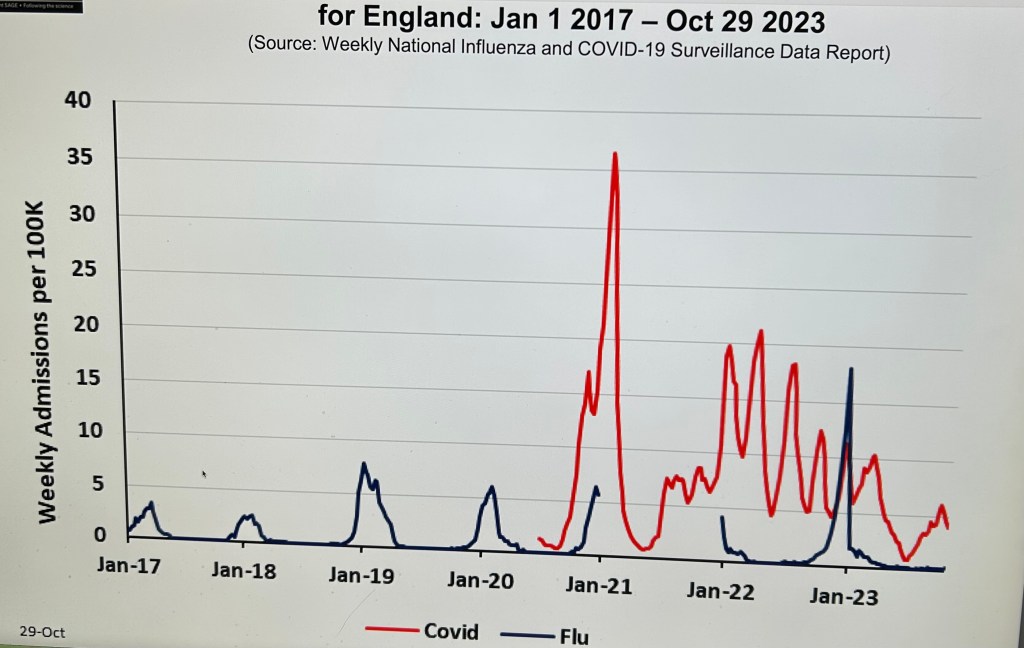
My response: none of the serious commentators think Covid is seasonal at this moment in time and this is clearly evident from the data on hospital admissions, for example – see chart below (also since the ending of routine testing in hospitals it is estimated that hospitals are failing to record a significant number of Covid patients. This fails to acknowledge my point about cherry picking a short time period when flu was in full flow, and also lumping it together with pneumonia. The BBC is a public service broadcaster and as such should not be twisting data to suit their argument.
5. BBC We used the word “anxiety” to simply describe people who are still worried about Covid, in line with the Oxford English Dictionary definition. We believe this is an appropriate and factual description of how some people still feel.
My response: the connotations around the word anxiety in this context are unhelpful and offensive to vulnerable people. See my original response
6. BBC Regarding the fact we have not mentioned Long Covid, we maintain that the BBC has reported on this extensively in the past, and has an entire topic page dedicated to Long Covid.
My response: this still fails to acknowledge the risks of serious illness from getting infected. It is this acknowledgement of the risks that I was looking for in the response – not information about LC per se.
7. BBC We therefore believe the current article is duly impartial, fair and accurate.
We hope this addresses your reservations and would like to thank you again for contacting us to make your views known. All feedback from readers is appreciated and shared with senior editors so that they are aware of audience concerns.
This concludes Stage 1 of our complaints process. That means we can’t correspond with you further here. If you remain unhappy, you can now contact the BBC’s Executive Complaints Unit (ECU). The ECU is Stage 2 of the BBC’s complaints process. You’ll need to explain why you think there’s a potential breach of standards, or if the issue is significant and should still be investigated. Please do so within 20 working days of this reply.
Full details of how we handle complaints are available at http://www.bbc.co.uk/complaints/handle-complaint/.
How to contact the ECU:
We’ve provided a unique link for you in this email. This will open up further information about how to submit your complaint. You’ll be asked for the case reference number we’ve provided in this reply. Once you’ve used the link and submitted your complaint, the link will no longer work.
This is your link to contact the ECU if you wish:
Click Here
Kind regardsBBC Complaints Team
www.bbc.co.uk/complaints
I am currently considering how to take this forward to the next stage in consultation. I believe the article is highly misleading, factually incorrect, biased towards the government laissez faire position and offensive.

 Living on Plague Island
Leave a comment