
As many people will be aware since our last blog ‘Heading into the dark’ the UK has gone far further than imagined in making it near impossible to judge what is happening with Covid and hence making it extremely difficult for the clinically vulnerable, and others, to weight up the risks of doing things.
This is despite the World Health Organisation (WHO) urging governments not to do this and stressing that COVID-19 remains a global health threat. WHO director general Dr Ghebreyesus said:
“The worst thing any country could do now is to use this news as a reason to let down its guard, to dismantle the systems it has built, or to send the message to its people that COVID-19 is nothing to worry about.”
The Covid-19 and Respiratory Infections Survey
Following the cancellation of the ONS Infection Survey in March 2023 the ONS launched a new survey in May called the Covid-19 and Respiratory Infections Survey.
This was always going to be far more limited than the Infection Survey because no swab tests were collected and there was no financial incentive for taking part in what was a monthly, rather badly designed and repetitive on-line questionnaire. Many of us raised worries about the likely sample bias and low response rate at the time, particularly given the withdrawal of the financial reward.
Two waves of this survey took place in May and June and then suddenly out of the blue on 28 June 2023 ONS announced that they were cancelling it on the grounds of the transition to ‘living with Covid-19’ policy. There was no mention whatsoever that this would mean we had no data on the extent of long Covid.
Following on from this on 10 July 2023 ONS published a number of reports based on the new survey and it quickly became evident why they had cancelled the survey.
Despite the lack of full information it is fairly clear that the response rate was low and the sample was biased, probably in favour of people who were interested in or concerned about Covid. This is of course not surprising as people will little or no interest in Covid would need to be incentivised to participate.
The survey did suggest that there was an incredibly high rate of respiratory illness given it was conducted in May and June; an average of approximately 1 in 6 people reported symptoms consistent with influenza like illness (ILI) as defined by the European Centre for Disease Prevention and Control (ECDC), in the seven days prior to completing the COVID-19 and Respiratory Infections Survey (CRIS).
Despite the criticism of the survey and resulting lack of data, there has been complete silence from The UK Health and Security Agency (UKHSA) – the body responsible for commissioning the survey. This is also silence from ONS.
Making the best of remaining data?
Moving on from this unfortunate episode a subsequent twitter thread from Professor Christina Pagel published on 10 July analysed the data that is available to decipher what is actually going on re the level of infection across the UK population. Whilst potentially helpful in helping people to plan their summer activities and assess risks, it does expose how little we know.
Professor Pagel concluded, with strong caveats, that the rate of Covid infections is probably lower now – albeit on 10 July – than at any point over the last two years for a number of reasons:
- Recorded Covid admissions are lower than they’ve been in a long time. Of course people often doubt this data because testing has changed (there is less testing in hospitals now). But when we dig further there is perhaps merit in the data because the main testing that’s stopped is the testing of people with no symptoms. But if you are in hospital because of respiratory symptoms, you are meant to be tested and there is also testing if Covid might affect your treatment – this is likely to be true of people in ICU, for example.
- People in hospital ‘primarily’ because of Covid is also much much lower than it’s been since Autumn 2021, and the number of people with Covid in intensive care is also very low and lower than last year. The number of staff off sick with Covid is also low.
- The number of people dying with Covid on the death certificate has been falling steadily and is lower than it’s been for two years.
- The Zoe covid symptom tracker app also showed no new waves and relative low estimated new cases. It is true that far fewer people are reporting to Zoe now and it is hard to know how reliable the data is.
- There were no new variants on the horizon (as far as we can tell) either. UKHSA data up to end June 2023 shows a dominant XBB landscape continuing with slow shifts between XBB subvariants over the last 3 months
- The only bit of potentially “high covid” data is the ONS Covid-19 and Respiratory Infections survey “flu like symptoms” survey from May 2023 where as we noted above about 1 in 6 people (~15%) reporting flu like symptoms. But it seems unlikely given bullet points 1 – 5 that all or many of these were Covid infections. Most frequent symtpoms were “headache, runny nose or sneezing, and fatigue”
- Wastewater monitoring in Scotland was also showing v low levels, but by 10 July there was a hint of a very recent uptick. This was also true of Wales where wastewater levels were lower than Feb/Mar 2023 but had begun to creep up. This has continued in recent weeks.
This all led Professor Pagel to conclude that the simplest explanation is that there is just not much Covid around this summer but the situation in the Autumn may of course change significantly.
A fierce debate ensued on twitter and elsewhere questioning how she could conclude this with such certainty (which she did not of course – she added lots of caveats). It also did not help that the ZOE app showed a fairly small uptick in the number of daily infections shortly after Professor Pagel’s twitter thread and this has continued in recent days.
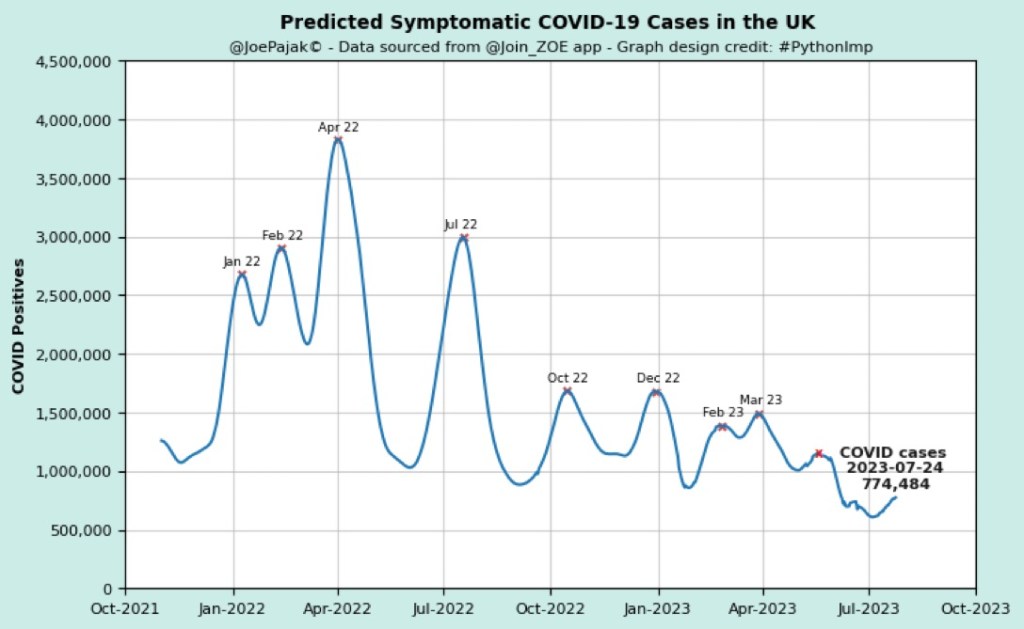
This is also true of Welsh wastewater levels which have seen small upticks in the recent past.
Excess Deaths
Some people have argued that ONS data on excess deaths is the best indicator of what is going on. This has shown a fairly consistent level of weekly excess deaths over and above the 5 year average (which excludes 2020 but includes 2021 despite the very high number of Covid deaths in this year) of between 5% – 10% on average, sometimes higher, sometimes lower.
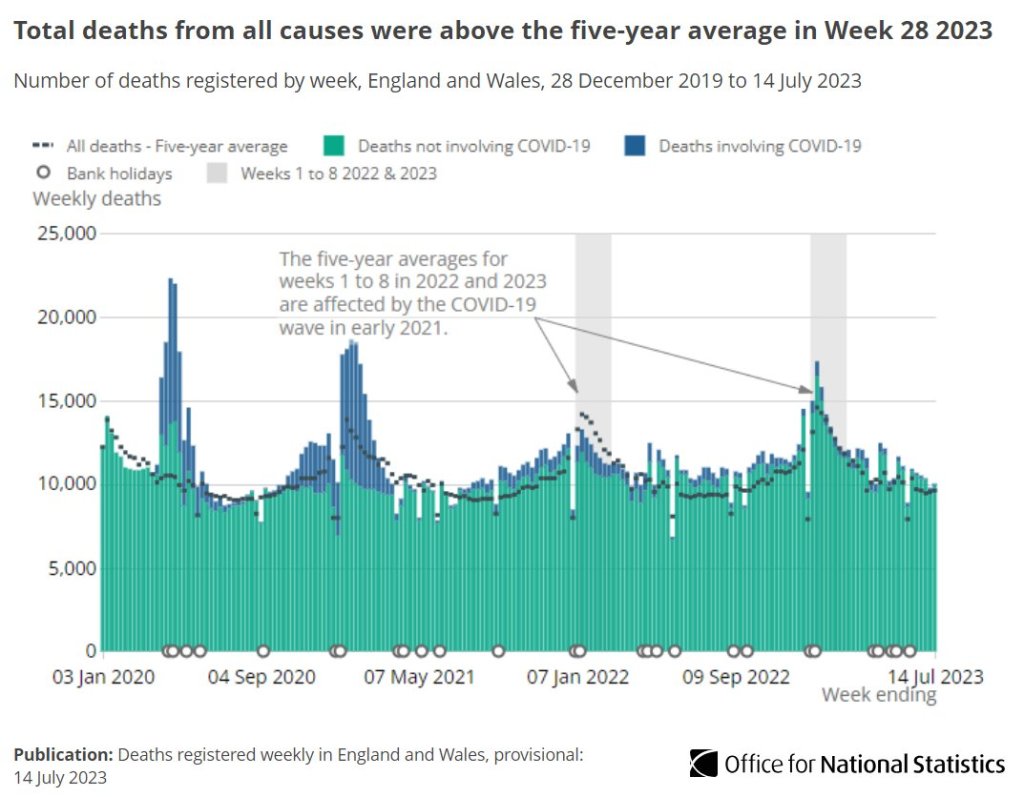
This could be occurring for a number of reasons, not least the state of the NHS and the number of missed appointments, long waiting lists and ambulance delays.
Although it is rarely mentioned by the media, long covid and conditions generated by Covid infections on all parts of the body is without doubt a contributing factor to the high number of excess deaths being observed. Indeed it would be incredibly difficult to argue that this is not the case given the increasing amount of evidence emerging on the health impacts of Covid infections. For example, the report of a recent study led by Danny Altman estimated that about 1 in 10 infections led to persistent symptoms which led the team to declare the burden of the post-infection condition “so large as to be unfathomable”. Symptoms were wide ranging and Altman concluded that:’Research has found signs of damage in long Covid patients’ hearts, lungs, brains and nervous systems, and signs of disease in their immune systems’.
In sum, monitoring and researching long Covid is incredibly important and a potential driver of the level of excess deaths being observed. I would however, caution against excess deaths being used as an indicator of the current level of infections because there will be time lags between the initial covid infection, the subsequent development of long Covid and associated conditions – and then death.
Conclusions
The situation is highly unsatisfactory because, if Professor Pagel is correct, we could have eased up on precautions and taken advantage of the admittedly somewhat soggy UK summer – at least so far. In my assessment the termination of the Infection Survey, the ending of wastewater monitoring in England and the failure to spend big money on research into long covid are unforgivable. There is a current, active petition about the need to reinstatement of wastewater monitoring in England and readers are encouraged to sign this.
The continuing lack of data will place the UK, and especially England, in a precarious position as we head into the Autumn and schools and colleges return and it gets colder. How will we know whether infections are rising or not? I don’t know?

 Living on Plague Island
Leave a comment